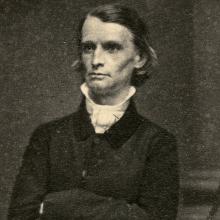
Henry Alexander Wise was an American governor of Virginia and an army officer. He was a member of the United States House of Representatives from Virginia, and member Virginia Constitutional Convention, 1850-1851.
Background
Henry Alexander was born on December 3, 1806, in Drummondtown, Accomac County, Virginia, United States. He was the son Major John Wise, a Washingtonian Federalist, who served in the Virginia House of Delegates from 1791 to 1802 and was speaker from 1794 to 1799, and Sarah Corbin Cropper, daughter of General John Cropper of Accomac County, an ardent Revolutionary patriot.
Henry was of mixed English and Scotch descent, and his paternal ancestors had been prominent citizens of the Eastern Shore of Virginia since the first John Wise arrived from Devonshire, England, in 1635.
Education
After preparation by private tutors and at a classical school in Accomac County Henry was sent to Washington College (now Washington & Jefferson College), Washington, Pennsylvania, and was graduated with honors in 1825. Later he attended for two years the law school of Judge Henry St. George Tucker of Winchester, Virginia, an expounder of the old Virginia doctrine of state rights.
In 1828 Henry Alexander Wise opened a law office in Nashville, Tennessee. Two years later he returned to Accomac County and resumed there his legal practice. Wise began his political life voting for Andrew Jackson and was nominated by the Jacksonian Democrats for Congress in 1833. Once in office, however, he displayed characteristic political independence by voting against the president on both the national bank renewal and the force bill. His constituents seemed satisfied, though, and reelected him five times. He chaired the House Naval Affairs Committee, but his independence hindered his legislative success.
Dissatisfied with Jackson’s chosen successor, machine politico Martin Van Buren, Wise shifted his allegiance to the Whigs. After the death of Whig President William Henry Harrison, many in the party became angry over the policies of his successor, former Democrat John Tyler. Henry Wise, however, cast his lot with the new president, a fellow Virginian, who appointed him United States minister to Brazil in 1844. Henry's stance alienated him from the Brazilian government and he left the post in 1847 nearly a persona non grata.
Returning to his plantation and law practice, he gained a comfortable level of wealth.
In 1848, Wise returned to the Democratic fold but was denied a desired Senate seat in favor of Robert M. T. Hunter, a more dependable defender of slavery. Wise was a major voice at the Virginia constitutional convention of 1850-1851 and helped apportion the legislature in a more equitable fashion. When he ran for governor as a Democrat in 1855, Wise attracted more votes than any other candidate in Virginia during the nineteenth century. He was an activist governor, working to strengthen the business, industry, transportation, and education in the state. He was also governor during John Brown’s raid on the federal arsenal at Harper's Ferry and did not intervene to stop the execution of the anti-slavery radical and his co-conspirators.
Although Wise had opposed the Kansas - Nebraska Act, he sided with its author, Senator Stephen Douglas, over President James Buchanan by opposing the pro-slavery Lecompton Constitution. Since the document, which was narrowly defeated in Congress, would have allowed Kansas to enter the Union as a slave state, Wise was vilified in the South for his opposition. Some Northern Democrats, on the other hand, promoted his presidential candidacy in 1860; but he eventually endorsed John Breckinridge, the nominee of the Southern wing of a divided Democratic Party.
Following Lincoln’s election, Wise urged Virginians to arm themselves for "fighting in the Union," but did not support the secessionists until April 1861. After the firing on Fort Sumter, he organized, under his own authority, attacks on the federal armory at Harper’s Ferry and on the Norfolk Naval Shipyard. In June 1861, he was appointed a brigadier general in the Confederate Army, but his military record during the war was not notable. After the war, he was indicted for treason, but the charge was soon dropped. In 1866, he returned to the practice of law, this time with his eldest surviving son, John. During Reconstruction, he defended Republicans and blacks against the Democratic "Redeemers," who gained control of the Virginia state government in 1869-1870. His memoirs, "Seven Decades of the Union," were published in 1871.
Achievements
Henry Alexander Wise was a distinguished politician, who was known for his unabashed defense of slavery and states' rights. In addition, he gained notoriety as a result of John Brown's raid on Harpers Ferry, Virginia (now West Virginia). Counties were named in his honor in Virginia (Wise County, Virginia) and Texas (Wise County, Texas).
In 1832, Henry Alexander Wise was elected Representative as a Jackson Democrat. After this election, Wise fought a duel with his defeated opponent, Richard Coke, Wise was reelected in 1834, but then broke with the Jackson administration over the rechartering of the Bank of the United States.
He became a Whig but was sustained by his constituents. Wise was re-elected as a Whig in 1836, 1838, and 1840.
From 1847, he identified with the Democratic Party and was active in politics.
In his later years, Henry Wise became a Republican and strong supporter of President Ulysses S. Grant.
Views
In Congress, Wise had criticized slavery and abolitionists, while defending the state institution against federal interference. As minister to Brazil, he condemned American involvement, particularly of northern shippers, in the transatlantic African slave trade.
Quotations:
"I have lately returned from Harpers Ferry, to which place I was suddenly called, on the 17th instant, by causes the most disturbing and destructive to the peace and safety of this State."
"I will not nullify, I will not secede, but I will under sovereign State authority fight in the Union another revolutionary conflict for civil liberty, and a Union which will defend it."
Personality
Henry was an inveterate chewer and swearer, rough but warm-hearted, of great ability, though lacking in moderation and judgment.
Physical Characteristics:
Wise was a man of tall, very lean appearance and piercing eyes.
Connections
On October 8, 1828, Henry Wise married Ann Elizabeth Jennings, daughter of a Presbyterian minister. Anne died in 1837, leaving Henry with four children: two sons and two daughters. A fifth child died with her in a fire.
In November 1840, he married Sarah Sergeant of Philadelphia. The couple had ten children, but only three survived infancy. Sarah Sergeant Wise died during childbirth in 1850.
In November 1853, Henry married Mary Elizabeth Lyons, and the couple had no children.
Father:
John Wise
1765-1812
Mother:
Sarah Corbin Cropper Wise
1777-1813
late wife:
Ann Elizabeth Jennings Wise
1808-1837
late wife:
Sarah Sergeant Wise
1817-1850
Sister:
Margaret Douglas Pettitt Wise
1803-1866
Brother:
John Cropper Wise
1808-1866
Half Brother:
George Douglas Wise
1790-1821
Half Brother:
John James Wise
1794-1834
Wife:
Mary Elizabeth Lyons Wise
1817-1901
Daughter:
Mary Elizabeth Wise Garnett
1829-1898
Son:
Obadiah Jennings Wise
1831-1862
Son:
Henry Alexander Wise
1834-1869
Daughter:
Annie Jennings Wise Hobson
1837-1914
Son:
Richard Alsop Wise
1843-1900
Daughter:
Margaretta Ellen Wise Mayo
1844-1909
Son:
John Sergeant Wise
1846-1913
opponent:
John Quincy Adams
While in Congress, Wise was the "faithful" opponent of John Quincy Adams.