

Background
Caligari, Peter Douglas Savaria was born on November 10, 1949 in Rinteln, Germany. Son of Kenneth Vane Savaria and Mary Annetta (Rock) Caligari. (parents British citizens).

( Written for plant breeders, researchers and post-gradua...)
Written for plant breeders, researchers and post-graduate students, this excellent new book provides a comprehensive review of the methods and underlying theoretical foundations used for selection in plant breeding programs. The authors review basic elements of population and quantitative genetic theory, moving on to consider in a unique way the tackling of the problems presented by soil heterogeneity and intergenotypic competition when selecting quantitative characters.
http://www.amazon.com/gp/product/1402063695/?tag=2022091-20

(This text demonstrates the scientific principles behind p...)
This text demonstrates the scientific principles behind plant breeding. It integrates plant breeding, population genetics, quantitative genetics, probability theory and statistics to provide an objective basis for plant selection and breeding.
http://www.amazon.com/gp/product/0412553309/?tag=2022091-20

( This book, Plant Breeding, has it bases in an earlier t...)
This book, Plant Breeding, has it bases in an earlier text entitled An Introduction to Plant Breeding by Jack Brown and Peter Caligari, first published in 2008. The challenges facing today’s plant breeders have never been more overwhelming, yet the prospects to contribute significantly to global food security and farmers’ quality of life have never been more exciting and fulfilling. Despite this there has been a worrying decline in public funding for plant breeding-related research and support for international centers of germplasm development and crop improvement. In part, this has resulted in a serious reduction in the number of young people interested in devoting their professional careers to plant breeding as well as the number of universities offering plant breeding courses or conducting relevant research in plant breeding. The authors’ aim in writing this book is to provide an integrated and updated view of the current scientific progress related to diverse plant breeding disciplines, within the context of applied breeding programs. This excellent new book will encourage a new generation of students to pursue careers related to plant breeding and will assist a wider audience of agricultural students, agronomists, policy makers and those with an interest in agriculture in gaining insight about the issues affecting plant breeding and its key role in improving the quality of life of people and in securing sufficient food, at the quality required and at an affordable price. With comprehensive coverage including questions designed for students, and an accompanying website containing additional material to help in the study of the subject, Plant Breeding is an ideal text for all those studying plant and crop sciences, and a convenient reference source for professionals working in the area. All libraries within universities and research establishments where biological and agricultural sciences are studied and taught should have multiple copies of this book.
http://www.amazon.com/gp/product/0470658304/?tag=2022091-20
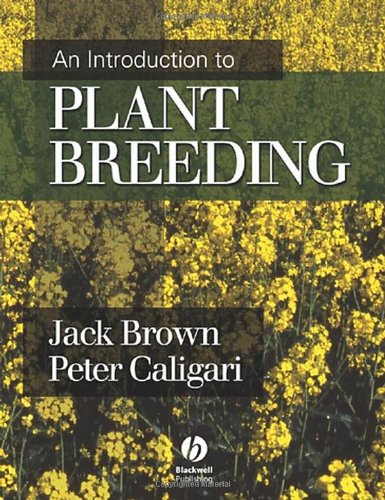
(Plants have been successfully selectively bred for thousa...)
Plants have been successfully selectively bred for thousands of years, culminating in incredible yields, quality, resistance and so on that we see in our modern day crops and ornamental plants. In recent years the techniques used have been rapidly advanced and refined to include molecular, cell and genetic techniques. An Introduction to Plant Breeding provides comprehensive coverage of the whole area of plant breeding. Covering modes of reproduction in plants, breeding objectives and schemes, genetics, predictions, selection, alternative techniques and practical considerations. Each chapter is carefully laid out in a student friendly way and includes questions for the reader. The book is essential reading for all those studying, teaching and researching plant breeding.
http://www.amazon.com/gp/product/1405133449/?tag=2022091-20

http://www.amazon.com/gp/product/B01FKS0JKC/?tag=2022091-20
Caligari, Peter Douglas Savaria was born on November 10, 1949 in Rinteln, Germany. Son of Kenneth Vane Savaria and Mary Annetta (Rock) Caligari. (parents British citizens).
Bachelor of Science, U. Birmingham, England, 1971; Doctor of Philosophy, U. Birmingham, 1974; Doctor of Science, U. Birmingham, 1989.
Senior scientific officer, Scottish Crop Research Institute, Edinburgh, 1981-1984;
principal scientific officer, Scottish Crop Research Institute, Edinburgh, 1984-1986;
professor agricultural botany, U. Reading, England, since 1986;
head Department, University Reading, 1987-1998. Research assistant, U. Birmingham, 1971-1974, research fellow, 1974-1981. Member gov.bd. Plant Sciences Research Ltd., Norwich, England, 1991-1994, John Innes Center, Norwich, since 1994.
Managing director BioHybrids International Ltd., Reading, since 1996, Biomarkers, Ltd., since 1997.
( Written for plant breeders, researchers and post-gradua...)
(Plants have been successfully selectively bred for thousa...)
( This book, Plant Breeding, has it bases in an earlier t...)
(This text demonstrates the scientific principles behind p...)
Fellow Institute Biology. Member Genetical Society (member committee 1985-1991), Eucarpia, European Association Potato Research, Potato Association American, International Lupin Association.
Married Patricia Ann Feeley, June 23, 1973. Children: Louise Rebecca Vane, Helena Rachel Vane.
