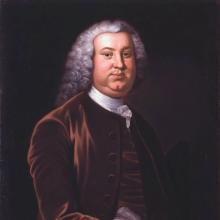
Background
Peyton Randolph was born on September 10, 1721 in Virginia, presumably at "Tazewell Hall, " Williamsburg, the home of his father, Sir John Randolph. His mother was Susanna (Beverly) Randolph.


(Excerpt from Reports of Cases Argued and Determined in th...)
Excerpt from Reports of Cases Argued and Determined in the Court of Appeals of Virginia, Vol. 1 As every circumstance in the case agreed is important, it is deemed proper to give it at full length. About the Publisher Forgotten Books publishes hundreds of thousands of rare and classic books. Find more at www.forgottenbooks.com This book is a reproduction of an important historical work. Forgotten Books uses state-of-the-art technology to digitally reconstruct the work, preserving the original format whilst repairing imperfections present in the aged copy. In rare cases, an imperfection in the original, such as a blemish or missing page, may be replicated in our edition. We do, however, repair the vast majority of imperfections successfully; any imperfections that remain are intentionally left to preserve the state of such historical works.
https://www.amazon.com/Reports-Determined-Appeals-Virginia-Classic/dp/0266087663?SubscriptionId=AKIAJRRWTH346WSPOAFQ&tag=prabook-20&linkCode=sp1&camp=2025&creative=165953&creativeASIN=0266087663

(Excerpt from Reports of Cases Argued and Determined in th...)
Excerpt from Reports of Cases Argued and Determined in the Court of Appeals of Virginia, Vol. 2 Reports 0 Cases argued and determined in the Court of Jppeals of Virginia. 01. IL 31 Peyton Randolph. Counsellor at law. About the Publisher Forgotten Books publishes hundreds of thousands of rare and classic books. Find more at www.forgottenbooks.com This book is a reproduction of an important historical work. Forgotten Books uses state-of-the-art technology to digitally reconstruct the work, preserving the original format whilst repairing imperfections present in the aged copy. In rare cases, an imperfection in the original, such as a blemish or missing page, may be replicated in our edition. We do, however, repair the vast majority of imperfections successfully; any imperfections that remain are intentionally left to preserve the state of such historical works.
https://www.amazon.com/Reports-Determined-Appeals-Virginia-Classic/dp/0260401390?SubscriptionId=AKIAJRRWTH346WSPOAFQ&tag=prabook-20&linkCode=sp1&camp=2025&creative=165953&creativeASIN=0260401390
Peyton Randolph was born on September 10, 1721 in Virginia, presumably at "Tazewell Hall, " Williamsburg, the home of his father, Sir John Randolph. His mother was Susanna (Beverly) Randolph.
He received general education at the College of William and Mary.
In accordance with the wish of his father, expressed in his will, he entered the law as his profession.
He was admitted to the Middle Temple, October 13, 1739, and called to the bar on Feburary 10, 1744, N. S. In the group of lawyers at Williamsburg he soon won distinction and in 1748 was appointed King's attorney for the province. He won favor while he held this office through the qualities of his personality and his policy of regarding himself as the spokesman of the rights of the Colony as well as those of the Crown.
He was constantly a member of the House of Burgesses, representing Williamsburg in 1748-49, the College of William and Mary, 1752-58, and Williamsburg from 1758 to 1775. After the death of John Robinson, Randolph resigned as King's attorney and was elected speaker in his place in November 1766. In successive Assemblies until the Revolution he was reelected. Conservative in temperament and representative of the point of view of the colonial aristocracy, Randolph, while serving the King, was on several occasions brought into sharp conflict with the royal governor.
When Governor Dinwiddie sought to correct certain abuses of the Crown's interests in land grants in Virginia and to augment the revenues by charging a fee of a pistole on every land patent, Randolph was sent by the Burgesses to England to oppose the Governor's policy and secure the withdrawal of the fee. Randolph, who prosecuted the mission with vigor, was suspended from his office by the irate Dinwiddie, but was voted a reward of 2500 by the grateful House of Burgesses who placed the item as a rider on the supply bill in an effort to force the reluctant Governor to sign the appropriation.
Dinwiddie reinstated Randolph as attorney-general on the suggestion of the Lords of Trade and Randolph, with his customary urbanity, acknowledged to the uncomfortable Governor his error in having left his office without His Majesty's leave. When English and Scotch merchants protested against the use of paper money in Virginia he replied in 1759 in a pamphlet defending the action of the Assembly. His patriotism was challenged by the news of Braddock's defeat and he led in the formation of a company of a hundred lawyers and other gentlemen in Williamsburg who went at their own expense to the assistance of the regular force and militia.
He served from 1759 to 1767 on the Virginia committee of correspondence, a group officially keeping in touch with the Virginia agent in London. When Patrick Henry carried through his challenging resolutions against the Stamp Act after a bitter fight in the House of Burgesses, Randolph declared as he left the House that he would have given one hundred guineas for a single vote, so deeply did he deplore the radical expressions passed that day.
Yet Randolph himself had written a moderate protest the year before to the King for the House of Burgesses against the Act. Between 1765 and 1774 Randolph moved steadily with the current of revolutionary sentiment in Virginia, though he was moderating in his influence and cautious in his leadership. He was made the presiding officer of every important revolutionary assemblage in Virginia. In 1773 he was named chairman of the committee of correspondence.
In 1774 and again in 1775 he presided over the revolutionary conventions. He was named first in the list of seven delegates appointed by the Virginia convention to the first session of the Continental Congress and in turn was elected president of that body in 1774 and again in 1775.
When the volunteers of Fredericksburg were ready to march against Dunmore at the news of his removal of the powder, it was Randolph's voice that restrained them. And it was Randolph who persuaded Dunmore it was well to pay for the powder.
In his social relations Randolph consorted with the leading gentlemen of the colony, Governor Fauquier and George Washington being among his intimates. As King's attorney he opposed the right of the persuasive dissenter Samuel Davies to preach in Virginia, though the latter proved Randolph's equal in the legal encounter. Randolph was a member of the vestry of Bruton Parish Church and of the board of visitors of the College of William and Mary.
He was often called on to serve as executor of the estates of friends, was generous in charitable endeavors, was one of the directors in William Byrd's lottery for the sale of lands in Richmond, and was president of the Williamsburg textile factory, organized about 1770. In 1774 he was made provincial grand master in the Masonic Order in Williamsburg.
His sudden death in Philadelphia in October 1775 from a stroke of apoplexy brought great distress in Virginia for he was widely beloved. He was buried in the chapel of the College of William and Mary.
(Excerpt from Reports of Cases Argued and Determined in th...)
(Excerpt from Reports of Cases Argued and Determined in th...)
His judgment and sagacity were extolled by his contemporaries and attested by his fellows.
His sense of justice, his kindly and moderate tone, his legal knowledge, and steady tact made him trusted.
Quotes from others about the person
Jefferson gave this estimate of him: "He was indeed a most excellent man; and none was ever more beloved and respected by his friends. Somewhat cold and coy towards strangers, but of the sweetest affability when ripened into acquaintance. Of attic pleasantry in conversation, always good humored and conciliatory. With a sound and logical head, he was well read in the law; and his opinions when consulted, were highly regarded, presenting always a learned and sound view of the subject but generally, too, a listlessness to go into its thorough development; for being heavy and inert in body, he was rather too indolent and careless for business, which occasioned him to get a smaller proportion of it at the bar than his abilities would otherwise have commanded".
His wife, Elizabeth (generally known as Bettie) Harrison, daughter of Col. Benjamin Harrison of "Berkeley" in Charles City County and sister of Benjamin Harrison, signer of the Declaration of Independence, whom he had married on March 8, 1745/46, survived him. There were no children and his large estate, including 105 slaves, was left to his wife in life tenure and at her death to his nephew Edmund Randolph.