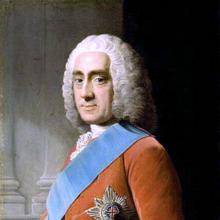
(The complete edition. The majority of the letters were wr...)
The complete edition. The majority of the letters were written between 1746 and 1754. They are mostly instructive letters on such subjects as geography, history, and classical literature. Later letters, written when the author had become an established minor diplomat, deal largely with political matters.
Cartas Completas De Lord Chesterfield Á Su Hijo Felipe Stanhope
(This book was originally published prior to 1923 and repr...)
This book was originally published prior to 1923 and represents a reproduction of important historical work, maintaining the same format as the original work. While some publishers have opted to apply OCR (optical character recognition) technology to the process, we believe this leads to sub-optimal results (frequent typographical errors, strange characters, and confusing formatting) and does not adequately preserve the historical character of the original artifact.
Complete Project Gutenberg Earl of Chesterfield Works
(This book was converted from its physical edition to the ...)
This book was converted from its physical edition to the digital format by a community of volunteers. You may find it for free on the web. Purchase of the Kindle edition includes wireless delivery.
Philip Dormer Stanhope, 4th Earl of Chesterfield, was a British statesman, man of letters, and wit.
Background
Philip Dormer Stanhope, 4th Earl of, son of Philip Stanhope, third earl, and Elizabeth Savile, daughter of George Savile, marquess of Halifax, was born in London on the 22nd of September 1694; Philip, the first earl, son of Sir John Stanhope of Shelford, was a royalist who in 1616 was created Baron Stanhope of Shelford, and in 1628 earl of Chesterfield; and his grandson the 2nd earl was grandfather of the 4th earl.
Education
His education, begun under a private tutor, was continued (1712) at Trinity Hall, Cambridge; here he remained little more than a year and seems to have read hard, and to have acquired a considerable knowledge of ancient and modern languages.
His university training was supplemented (1714) by a continental tour, untrammelled by a governor; at the Hague his ambition for the applause awarded to adventure made a gamester of him, and at Paris he began, from tlw same motive, that worship of the conventional Venus, the serious inculcation of which has earned for him the largest and most unenviable part of his reputation.
Career
Deprived at an early age of his mother, the care of the boy devolved upon his grandmother, the marchioness of Halifax, a lady of culture and connexion, whose house was frequented by the most distinguished Whigs of the epoch.
The death of Anne and the accession of George I opened up a career for him and brought him back to England, His relative James Stanhope (afterwards first Earl Stanhope), the king's favourite minister, procured for him the place of gentleman of the bedchamber to the prince of Wales.
He soon began to prove himself possessed of that systematic spirit of conduct and effort which appeared so much in" his life and character.
He maintained a correspondence with this lady which won for him the hatred of the princess of Wales (afterwards Queen Caroline).
He took his seat in the Upper House, and his oratory, never effective in the Commons by reason of its want of force and excess of finish, at once became a power.
He supported the ministry, but his allegiance was not the blind fealty Walpole exacted of his followers.
The Excise Bill, the great premier's favourite measure, was vehemently opposed by him in the Lords, and by his three brothers in the Commons.
Walpole bent before the storm and abandoned the measure; but Chesterfield was summarily dismissed from his stewardship.
For the next two years he led the opposition in the Upper House, leaving no stone unturned to effect Walpole's downfall.
In 1741 he signed the protest for Walpole's dismissal and went abroad on account of his health.
He visited Voltaire at Brussels and spent some time in Paris, where he associated with the younger Crebillon, Fontenelle and Montesquieu.
In 1742 Walpole fell, and Carteret was his real, though not his nominal successor.
He remained in opposition, distinguishing himself by the courtly bitterness of his attacks on George II, who learned to hate him violently.
For this paper Chesterfield wrote under the name of " Jeffrey Broadbottom. "
A number of pamphlets, in some of which Chesterfield had the help of Edmund Waller, followed.
His energetic campaign against George.
The object of his mission was to persuade the Dutch to join in the War of the Austrian Succession and to arrange the details of their assistance.
To have conceived and carried out a policy which, with certain reservations, Burke himself might have originated and owned, is indeed no small title to regard.
With a curious respect for those theories his familiarity with the secret social history of France had caused him to entertain, he hoped and attempted to retain a hold over the king through the influence of Lady Yarmouth, though the futility of such means had already been demonstrated to him by his relations with Queen Caroline's "bonne Howard. "
The influence of Newcastle and Sandwich, however, was too strong for him; he was thwarted and over-reached; and in 1748 he resigned the seals, and returned to cards and his books with the admirable composure which was one of his most striking characteristics.
He continued for some years to attend the Upper House, and to take part in its proceedings.
The earl showed himself finely capable in practice as in theory, vigorous and tolerant, a man to be feared and a leader to be followed; he took the government entirely into his own hands, repressed the jobbery traditional to the office, established schools and manufactures, and at once conciliated and kept in check the Orange and Roman Catholic factions.
In 1751, seconded by Lord Macclesfield, president of the Royal Society, and Bradley, the eminent mathematician, he distinguished himself greatly in the debates on the calendar, and succeeded in making the new style a fact.
Deafness, however, was gradually affecting him, and he withdrew little by little from society and the practice of politics.
In 1755 occurred the famous dispute with Johnson over the dedication to the English Dictionary.
In 1747 Johnson sent Chesterfield, who was then secretary of state, a prospectus of his Dictionary, which was acknowledged by a subscription of £10.
It was said that Johnson was kept waiting in the anteroom when he called while Cibber was admitted.
Chesterfield's " respectable Hottentot, " now identified with George, Lord Lyttelton, was long supposed, though on slender grounds, to be a portrait of Johnson.
During the twenty years of life that followed this episode, Chesterfield wrote and read a great deal, but went little into society.
(The complete edition. The majority of the letters were wr...)
Membership
In 1715, Philip Dormer Stanhope entered the House of Commons as Lord Stanhope of Shelford and as member for St Germans.
Connections
In 1726 his father died, and Lord Stanhope became earl of Chesterfield and return joined the opposition to Walpole.
In 1768, Philip Stanhope died, leaving two sons, Charles and Philip, and a widow, Eugenia Stanhope. Despite his short life, the privileged education, provided by his father, Lord Chesterfield, allowed Philip Stanhope an honourable career in the diplomatic service of Britain, despite being handicapped as a nobleman's illegitimate son. As a father, the grieving Chesterfield was disappointed to learn that Philip's long marriage had been to Eugenia, a woman of humble social class; however, Chesterfield bequeathed an annuity of ₤100 to each of his grandsons, Charles Stanhope (1761–1845) and Philip Stanhope (1763–1801), and a further £10, 000 for them both, yet bequeathed no pension for his widowed daughter-in-law, Eugenia.