

Background
Converse, Philip Ernest was born on November 17, 1928 in Concord, New Hampshire, United States. Son of Ernest Luther and Evelyn (Eaton) Converse.

http://www.amazon.com/gp/product/B000NVQSNY/?tag=2022091-20
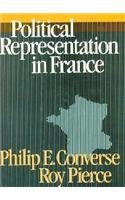
( There can scarcely be a greater tribute to the vitalit...)
There can scarcely be a greater tribute to the vitality of the Fifth Republic's democracy than this monumental work. A searching analysis of how the will of the voters is translated into authoritative political decision making, this book not only uncovers political truths about contemporary France but also provides a model for the study of other popular forms of government. The authors set out to find an answer to the perplexing question of how representative government operates in France in the seemingly unstable context of multiparties. By interviewing voters as well as legislators in 1967 and in 1968 after the great upheaval, and by monitoring policies of the National Assembly from 1967 to 1973, the authors test relationships between public opinion and decision making. They are able to sort out the abiding political cues that orient the French voter, to establish the normal electoral processes, to gauge the nature of mass perceptions of the political options available to voters, and to interpret the strikes, riots, and demonstrations of 1968 as a channel of communication parallel to the electoral process itself. Lucid in style, methodologically sophisticated, and often comparative in approach, Political Representation in France is a seminal work for political scientists, sociologists, and historians.
http://www.amazon.com/gp/product/0674686608/?tag=2022091-20
( Here is the unabridged version of the classic theoretic...)
Here is the unabridged version of the classic theoretical study of voting behavior, originally published in 1960. It is a standard reference in the field of electoral research, presenting formulations of the theoretical issues that have been the focus of scholarly publication. No single study matches the study of The American Voter.
http://www.amazon.com/gp/product/0226092542/?tag=2022091-20
http://www.amazon.com/gp/product/047113340X/?tag=2022091-20

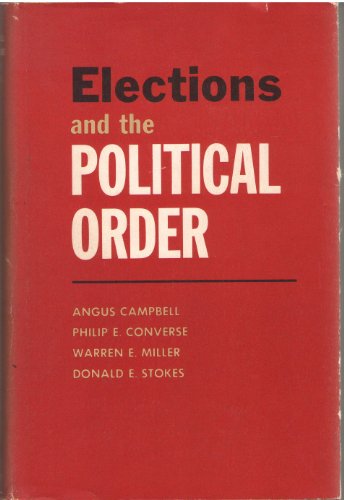
( This book is a companion piece to Sheldon and Moore’s I...)
This book is a companion piece to Sheldon and Moore’s Indicators of Social Change. Whereas Indicators of Social Change was concerned with various kinds of “hard” data, typically sociostructural, this book is devoted chiefly to so-called “softer” data of a more social-psychological sort: the attitudes, expectations, aspirations, and values of the American population. The book deals with the meaning of change from two points of view. First, it is interested in the human meaning which people attribute to the complex social environment in which they find themselves; their understanding of group relations, the political process, and the consumer economy in which they participate. Secondly, it discusses the impact that the various alternatives offered by the environment have on the nature of their lives and the fulfillment of those lives. The twelve essays which make up the volume deal successively with the major domains of life. Each author sets forth an inclusive statement of the most significant dimensions of psychological change in a specific area of life, to review the state of present information, and to project the measurements needed to improve understanding of these changes in the future.
http://www.amazon.com/gp/product/0871541939/?tag=2022091-20
author and professor of political science
Converse, Philip Ernest was born on November 17, 1928 in Concord, New Hampshire, United States. Son of Ernest Luther and Evelyn (Eaton) Converse.
Bachelor, Denison University, 1949. Doctor of Humane Letters (honorary), Denison University, 1974. Master of Arts, State University Iowa, 1950.
Certified, University Paris, 1954. Master of Arts, University Michigan, 1956. Doctor of Philosophy, University Michigan, 1958.
Doctor of Humane Letters (honorary), University Chicago, 1979. Doctor of Laws (honorary), Harvard University, 2006. Doctor of Science (honorary), University Michigan, 2007.
Assistant Professor, of Sociology University of Michigan 1960-1963, Association Professor, of Political Science 1963-1965, Professor, of Sociology and Political Science since 1965, Program Director Survey Research Center 1965-1982, Robert C. Angell Distinguished Professor, of Political Science and Sociology since 1975, Director Center for Political Studies 1982-1986. Director Institute for Social Research 1986-1989, Center Advanced Study in Behavioral Sciences since 1989. Trustee Russell Sage Foundation since 1982.
Fulbright Fellow 1959-1960.
Guggenheim Fellow 1975-1976. Fellow American Academy, of Arts and Sciences, North.A.S., American Association for the Advancement of Science.
President Institute Society of Political Psychology 1980-1981. President American Political Science Association 1983-1984.
( Considers how Americans define the quality of their lif...)
( There can scarcely be a greater tribute to the vitalit...)
( Here is the unabridged version of the classic theoretic...)
( This book is a companion piece to Sheldon and Moore’s I...)
Served with United States Army, 1950-1952. Member American Association for the Advancement of Science, American Sociological Association, American Political Science Association (president 1983-1984), International Society Political Psychology (president 1980-1981), National Academy of Sciences, American Academy Arts and Sciences, American Philosophical Society.
Married Jean Gilmore McDonnell, August 25, 1951. Children: Peter Everett, Timothy McDonnell.
