

Background
Rackin, Phyllis was born on September 15, 1933 in Newark. Daughter of Milton Philip and Ethel Shulman Finkelstein.
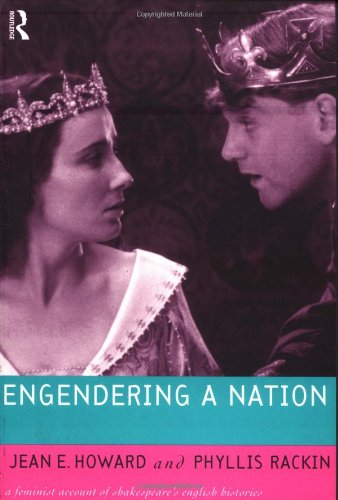
( Engendering a Nation adopts a sophisticated feminist an...)
Engendering a Nation adopts a sophisticated feminist analysis to examine the place of gender in contesting representations of nationhood in early modern England. Plays featured include: * King John * Henry VI, Part I * Henry VI, Part II * Henry, Part III * Richard III * Richard II * Henry V. It will be a must for students and scholars interested in the cultural and social implications of Shakespeare today.
http://www.amazon.com/gp/product/0415047498/?tag=2022091-20

(Shakespeare and Women situates Shakespeare's female chara...)
Shakespeare and Women situates Shakespeare's female characters in multiple historical contexts, ranging from the early modern England in which they originated to the contemporary Western world in which our own encounters with them are staged. In so doing, this book seeks to challenge currently prevalent views of Shakespeare's women-both the women he depicted in his plays and the women he encountered in the world he inhabited. Chapter 1, "A Usable History," analyses the implications and consequences of the emphasis on patriarchal power, male misogyny, and women's oppression that has dominated recent feminist Shakespeare scholarship, while subsequent chapters propose alternative models for feminist analysis. Chapter 2, "The Place(s) of Women in Shakespeare's World," emphasizes the frequently overlooked kinds of social, political, and economic agency exercised by the women Shakespeare would have known in both Stratford and London. Chapter 3, "Our Canon, Ourselves," addresses the implications of the modern popularity of plays such as The Taming of the Shrew which seem to endorse women's subjugation, arguing that the plays--and the aspects of those plays--that we have chosen to emphasize tell us more about our own assumptions than about the beliefs that informed the responses of Shakespeare's first audiences. Chapter 4, "Boys will be Girls," explores the consequences for women of the use of male actors to play women's roles. Chapter 5, "The Lady's Reeking Breath," turns to the sonnets, the texts that seem most resistant to feminist appropriation, to argue that Shakespeare's rewriting of the idealized Petrarchan lady anticipates modern feminist critiques of the essential misogyny of the Petrarchan tradition. The final chapter, "Shakespeare's Timeless Women," surveys the implication of Shakespeare's female characters in the process of historical change, as they have been repeatedly updated to conform to changing conceptions of women's nature and women's social roles, serving in ever-changing guises as models of an unchanging, universal female nature.
http://www.amazon.com/gp/product/0198186940/?tag=2022091-20
Rackin, Phyllis was born on September 15, 1933 in Newark. Daughter of Milton Philip and Ethel Shulman Finkelstein.
Bachelor, New Jersey College, New Brunswick, 1954. Master of Arts, Auburn University, 1957. Doctor of Philosophy, University Illinois, 1962.
Instructor University Pennsylvania, Philadelphia, 1962—1964, from assistant professor to associate professor, 1964—1990, professor, 1990—2002, professor emeritus, since 2002.
(Shakespeare and Women situates Shakespeare's female chara...)
( Engendering a Nation adopts a sophisticated feminist an...)
Member of Modern Language Association (chair Shakespeare division 1994), Shakespeare Association American (president 1993-1994).
Married Donald Rackin, January 1, 1954. Children: Rebecca Hoenig, Ethel.
