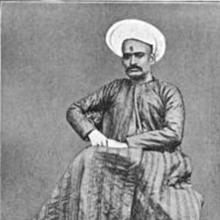
Raja Sir Dinkar Rao was an Indian statesman who served as Dewan of Gwalior from 1851 to 1859, introduced fiscal and administrative reforms, and supported Maharaja Jayajirao Scindia during the upheavals of 1857. He later served on the Governor-General’s Legislative Council, supervised Dholpur, and received the KCSI and the hereditary title Raja.
Background
Ethnicity:
He belonged to the Chitpavan Brahmin community of the Konkan region.
Dinkar Rao was born on December 20, 1819, in Ratnagiri District in the Bombay Presidency, into a Chitpavan Brahmin family associated with service to the Gwalior state. His father was Ragoba Dadu, and his ancestors had held administrative office in Gwalior territory. His early education began at home in his mother tongue, followed by instruction in Sanskrit and Persian.
He grew up as an orthodox Hindu and was known for punctual observance of religious duties. English was introduced comparatively late in his education; he began studying it at about forty, after his career in Indian state administration was already established. This combination of traditional learning and later engagement with English shaped the setting in which he worked with both princely authorities and British officials.
Education
Dinkar Rao was educated at home rather than at a recorded school or university. His instruction included his mother tongue, Sanskrit, Persian, and later English. Sanskrit and Persian were important components of elite education and administration in nineteenth-century India, while English increasingly became necessary for dealings with the British Indian government and its officials.
Career
Dinkar Rao entered the service of the Gwalior state at the age of fifteen, following a family tradition of state employment. He began as an accountant and later succeeded his father as Subadar of a division. His administrative ability led to his appointment to the responsible charge of Taranagar Division, where he reorganized the police and revenue departments and brought greater order to a disorganized administration.
In 1851 he became Dewan, or chief minister, of Gwalior under Maharaja Jayajirao Scindia. The state faced financial weakness, unsettled troops, and diminished administrative authority after the conflicts of the 1840s. Rao introduced fiscal reforms, reduced official salaries including his own, abolished ruinous imposts, improved roads and other public works, and prepared a code of regulations for subordinate officers. These measures helped convert a deficit into a surplus and strengthened the central administration of the princely state.
During the uprising of 1857 and the subsequent disturbances in Gwalior, Rao remained loyal to the British government and encouraged Maharaja Scindia to maintain that allegiance. When Gwalior troops mutinied in June 1858 during Tantia Tope’s advance, Rao withdrew with the Maharaja to the Agra fort. He remained minister until December 1859, after which he left the Gwalior administration.
Rao later served as Superintendent of Dholpur State and was appointed guardian to its minor ruler in 1873, although ill health soon led to his resignation. He became a member of the Governor-General’s Legislative Council in the early 1860s and was among the first Indian members appointed to the reconstituted council after the Indian Councils Act of 1861. In 1875 he served on the tribunal that tried Malhar Rao Gaekwar of Baroda. His advice was sought by successive viceroys on difficult questions involving Indian states.
Achievements
As Dewan of Gwalior, Dinkar Rao reorganized the state’s police and revenue departments, introduced fiscal reforms, reduced official expenditure, improved roads and public works, and helped convert a budget deficit into a surplus.
He prepared a code of regulations for subordinate officers, strengthening administrative uniformity in the Gwalior state.
During the upheavals of 1857 and 1858, he maintained Maharaja Jayajirao Scindia’s allegiance to the British government and helped preserve the Gwalior administration during a period of military mutiny and political instability.
He was among the first Indian members appointed to the Governor-General’s Legislative Council after the reorganization of imperial legislative institutions under the Indian Councils Act of 1861.
Religion
Dinkar Rao was an orthodox Hindu who received instruction in Sanskrit and Persian and was given particular attention to religious education. His Chitpavan Brahmin background placed him within a Hindu intellectual and administrative tradition with strong associations with Sanskrit learning.
His religious life was shaped by regular observance and the learned traditions of nineteenth-century Hindu society. The Gwalior court in which he served operated within the political world of princely states, where Hindu court culture, hereditary service, and Persianate administrative practices continued to coexist under British paramountcy.
Personality
Contemporary biographical accounts describe Dinkar Rao as a capable, disciplined, and forceful administrator. His willingness to reduce his own salary during Gwalior’s fiscal crisis is recorded alongside his broader program of administrative reform.
Quotes from others about the person
British and Indian biographical accounts of the period regarded Dinkar Rao as one of the most prominent Indian statesmen of the nineteenth century and emphasized his administrative ability and loyalty during the disturbances of 1857.
Connections
Dinkar Rao was the son of Ragoba Dadu by his first wife. His career continued a family connection with the Gwalior state, where earlier generations had held administrative positions. He was professionally associated with Maharaja Jayajirao Scindia through his service as the Maharaja’s Dewan and adviser.
Father:
Ragoba Dadu
He was Dinkar Rao’s father and supervised the beginning of his education.
colleague:
Jayajirao Scindia
Maharaja of Gwalior during Rao’s service as Dewan and chief minister.
colleague:
Robert Phayre
A British Indian Army officer associated with the political and administrative affairs of princely India.
Knight Commander of the Order of the Star of India
Awards
Knight Commander of the Order of the Star of India,
India
Dinkar Rao was appointed a Knight Commander of the Order of the Star of India in May 1866 for his public service, acquiring the right to use the style Sir Dinkar Rao.
Dinkar Rao was appointed a Knight Commander of the Order of the Star of India in May 1866 for his public service, acquiring the right to use the style Sir Dinkar Rao.