

Background
Ruof, Richard Alan was born on October 11, 1932 in Lancaster, Pennsylvania, United States. Son of Robert Jacob and Geneva May (Devers) Ruof.
(We in contemporary times live in an era of imposing messa...)
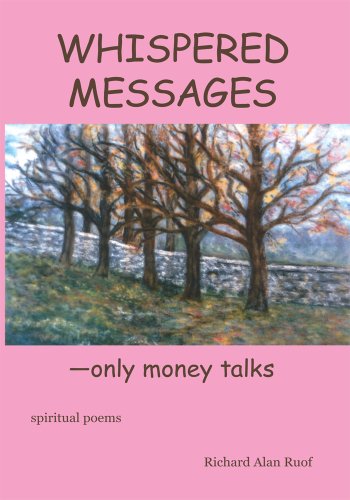
We in contemporary times live in an era of imposing messages on TV, The Internet, billboards, and in periodicals. They proclaim that what is important is what assaults us with repeated messages of great buys, lucrative employment, and dollar materialism. Whatever is boldly proclaimed is assumed to be value. Reports of war and violence command our constant attention. Aren’t we missing something? The real treasures are those attained through quiet thought and willing sacrifice; as we make daily decisions, the whispers speak to us. They are the voice of faith, conviction, and of God. The prophet Elijah described the voice of God: after the fire there was the soft whisper of a voice (1 Kings 19:12 GNT)). Jesus speaks of whispers. Whatever you have whispered in private in a closed room will be shouted from the housetops (Luke 12:3 GNT). Our neglect of whispered messages results in devastated homes of modern society. Because the voice is but a whisper, we habitually assume it is unimportant and so it is unheeded. A figure of the past promised her return. Most fawned at her strange assertion. She brings sorrowful words of caution amid shallow values and hasty decisions. Who is this quiet voice of the martyrs?
http://www.amazon.com/gp/product/B009JU6GBE/?tag=2022091-20
(The poems in this book depict the conflict between the se...)
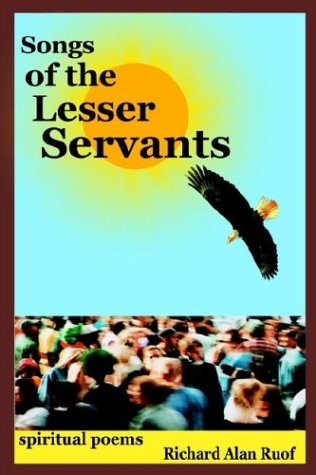
The poems in this book depict the conflict between the secular-commercial and inner-spiritual views of life. In many poems the spiritual world interrupts the daily round of life flowing into consciousness, bringing harmony and an awe of the divine. Other times the poems portray lawlessness and distortion that make human life grotesque. Rather than teaching lessons, the poems describe how modern society has lost touch with spiritual truths. As an obsession with the material and secular way grows, a beautiful harmony yields to conflict; the divine and profane vie for attention. Only a renewal of traditional faith restores the spiritual. Poetry's rhythms relay the inner sights. The reader hears the words in his or her own voice, suddenly glimpsing the spiritual world, which departs the scene having stirred the inner experience that often in modern life is fading. The spiritual is ageless. But the material quickly dissolves exacting a toll upon the age that surrenders the eternal dimension.
http://www.amazon.com/gp/product/1410735826/?tag=2022091-20
(These poems describe the character, trials, and faith of ...)
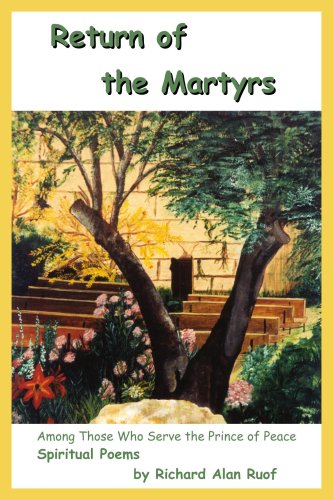
These poems describe the character, trials, and faith of the neighborhood churches that deeply affected the lives of children, teenagers, and adults on the American scene. The changing experience is described in poems on the Beatitudes and American life as parents unknowingly invite strangers into their homes who instill the secular views of television, the Internet, and public school text books. The sheer weight of indoctrination dismisses the Spiritual from childhood experience and conviction.The book concludes with the trials of the martyrs who pursued the poet throughout his life. They were not then known to him by name or story, save in spiritual experiences. Lately he fully learned their identity as the founders of Christian schools for children in Wales and England. Their costly sacrifice is related.The book ends with a tribute to those martyrs who died before a weeping nation-the heroes of the Twin Towers-a tragedy, but a willing sacrifice of historic proportion.
http://www.amazon.com/gp/product/1420812106/?tag=2022091-20
(We in contemporary times live in an era of imposing messa...)
We in contemporary times live in an era of imposing messages on TV, The Internet, billboards, and in periodicals. They proclaim that what is important is what assaults us with repeated messages of great buys, lucrative employment, and dollar materialism. Whatever is boldly proclaimed is assumed to be value. Reports of war and violence command our constant attention. Aren?t we missing something? The real treasures are those attained through quiet thought and willing sacrifice; as we make daily decisions, the whispers speak to us. They are the voice of faith, conviction, and of God. The prophet Elijah described the voice of God: after the fire there was the soft whisper of a voice (1 Kings 19:12 GNT)). Jesus speaks of whispers. Whatever you have whispered in private in a closed room will be shouted from the housetops (Luke 12:3 GNT). Our neglect of whispered messages results in devastated homes of modern society.Because the voice is but a whisper, we habitually assume it is unimportant and so it is unheeded. A figure of the past promised her return. Most fawned at her strange assertion. She brings sorrowful words of caution amid shallow values and hasty decisions. Who is this quiet voice of the martyrs?
http://www.amazon.com/gp/product/1438902972/?tag=2022091-20

(The poems in How Still the Songbird Lies avoid the purely...)
The poems in How Still the Songbird Lies avoid the purely subjective by relating startling or thought-provoking happenings in daily life that take place visually. The poems do not arise from a desire to state a particular viewpoint or message, nor do they attempt to advance doctrine. They describe unexpected events that convince one of the presence of the spiritual. Because poetry utilizes many devices, it seems the best way to relay such experiences. Poetry may be referred to as a gift by which understanding mysteriously advances. To create through effort or research does not result in poetic expression. Poetry is a spontaneous response that employs analogy rather than analysis. It is a combination of event and verbalization, rhythm and harmony. Its gift is joy rather than pride, enriching the heart and soul. The Holy Scriptures, the accounts of Christ, and the writings of the Saints are the measure of the validity of the spiritual (1John 4:1-2) The poet offers these poems in a time when commerce and government routinely remove spiritual and moral elements from human experience, resulting in a loss of values, family ties, and the exalting spirit. Materialism soils life and presently visits tragic circumstances upon our people
http://www.amazon.com/gp/product/1438948670/?tag=2022091-20

(The poems in Departure of the Blossoms continue the narra...)
The poems in Departure of the Blossoms continue the narrative of Return of the Martyrs, as three martyrs return after four centuries to view modern society and to rejoin those from whom they were separated. In their experiences they discover the dissolution of marriage and family, the state of normless society, and the switch of priority from love to material wealth. Once more they witness that rulers, opinion makers, and commerce impose upon a nation the values of a few elites. However, the process is thorough, widespread, and rapidly advancing in modern society. The ultimate effect of the poems is to compare the eternal with the momentary and to challenge the reader to consider the loss of the higher identity. In spontaneous ways the poems assert that love is eternal, reconciled by divine compassion and renewed in the afterlife. They ask: will an essential capability of human nature eventually be lost? The story that pervades the poems was given to the author to warn that the desire for personal gain, position, and power of peoples and nations needs to be placed second to the cause of relieving pain and sorrow. For this concern is of an eternal nature, as is the human spirit.
http://www.amazon.com/gp/product/1425945961/?tag=2022091-20
Ruof, Richard Alan was born on October 11, 1932 in Lancaster, Pennsylvania, United States. Son of Robert Jacob and Geneva May (Devers) Ruof.
AB, Franklin and Marshall College, 1954. Master of Divinity, Lancaster Theological Seminary, Pennsylvania. Master of Divinity, Union Theological Seminary, Richmond, Virginia, 1960.
Master of Sacred Theology, Lutheran Theological Seminary, Gettysburg, Pennsylvania, 1974. Doctor of Ministry, McCormick Theological Seminary, 1981.
Ordained to ministry United Church Christ, 1960. Pastor Harrisville (Virginia) Charge of United Church Christ, 1959-1962, Thurmont (Maryland.) Charge, 1962-1967, First Congressional Church, Cortland, New York, 1967-1977, Saint Paul"s United Church Christ of Hamlin, Fredericksburg, Pennsylvania,1977-1981, Saint John"s United Church of Christ, Egg Harbor City, New Jersey, 1982-1987, Saint John"s United Church of Christ, Friedensburg, Pennsylvania, 1987-1994. Retired, 1994. Registrar-treasurer Susquehanna assosiation, New York Conference, United Ch.Christ, 1968-1974.
Member Egg Harbor City Board Education, 1984.
(The poems in Departure of the Blossoms continue the narra...)
(These poems describe the character, trials, and faith of ...)
(The poems in How Still the Songbird Lies avoid the purely...)
(We in contemporary times live in an era of imposing messa...)
(We in contemporary times live in an era of imposing messa...)
(The poems in this book depict the conflict between the se...)
Member Egg Harbor City Board Education, 1984. Registrar-treasurer Susquehanna Association New York Conference, United Church Christ, 1968—1974.
Married Anne Margaret Demos. Children: Mark Alan Demos Ruof, Anne Tracy Demos Ruof, Richard James Demos Ruof.
