

Background
Lerner, Richard Martin was born on February 23, 1946 in Brooklyn. Son of Max and Sara (Goldfarb) Lerner.

(This book places career development into the mainstream o...)
This book places career development into the mainstream of human development research and theory. The result is a powerful synthesis of vocational psychology and the most recent advances in lifespan developmental psychology, thus offering a developmental-contextual framework for guiding theory and research in career development. Its chapters demonstrate the utility of this framework for the study of women's career development, health and careers, career intervention, and the selection and application of appropriate research methodologies. Scholars as well as intervention specialists should find this volume to be of great value. The adaption of this developmental-contextual framework for career development theory, research, and intervention may represent an important future for vocational psychology and the study of career development.
http://www.amazon.com/gp/product/0898598281/?tag=2022091-20

( A classic in the field, this third edition will continu...)
A classic in the field, this third edition will continue to be the book of choice for advanced undergraduate and graduate-level courses in theories of human development in departments of psychology and human development. This volume has been substantially revised with an eye toward supporting applied developmental science and the developmental systems perspectives. Since the publication of the second edition, developmental systems theories have taken center stage in contemporary developmental science and have provided compelling alternatives to reductionist theoretical accounts having either a nature or nurture emphasis. As a consequence, a developmental systems orientation frames the presentation in this edition. This new edition has been expanded substantially in comparison to the second edition. Special features include: • A separate chapter focuses on the historical roots of concepts and theories of human development, on philosophical models of development, and on developmental contextualism. • Two new chapters surrounding the discussion of developmental contextualism--one on developmental systems theories wherein several exemplars of such models are discussed and a corresponding chapter wherein key instances of such theories--life span, life course, bioecological, and action theoretical ones--are presented. • A new chapter on cognition and development is included, contrasting systems' approaches to cognitive development with neo-nativist perspectives. • A more differentiated treatment of nature-oriented theories of development is provided. There are separate chapters on behavior genetics, the controversy surrounding the study of the heritability of intelligence, work on the instinctual theory of Konrad Lorenz, and a new chapter on sociobiology. • A new chapter concentrates on applied developmental science.
http://www.amazon.com/gp/product/1138012459/?tag=2022091-20

(To what extent are human beings capable of changing their...)
To what extent are human beings capable of changing their physical characteristics and behavioural patterns over the course of their lives? This question has engaged scientists for decades: the fundamental issue is plasticity. In this wide-ranging book, Richard Lerner explores the relevant theory and empirical evidence in a variety of disciplines: molecular genetics, neuroanatomy, neurochemistry, evolutionary biology, anthropology, comparative and developmental psychology, and sociology. The processes studied by each of these disciplines show evidence of plasticity. Conclusions about plasticity have important implications for interventions aimed at enhancing human life, as well as for future research agendas. On the Nature of Human Plasticity will be a valuable resource for all those scientists concerned with human development at biological and social levels and for their students.
http://www.amazon.com/gp/product/0521256518/?tag=2022091-20
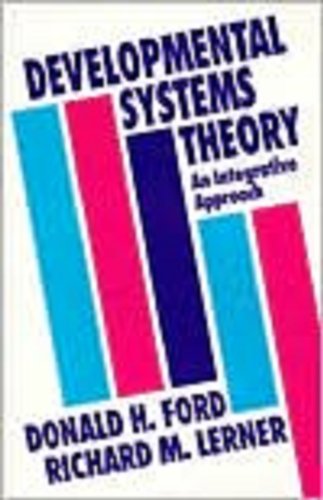
(The first integrative theory of human development in deca...)
The first integrative theory of human development in decades is presented in this volume by two leading developmentalists. Through a synthesis of developmental contextualism and the Living Systems Framework, the authors examine how people interact with the environment and how, in turn, these interactions impact upon individuals' biology, psychology and behaviour. By integrating the results from many research investigations, this volume offers a comprehensive exploration of how multiple elements interact and shape people's lives.
http://www.amazon.com/gp/product/0803946619/?tag=2022091-20

http://www.amazon.com/gp/product/0070372160/?tag=2022091-20

( The nature-nurture debate continues to stir controversy...)
The nature-nurture debate continues to stir controversy in the social and behavioral sciences. How much of human behavior and development can be attributed to biology and how much to the environment? Can either be said to “determine” human development? And what are the implications of each view for society? In this important study, a noted developmental psychologist contributes to this debate by confronting the difficult issue of “doctrines” of human development and the consequences for society of deriving political programs and public policy from them. Beginning with the premise that scientific ideas are not neutral but can be used for either good or evil, Richard Lerner considers the recent history of one such idea, biological determinism, which at times has had the backing of respected scientists, intellectuals, and political leaders. During this century, biological determinism has been coupled with political philosophies that hold that some people are inherently better than others. This has meant that certain groups of people—Jews, Blacks, Native Americans, women—have been stigmatized because of supposedly innate, even “biological,” differences, with sometimes disastrous consequences. The most notorious instance was Nazi Germany, where “racial science,” given legitimacy by the scientific community, became a cornerstone of the Nazi “Final Solution.” Meanwhile, theories of biological determinism continue to find adherents within the scientific community. Konrad Lorenz, who was awarded a Nobel Prize in 1973, was a critical figure in the development of the most recent manifestation of biological determinism—sociobiology. Lerner examines the work of Lorenz and current sociobiologists and the implications of their claims for modern society. He fears that biological determinism may again be co-opted to serve the political agenda of today’s reactionary politicians. In fact, Lerner notes, sociobiologists have had to face the fact that organizations such as the fascist National Front party in Britain and its counterparts in France and the United States have selectively seized upon sociobiology to fuel their notions of genetically superior and inferior races.
http://www.amazon.com/gp/product/0271007931/?tag=2022091-20

http://www.amazon.com/gp/product/B00Y3405WC/?tag=2022091-20

http://www.amazon.com/gp/product/B00Y340LT4/?tag=2022091-20

( A classic in the field, this third edition will continu...)
A classic in the field, this third edition will continue to be the book of choice for advanced undergraduate and graduate-level courses in theories of human development in departments of psychology and human development. This volume has been substantially revised with an eye toward supporting applied developmental science and the developmental systems perspectives. Since the publication of the second edition, developmental systems theories have taken center stage in contemporary developmental science and have provided compelling alternatives to reductionist theoretical accounts having either a nature or nurture emphasis. As a consequence, a developmental systems orientation frames the presentation in this edition. This new edition has been expanded substantially in comparison to the second edition. Special features include: • A separate chapter focuses on the historical roots of concepts and theories of human development, on philosophical models of development, and on developmental contextualism. • Two new chapters surrounding the discussion of developmental contextualism--one on developmental systems theories wherein several exemplars of such models are discussed and a corresponding chapter wherein key instances of such theories--life span, life course, bioecological, and action theoretical ones--are presented. • A new chapter on cognition and development is included, contrasting systems' approaches to cognitive development with neo-nativist perspectives. • A more differentiated treatment of nature-oriented theories of development is provided. There are separate chapters on behavior genetics, the controversy surrounding the study of the heritability of intelligence, work on the instinctual theory of Konrad Lorenz, and a new chapter on sociobiology. • A new chapter concentrates on applied developmental science.
http://www.amazon.com/gp/product/0805827986/?tag=2022091-20

(The study of and interest in adolescence in the field of ...)
The study of and interest in adolescence in the field of psychology and related fields continues to grow, necessitating an expanded revision of this seminal work. This multidisciplinary handbook, edited by the premier scholars in the field, Richard Lerner and Laurence Steinberg, and with contributions from the leading researchers, reflects the latest empirical work and growth in the field.
http://www.amazon.com/gp/product/0470149213/?tag=2022091-20

http://www.amazon.com/gp/product/B008KULBBE/?tag=2022091-20

(Concepts & Theories of Human DevelopmentLerner, Richard M.)
Concepts & Theories of Human DevelopmentLerner, Richard M.
http://www.amazon.com/gp/product/B009O2RUVW/?tag=2022091-20
academic administrator educator
Lerner, Richard Martin was born on February 23, 1946 in Brooklyn. Son of Max and Sara (Goldfarb) Lerner.
Bachelor in Psychology with honors, Hunter College of City University of New York, 1966. Master of Arts, Hunter College of City University of New York, 1967. Doctor of Philosophy, City University of New York, 1971.
Research assistant department education, Brooklyn College of CUNY, 1966-1967;
science research assistant department psychology, Hunter College of CUNY, 1966-1967;
lecturer department psychology, Hunter College of CUNY, 1967-1969;
assistant to associate professor psychology, Eastern Michigan U., Ypsilanti, 1969-1976;
associate professor child development, Pennsylvania State University, University Park, 1976-1980;
professor child and adolescent development, Pennsylvania State University, University Park, 1981-1991;
director Institute Children, Youth and Families, Michigan State University, East Lansing, 1991-1996;
professor family and child ecology, psychology, pediatrics and human development, Michigan State University, East Lansing, since 1991;
Anita L. Brennan professor education, director, Boston College Center for Child, Family and Cmty. Partnerships, Chestnut Hill, Massachusetts, since 1996. Visiting scientist Max-Planck-Institut fûr Bildungsforschung, Berlin, 1983.
Co-director Center for Advanced Study in the Behavioral Sciences, Stanford, California, 1984. Director Center for the Study of Child and Adolescent Development, Pennsylvania State University, 1984-1989, professor-in-charge Graduate Program in Human Development and Family Studies, 1985-1987, coordinator research Carnegie Corporation-Pennsylvania State University Policy, Research and Intervention for Development in Early Adolescence Program, 1990-1991: Lansdowne visiting scholar U. Victoria, B.C., Canada, 1989.
(To what extent are human beings capable of changing their...)
( Liberty: Thriving and Civic Engagement Among America's Y...)
( A classic in the field, this third edition will continu...)
( A classic in the field, this third edition will continu...)
(The study of and interest in adolescence in the field of ...)
(The first integrative theory of human development in deca...)
(This book places career development into the mainstream o...)
( The nature-nurture debate continues to stir controversy...)
(This volume explores the various concepts and theories of...)
(Concepts & Theories of Human DevelopmentLerner, Richard M.)
(Will be shipped from US. Brand new copy.)
(Will be shipped from US. Brand new copy.)
Fellow American Association for the Advancement of Science, American Psychological Society (charter), American Psychological Association (division 2, 7, and 9, distinguished visitor program), American Association Applied and Preventive Psychology (charter), Society for the Psychological Study of Social Issues. Member International Society for the Study of Behavioral Development, American Educational Research Association, American Home Economics Association, National Council Family Relations, Eastern Psychological Association, New York Academy of Sciences, Merrill-Palmer Society (charter), Society Research on Adolescence, Society Research in Child Development, Society for the Study of Social Biology, Kappa Omicron Nu, Sigma Xi, Psi Chi.
Married Jacqueline Rose Verdirame, July 24, 1977. Children: Justin, Blair, Jarrett.
