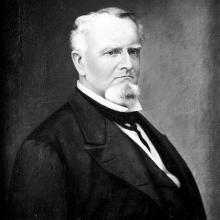
Speech of Mr. Johnson of Arkansas, in the C. S. Senate, February 9th, 1864, on the Bill to Limit and Define the Terms of Office of the Principal Officers or Heads of Departments
Robert Ward Johnson was an American politician and lawyer from Arkansas. He served as a United States Representative, United States Senator, and the Confederate States Senator.
Background
Johnson was born on July 22, 1814, in Scott County, Kentucky, United States. He was the son of Benjamin and Matilda Williams Johnson. His father, a brother of James and Richard Mentor Johnson, sat on the bench for thirty-eight years, first as a state judge in Kentucky and then as a federal judge in the territory and state of Arkansas.
Education
Johnson received his academic training in the Choctaw Academy, which was established on the land of his uncle Richard M. Johnson, and at St. Joseph's College, Bardstown, Kentucky.
After studying law, Johnson opened an office in Little Rock, Arkansas, in 1835. Five years later he became prosecuting attorney for the district including Little Rock and thus, ex officio, attorney-general for the state. In 1846 he was elected to Congress as a Democrat, and was twice re-elected, but declined to be a candidate in 1852. The following year he was appointed to the Senate by Governor Conway to fill the vacancy caused by the resignation of Solon Borland, was elected by the legislature to fill out the term, and re-elected for a full term, serving from July 1853 to March 3, 1861. He did not seek re-election in 1860, but in the following year, he stumped the state in favor of secession and was elected by the secession convention as a delegate to the Confederate Provisional Congress. Later he was elected to the Confederate Senate and served until the end of the war.
Johnson then planned flight to Mexico, but in Galveston, he met an old friend in General Granger, who was in command of the United States forces there. Granger gave him a pass and advised him to go to Washington, where President Johnson, another old friend, gave him due to protection. He then returned to his estate in Arkansas and tried to rebuild his fortune, but had to surrender it to his creditors. Going back to Washington he formed a law partnership with Albert Pike, but Pike said that he never practiced much. His disabilities removed by an act of Congress, he sought a seat in the Senate in 1878, but was defeated by J. D. Walker, and died the following year.
Achievements
Johnson is best known as the politician, who was a part of "The Family," a group of men related by marriage and politics, who dominated the state Democratic Party and politics, and its national representation in the antebellum years. He is also remembered as the chairman of the House Committee on Indian Affairs.
Johnson entered Congress in time to oppose the Wilmot Proviso and in 1850 he opposed Clay's plan of compromise, speaking and voting against the admission of California and voting against the compromise with Texas. He avoided committing himself on the territorial bill and the abolition of the slave trade in the District of Columbia, but supported the new fugitive-slave law. In the Senate, he supported Douglas' Kansas-Nebraska bill and the homestead bill, and during the latter half of his term was active on questions involving the public lands, securing large grants for railroads in Arkansas.
Connections
Johnson was married in 1836 to Sarah Smith, daughter of Dr. George W. Smith of Louisville, Kentucky, and after her death in 1862 he married her sister, Laura. His first wife bore him three children.