Background
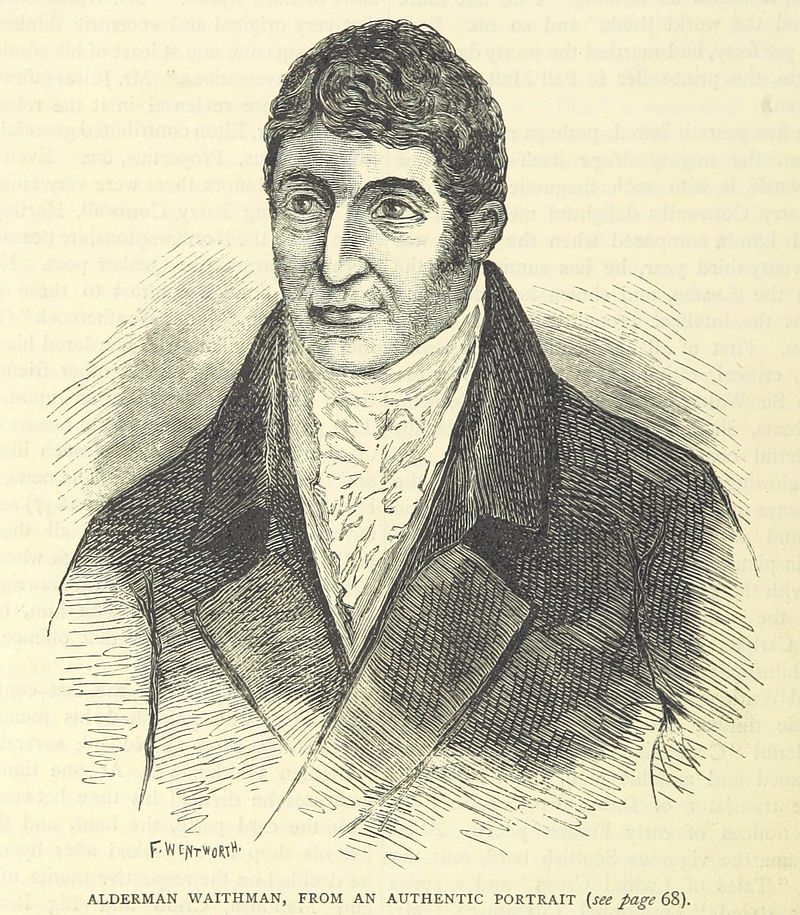
He was born in 1764 at Wrexham, to John Waithman, a joiner at the Bersham Ironworks, and Mary (née Roberts).
Waithman’s father was a native of Warton, Lancashire, evidently of Quaker antecedents, who came to the Bersham furnace in the wake of Isaac and John Wilkinson the iron-masters, when (by 1756) they moved from Backbarrow near Furness to Bersham.
He married Mary Roberts at Wrexham 29 January 1761, but Waithman’s baptism is not recorded there.
His father died soon after his birth and in 1776 his mother remarried at Wrexham, Thomas Mires, furnaceman, and had a second family, whom Waithman subsequently supported.
The boy was placed in the care of an uncle.
Career
Upon the death of his uncle he found employment first at Reading and subsequently in a linen draper’s shop in London.
He opened his own retail shop at Fleet Market about 1786 and prospered, moving by 1794 to 103-4 Fleet Street, but maintaining premises at 120 Newgate Street. His partners were Bristow (1798), Evrington (1805) and his sons by 1814: about 1823 they took over from him.
Waithman’s interest in politics was stimulated by the French revolution. A talented man, though with little formal education, he learnt to become a demagogue in debates at Founders’ Hall, Lothbury, which were held in imitation of the proceedings of the French revolutionaries.
In January 1795, as a London liveryman, he seconded resolutions in common hall against the war, which were rejected. He spoke against the sedition bills in November. As common councilman for Faringdon Without from 1795, he established his reputation as a radical orator critical of corporation and government measures, and acquired the esteem of his fellow travellers at the Chapter coffee house near St. Paul’s.
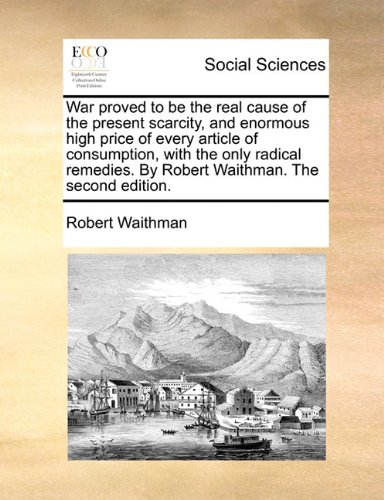
In 1800, as a member of the Independent Livery, he published a pamphlet entitled War proved to be the real cause of the present scarcity and enormous high price, of every article of consumption, with the only radical remedies, which was particularly vehement against the injustice of the income tax, and demanded the reform of abuses.
In 1802 Waithman was nominated for London by his radical friends, but hissed when he attempted to speak.
In April 1805 he was a leading opponent in common hall of Lord Melville and in February 1806 of the proposal to erect a monument to Pitt’s memory in the Guildhall. It was said that Fox intended to reward Waithman’s exertions on behalf of the Whigs (he was a member of the Whig Club) with the place of receiver-general of the land tax, but nothing came of it.
He appeared at Maidstone and Boston during the election of 1806, threatening to stand as an independent, but did not do so: a seat for London, where he supported the candidature of John Atkins, was his ambition, but he was thwarted by the prejudice against retail traders and hoped to obviate it by becoming a merchant (i. e. wholesaler).
On 10 June 1811, as a steward, he made a moderate and conciliatory speech at the meeting of the Friends of Constitutional Reform, urging the Whigs to return to it.
In 1812 Waithman, claiming to be the shopkeeper’s friend against the ‘great interests’, contested London. He was no longer the man of the moment, as in 1809: ‘the patriotic linen draper’, as he had been dubbed, was placed fifth, more than a thousand votes behind the fourth man, after being supported by a subscription. He was reported to have blamed the Whigs for his defeat ‘because Combe’s friends would not sacrifice him and his election to Waithman’; but the candidature of his ‘brother patriot’ Alderman Wood, than whom he received more votes and to whom he had refused to give way, dished him. ‘Hinting his superiority both in purity and consequence’ over Wood, he was at daggers drawn with the latter.
In 1813 he fell out with Cobbett over the defence of the Princess of Wales. There was further bad blood in June 1814 when, during a debate on the slave trade at Freemasons’ Hall, he attacked Lord Grey after the latter had expressed his views, whereupon Grey rebuked him. Burdett, however, reported that ‘at the slave meeting they would not let Waithman reply to Lord Grey! These are your liberal people. How absurd public meetings if men cannot speak their minds. ’ He subsequently enhanced his reputation by leading the City opposition to the corn bill and the property tax and the petition for parliamentary reform in November 1816.
He somewhat redeemed his standing with the Whig leaders by corresponding, for instance, with Lord Holland ‘in a very temperate and serviceable mood’ in January 1817 on the subject of public meetings proposed by the Hampden Club, which he had joined in 1812, to harry the government.
When, however, he and the reformers met Lord Grey that month to discuss parliamentary reform, Grey refused to allow it as a priority among the Whig proposals. Waithman had promoted a common council petition for triennial elections and the enfranchisement of copyholders and taxpaying householders.
He had in the previous November clashed with the more radical Henry Hunt on the subject and now thwarted Hunt’s attempt to substitute annual parliaments in the petition. Likewise, in February 1818, he carried his resolutions against Hunt’s in opposition to the suspension of habeas corpus.
In the ensuing Parliament Waithman voted with opposition in most surviving divisions and made over 40 speeches.
His first, 25 January 1819, was in support of parliamentary investigation of the criminal code in accordance with a London petition which Alderman Wood had defended first; it ‘succeeded completely’ and was received with cheering from both sides of the House. He had not signed the requisition to Tierney to lead the Whigs, but William Henry Lyttelton wrote in the following month: ‘Even Citizen Waithman bends the knee to Tierney, and behaves decorously now that he is a senator’.
Sir Charles Monck informed Lord Grey, ‘Waithman’s appearance, of face particularly, is against him, and his expressions and pronunciation are both vulgar, but he is not coarse in sentiment’. Sydney Smith assured Lady Grey that Waithman ‘has been an improved man ever since Lord Grey gave him such a beating’.
In February 1819 he was the advocate of the London petition against the insolvent debtors bill, then due for renewal; he had been the City spokesman against the bill in 1813 and now stated that ‘no Act ever passed that House which made so complete an inroad on the property of traders, or which gave a more deadly blow to the morals of the people’. 8 He subsequently attempted to have merchants nominated to the committee on the bill: they would do justice to unfortunate creditors who had received less than a farthing in the pound since the operation of the Act.
In the autumn of 1819 Tierney communicated his views on the holding of a Middlesex county meeting to protest about the Peterloo affair to Waithman, who, he thought, had ‘conducted himself extremely well in the City’, and described him as ‘the most likely person to be informed of what was going on and the most certain channel through which, in certain circles, I could make known my opinion on the Manchester business and the steps which I think ought to be taken’.
Waithman claimed to know nothing about it, but thought no step should originate in the City and added, ‘gentlemen of property and influence should take the matter into their own hands, otherwise it will be done without them’. He spoke against the seditious meetings prevention bill, 6 December 1819: it was legislation ‘without evidence’. It tended to alienate a nation that had no desire for revolution, particularly the middle classes, who depended on meetings to promote parliamentary reform.
These views were not radical enough for the hero of the ‘Manchester business’, Henry Hunt, who regarded Waithman as ‘very little better than an aristocrat’.
Next day Waithman described the bill as ‘a subversion of the constitution’ and backed the London petition on the state of the nation. He deprecated Alderman Wood’s attempt to amend such a bill, which would be totally rejected by the people: the suggestion was, however, received with loud laughter.
Waithman’s differences with the extreme radicals became clear when on 9 December he deprecated the Westminster radicals’ meeting at Smithfield as ‘one of the most despicable public meetings which he had ever seen’, and when on 16 December he rejected Robert Owen’s plan as ‘a visionary expectation’ (a view he had already publicly expressed in August 1817) though he voted for its investigation by committee.
On 20 December he opposed the newspaper stamp duties bill as being fatal to the liberty of the press.
Waithman, who fell foul of his fellow aldermen during the mayoral election of 1819, was defeated in 1820, which soured him and made him all the more ‘violent and coarse in his abuse of government’ during the trial of Queen Caroline: but, after repeated frustration, he was finally elected mayor in 1823 and regained his seat in 1826.
He died a respectable figure, 6 February 1833, having ‘filled a large space in City politics’.
Politics
Waithman was a member of the Whig Club.
Views
on 10 May 1819 he rose to give his views on parliamentary reform, he was coughed down and exclaimed that ‘he could not see why on every occasion several Members in that House should exert themselves to cry him down’. He added that, however loath to speak unwanted, he could not ‘compromise the rights of his constituents’. It worked: ‘for the remainder of the worthy alderman’s speech, not the slightest symptom of impatience was evinced in any part of the House’. Waithman was then able to explain that he was a warm advocate of reform, though not of ‘the wild principles of universal suffrage and annual parliaments’: he would vote for the Barnstaple bribery bill, faute de mieux, but pointed out graver defects in the electoral system, such as the disfranchisement of freeholders in London.
A week later, on the same subject, he alleged that ‘the electoral franchise ought to be considered as a public not a private right, to be exercised for general and not for personal advantage’. On 8 June he objected to government’s tax proposals as unbearable and offered to move for an independent committee to propose alternative ways and means: he maintained, 18 June, that he would not vote for a single new tax until ‘the experiment of retrenchment’ had been tried.
Quotations:
When he was again active, organizing a dinner of reformers and a petition on behalf of Burdett, in April 1810, he hoped for the backing of the Whig leaders: "they must put their hearts and souls to the accomplishment of the great objects of reform in every branch of the government and the representation of the people if they mean to be supported by the people— the system is wore out", so he informed Creevey.
Membership
He was a member of the Independent Livery.
Personality
Quotes from others about the person
According to a recent estimate, ‘He led the long campaign which transformed the City of London from a bastion of Pittite loyalism into one of moderate reform; and within the national reform movement (although at times his attitude to the Whigs may have been too harsh and antagonistic) he deserves to be remembered as a pioneer of conciliation’.