

Background
Litan, Robert Eli was born on May 16, 1950 in Wichita, Kansas, United States. Son of David and Shirley Hermine (Krischer) Litan.

http://www.amazon.com/gp/product/B012YSGZNG/?tag=2022091-20
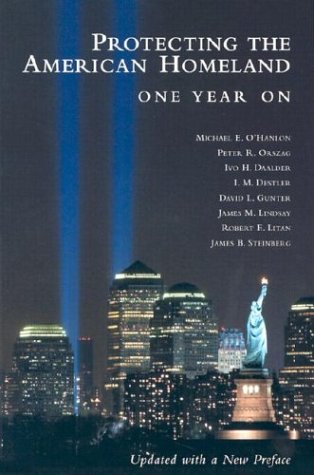
( A good deal has been done to improve the safety of Amer...)
A good deal has been done to improve the safety of Americans on their own soil since the attacks of September 11, 2001. Yet there have been numerous setbacks. The Bush administration and Congress wasted at least six months in 2002 due to partisan disagreement over a new budget for homeland security, and as one consequence, resources were slow to reach first responders across the country. Most improvements in homeland security have focused on "refighting the last war" —improving defenses against attacks similar to those the country has already suffered. Not enough has been done to anticipate possible new kinds of terrorist actions. Policymakers have also focused too much attention on the creation of a department of homeland security —rather than identifying and addressing the kinds of threats to which the country remains vulnerable. While the creation of a cabinet-level agency focusing on homeland security may have merit, the authors of this study argue that the department will not, in and of itself, make Americans safer. To the contrary, the complexity of merging so many disparate agencies threatens to distract Congress and the administration from other, more urgent security efforts. This second edition of Protecting the American Homeland urges policymakers to focus on filling key gaps that remain in the current homeland security effort: identifying better protection for private infrastructure; using information technology to share intelligence and more effectively "connect the dots" that could hold hints to possible terrorist tactics; expanding the capacities of the Coast Guard and Customs Service, as well as airline transportation security; dealing with the possible threat of surface-to-air missiles to airliners; and encouraging better coordination among intelligence agencies. While acknowledging the impossibility of preventing every possible type of terrorist violence, the authors recommend a more systematic approach to homeland security that focuses on preventing attacks that can cause large numbers of casualties, massive economic or societal disruption, or severe political harm to the nation.
http://www.amazon.com/gp/product/0815764537/?tag=2022091-20

(International accounting standards tend to converge, as d...)
International accounting standards tend to converge, as do auditing, enforcement and corporate governance, whereas trading of equity shares remains essentially national. The book provides a thorough analysis of what information investors really need, how financial accounting systems developed and their current requirements in major commercial countries, and examines current issues, particularly the benefits and costs a single or multiple accounting standards, the bases for accounting standards, and limitations to accounting disclosure in financial statements.
http://www.amazon.com/gp/product/0195305833/?tag=2022091-20

http://www.amazon.com/gp/product/B001TTCN5Q/?tag=2022091-20

( In just a few years, the Internet has had a visible imp...)
In just a few years, the Internet has had a visible impact on the daily lives of many Americans. But the recent demise of many of the "dot coms" that symbolized the Internet revolution has raised warning flags about its future. Until now, discussion of the impact of the Internet on the economy has been mostly speculation. In Beyond the Dot.coms, two of the nation's most respected economists articulate the anticipated economic impact of the Internet over the next five years. Drawing from detailed research conducted by the Brookings Task Force on the Internet and the Berkeley Roundtable on the International Economy (BRIE) Internet Task Force (see page 10), Robert Litan and Alice Rivlin address the Internet's potential impacts on productivity, prices, and market structure. The research suggests that the most significant economic impact of the Internet will be its potential to increase productivity growth in the existing economy —with cheaper transactions, greater management efficiency, increased competition and broadened markets, more effective marketing and pricing, and increased consumer choice, convenience, and satisfaction. The greatest impact may not be felt in e-commerce, but rather in a wide range of "old economy" arenas, including health care and government.
http://www.amazon.com/gp/product/0815700024/?tag=2022091-20

( "The authors are as knowledgeable about Superfund in al...)
"The authors are as knowledgeable about Superfund in all its glory as anyone in America. This book should be read by everyone interested in the subject, but be careful, it may curl your hair."--William Ruckelshaus, Chairman, Browning Ferris Industries, former U.S.E.P.A. Administrator The authors develop information on who is likely to pay the cost of the current Superfund program. They also explore the financial implications of changes in liability and taxes on four key sectors affected by Superfund: chemicals, oil, mining, and commercial property-casualty insurers. They analyze the different taxing mechanisms and liability schemes and compare the financial effects on specific industries of the current Superfund program and of several alternative liability and tax-based funding mechanisms available.
http://www.amazon.com/gp/product/0815729944/?tag=2022091-20

( The historic European Union Directive on Data Protectio...)
The historic European Union Directive on Data Protection will take effect in October 1998. A key provision will prohibit transfer of personal information from Europe to other countries if they lack "adequate" protection of privacy. If enforced as written, the Directive could create enormous obstacles to commerce between Europe and other countries, such as the United States, that do not have comprehensive privacy statutes. In this book, Peter Swire and Robert Litan provide the first detailed analysis of the sector-by-sector effects of the Directive. They examine such topics as the text of the Directive, the tension between privacy laws and modern information technologies, issues affecting a wide range of businesses and other organizations, effects on the financial services sector, and effects on other prominent sectors with large transborder data flows. In light of the many and significant effects of the Directive as written, the book concludes with detailed policy recommendations on how to avoid a coming trade war with Europe. The book will be of interest to the wide range of individuals and organizations affected by the important new European privacy laws. More generally, the privacy clash discussed in the book will prove a major precedent for how electronic commerce and world data flows will be governed in the Internet Age.
http://www.amazon.com/gp/product/081578239X/?tag=2022091-20
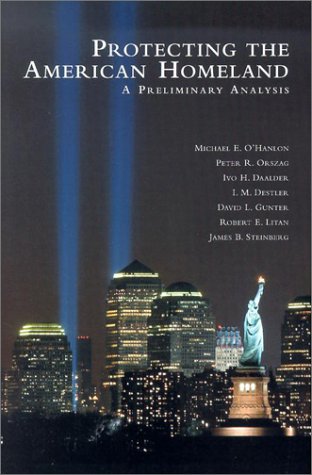
( The September 11 attacks forcefully brought home the ne...)
The September 11 attacks forcefully brought home the need to better protect the U.S. homeland. But how can this be accomplished most effectively? Here, a team of Brookings scholars offers a four-tier plan to guide and bolster the efforts under way by the Bush administration and Congress. There has been some progress in making our homeland more secure. But the authors are concerned that the Bush administration may focus too narrowly on preventing attacks like those of the recent past and believe a broader and more structured approach to ensuring homeland security is needed. Given the vulnerability of our open society, the authors recommend four clear lines of direction. The first and last have received a good deal of attention from the Bush administration, though not yet enough; for the other two, a great deal remains to be done: Perimeter defense at the border to prevent entry by potential perpetrators and the weapons and hazardous materials they may use Prevention by detecting possible terrorists within the United States and securing dangerous materials they might obtain here Identification and defense of key sites within the county: population centers, critical economic assets and infrastructure, and locations of key political or symbolic importance Consequence management to give those directly involved in responding to an attack that may nevertheless occur the tools necessary to quickly identify and attack and limit its damage Included are specific recommendations on how much more to spend on homeland security, how much of the cost should be borne by the private sector, and how to structure the federal government to make the responsible agencies more efficient in addressing security concerns. Specifically, the authors believe that annual federal spending on homeland security may need to grow to about $45 billion, relative to a 2001 level of less than $20 billion and a Bush administration proposed budget for 2003 of $38 billion. They also discuss what burden state, local, and private-sector actors should bear in the overall national effort. Finally, the authors conclude that rather than creating a homeland security superagency, Tom Ridge, the director of the Office of Homeland Security, should have enhanced authority.
http://www.amazon.com/gp/product/0815706510/?tag=2022091-20

http://www.amazon.com/gp/product/B012YSSE80/?tag=2022091-20

( Founded in 1948 amid bloodshed and the near devastation...)
Founded in 1948 amid bloodshed and the near devastation of the Jewish people after the Holocaust, modern Israel is something of a miracle. In a little more than fifty years of existence, the country has evolved into a significant economic and military power, both feared and resented by its Arab neighbors in the volatile Middle East. In Sticking Together, an Israeli and an American examine the major challenges confronting Israel within its own borders. These challenges —well known to Israelis but relatively little known elsewhere —have emerged in part out of the country's experience with large-scale immigration. Like the United States, Canada, and Australia, Israel has tried to melt different peoples into a cohesive nation. While its citizens have forged common bonds under circumstances of adversity — particularly constant threats from Palestinians and from neighboring Arab countries — the fabric of Israeli society is torn by four major schisms: between immigrants and native Israeli; between Jews and Arabs; between secular and religious Jews; and between Jews of different cultural and national backgrounds (such as Ashkenzim and Sephardim). Gradually, and often with great difficulty, Israelis have learned to accommodate and respect the deep differences among its population. To borrow a culinary analogy, Israeli society, much like American society, has become more "salad bowl" than "melting pot." Sticking Together examines the many challenges confronting Israel's experience with pluralism, and in the process, draws lessons that might prove useful to other societies that struggle to accommodate the needs of highly diverse populations.
http://www.amazon.com/gp/product/0815702264/?tag=2022091-20

http://www.amazon.com/gp/product/B010EUS61K/?tag=2022091-20

(Today's knowledge-based economy requires an entirely new ...)
Today's knowledge-based economy requires an entirely new system of assessing the value of companies―a system tapping the vast communication capabilities of the Internet.
http://www.amazon.com/gp/product/0844741477/?tag=2022091-20

(In recent years, the major industrialized nations have de...)
In recent years, the major industrialized nations have developed co-operative procedures for supervising banks, harmonized their standards for bank capital requirements, and initiated co-operative understanding about securities-market supervision. This book assesses what further co-ordination and harmonization will be required in an era of increased globalization. This work is part of the Integrating National Economies series. As global markets for goods, services and financial assets have become increasingly integrated, national governments no longer have as much control over economic markets. With the completion of the Uruguay Round of the GATT talks, the world economy has entered a fresh phase requiring different rules and different levels of international cooperation. Policies once thought to be entirely domestic and appropriately determined by national political institutions, are now subject to international constraints. Cogent analysis of this deeper integration of the world economy, and guidelines for government policies, are urgent priorities. This series aims to meet these needs over a range of 21 books by some of the world's leading economists, political scientists, foreign policy specialists and government officials. All the books in the series are offered at the same price: #22.50 for hardbacks and #8.50 for paperbacks.
http://www.amazon.com/gp/product/0815752849/?tag=2022091-20

( As trade flows expanded and trade agreements proliferat...)
As trade flows expanded and trade agreements proliferated after World War II, governmentsmost notably the United Statescame increasingly to use their power over imports and exports to influence the behavior of other countries. But trade is not the only way in which nations interact economically. Over the past two decades, another form of economic exchange has risen to a level of vastly greater significance and political concern: the purchase and sale of financial assets across borders. Nearly $2 trillion worth of currency now moves cross-border every day, roughly 90 percent of which is accounted for by financial flows unrelated to trade in goods and servicesa stunning inversion of the figures in 1970. The time is ripe to ask fundamental questions about what Benn Steil and Robert Litan have coined as financial statecraft,” or those aspects of economic statecraft directed at influencing international capital flows. How precisely has the American government practiced financial statecraft? How effective have these efforts been? And how can they be made more effective? The authors provide penetrating and incisive answers in this timely and stimulating book.
http://www.amazon.com/gp/product/0300138415/?tag=2022091-20

( In this important book, three prominent economists prop...)
In this important book, three prominent economists propose that there are different varieties of capitalism in the world today--some good for economic growth, others decidedly bad. Writing in an accessible style, William J. Baumol, Robert E. Litan, and Carl J. Schramm documentfour different varieties of capitalism and identify the conditions that characterize Good Capitalism—the right blend of entrepreneurial and established firms, which can vary among countries—as well as the features of Bad Capitalism. They examine how countries catching up to the United States can move faster toward the economic frontier, while laying out the need for the United States itself to stick to and reinforce the recipe for growth that has enabled it to be the leading economic force in the world. This pathbreaking book is a must read for anyone who cares about global growth and how to ensure America’s economic future.
http://www.amazon.com/gp/product/0300158327/?tag=2022091-20
http://www.amazon.com/gp/product/B009WYAM2Q/?tag=2022091-20

( As recently as thirty years ago, Americans lived in a f...)
As recently as thirty years ago, Americans lived in a financial world that today seems distant. Investment and borrowing choices were meager: virtually all transactions were conducted in cash or by check. The financial services industry was heavily regulated, as an outgrowth of the Depression, while an elaborate safety net was constructed to prevent a repeat of that dismal episode in American history. Today, consumers and businesses have a dizzying array of choices about where to invest and borrow. Plastic credit cards and electronic transfers increasingly are replacing cash and checks. Much regulation has been dismantled, although the industry remains fragmented by rules that continue to separate banks from other enterprises. Meanwhile, finance has gone global and increasingly high-tech. This book, originally prepared as a report to Congress by the Treasury Department, outlines a framework for setting policy toward the financial services industry in the coming decades. The authors, who worked closely with senior Treasury officials in developing their recommendations, identify three core principles that lie at the heart of that framework: an enhanced role for competition; a shift in emphasis from preventing failures of financial institutions at all cost toward containing the damage of any failures that inevitably occur in a competitive market; and a greater reliance on more targeted interventions to achieve policy goals rather than broad measures, such as flat prohibitions on certain activities.
http://www.amazon.com/gp/product/0815752881/?tag=2022091-20
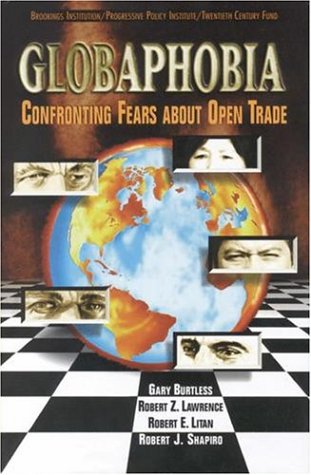
( For much of the post-World War II period, the increasin...)
For much of the post-World War II period, the increasing globalization of the U.S. economy was welcomed by policymakers and by the American people. We gained the benefits of cheaper and, in some cases, better foreign-made products, while U.S. firms gained wider access to foreign markets. The increasing economic interlinkages with the rest of the world helped promote capitalism and democracy around the globe. Indeed, we helped "win" the Cold War by trading and investing with the rest of the world, in the process demonstrating to all concerned the virtues of trade and markets. In recent years, however, a growing chorus of complaints has been lodged against globalization--which is blamed for costing American workers their jobs and lowering their wages. The authors of this book speak directly and simply to these concerns, demonstrating with easy prose and illustrations why the "globaphobes" are wrong. Globalization has not cost the United States jobs. Nor has it played any more than a small part in the disappointing trends in wages of many American workers. The challenge for all Americans is to embrace globalization and all of the benefits it brings, while adopting targeted policies to ease the very real pain of those few Americans whom globalization may harm. Globaphobia outlines a novel, yet sensible program for advancing this objective. Copublished with the Twentieth Century Fund and the Progressive Policy Institute
http://www.amazon.com/gp/product/0815711891/?tag=2022091-20

(The future of American banking is in doubt and the indust...)
The future of American banking is in doubt and the industry and the federal insurance fund that helps support it are in turmoil. The ingredients of the turmoil have been simmering in public view since at least the early 1980s when commercial bank loans to lesser developed countries (LDCs) began to default. The difficulties began to boil at the end of the decade when the prospect first arose that the banks' deposit insurer, the Bank Insurance Fund (BIF) that is administered by the Federal Deposit Insurance Corporation (FDIC), might require dollars to resolve bank failure as occurred in the savings and loan debacle. This book frames the major economic and policy issues raised by the banking crisis whose resolution largely determines the future of American banking. It focuses on the current reported condition of the banking industry, concentrating on large banks in particular. A longer-run economic prognosis for the banking industry is presented and the implications of future bank failures for the financial services sector and federal regulatory policy are discussed. Most importantly the book contains suggestions for changes in the nation's deposit-insurance system and accompanying banking laws. These changes would reduce the federal government's deposit insurance liability and would provide banks with potentially profitable opportunities. The study includes a wealth of data on the financial condition of American banks and the system as a whole, some of it not easily obtainable from any other source. The authors are internationally recognized as knowledgeable experts on the state of the American banking system and the options and prospects for US banking reform.
http://www.amazon.com/gp/product/1563241625/?tag=2022091-20
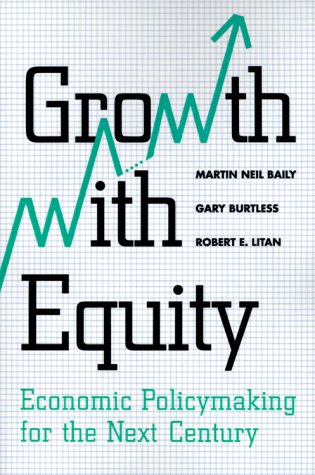
(In this book three of the nation's most noted economists ...)
In this book three of the nation's most noted economists look at the primary reasons for these trends and assess which of the many suggestions for change in policy-whether for increased tax incentives for investment, education reform, or accelerated research and development-are likely to work and which may not work and could even hinder economic development.
http://www.amazon.com/gp/product/0815707657/?tag=2022091-20

( The right to a jury trial is a fundamental feature of t...)
The right to a jury trial is a fundamental feature of the American justice system. In recent years, however, aspects of the civil jury system have increasingly come under attack. Many question the ability of lay jurors to decide complex scientific and technical questions that often arise in civil suits. Others debate the high and rising costs of litigation, the staggering delay in resolving disputes, and the quality of justice. Federal and state courts, crowded with growing numbers of criminal cases, complain about handling difficult civil matters. As a result, the jury trial is effectively being challenged as a means for resolving disputes in America. Juries have been reduced in size, their selection procedures altered, and the unanimity requirement suspended. For many this development is viewed as necessary. For others, it arouses deep concern. In this book, a distinguished group of scholars, attorneys, and judges examine the civil jury system and discuss whether certain features should be modified or reformed. The book features papers presented at a conference cosponsored by the Brookings Institution and the Litigation Section of the American Bar Association, together with an introductory chapter by Robert E. Litan. While the authors present competing views of the objectives of the civil jury system, all agree that the jury still has and will continue to have an important role in the American system of civil justice. The book begins with a brief history of the jury system and explains how juries have become increasingly responsible for decisions of great difficulty. Contributors then provide an overview of the system's objectives and discuss whether, and to what extent, actual practice meets those objectives. They summarize how juries function and what attitudes lawyers, judges, litigants, former jurors, and the public at large hold about the current system. The second half of the book is devoted to a wide range of recommendations that will both improve citizens' access to jury determinations and help resolve disputes in a more effective and efficient manner. Among their many suggestions, the authors call for changes in trial procedures and techniques that would improve the ability of jurors to understand the lay and evidence, a reduction in administrative costs and delays, and a change in they way juries are chosen. The authors also recommend shorter hours and more pay for jurors, greater flexibility in court schedules, and elimination of alternate jurors. In the final chapter the civil jury is considered in the broader context of how society resolves or manages civil disputes.
http://www.amazon.com/gp/product/0815752814/?tag=2022091-20

(In Saving Free Trade: A Pragmatic Approach, Robert Z. Law...)
In Saving Free Trade: A Pragmatic Approach, Robert Z. Lawrence and Robert E. Litan analyze both the allure of protectionism and the problems associated with free trade, proposing reasonable, cost-effective ways of helping industries, workers, and communities battered by intense import competition.
http://www.amazon.com/gp/product/081575177X/?tag=2022091-20

http://www.amazon.com/gp/product/B012YWC9V4/?tag=2022091-20
Litan, Robert Eli was born on May 16, 1950 in Wichita, Kansas, United States. Son of David and Shirley Hermine (Krischer) Litan.
Bachelor of Science in Economics (Class of 1946 award, West. Gordon award 1972, Albert A. Berg award 1971, 72), Wharton School, University of Pennsylvania, 1972. Master of Philosophy in Economics, Yale University, 1976, Juris Doctor (Felix South. Cohen award 1976),1977, Doctor of Philosophy in Economics, Yale University, 1987.
Research assistant Brookings Institution, 1972-1973. Instructor to lecturer economics Yale University, 1975-1976. Energy consultant National Academy of Sciences, 1975-1977.
Regulation and energy specialist President's Council Economic Advisers, 1977-1979. Associate Arnold & Porter, Washington, 1979-1982. Associate, then partner and counsel Powell, Goldstein, Frazer & Murphy, 1982-1990.
Senior fellow Brookings Institution, 1984-1992, since 2003, director Center for Economic Progress, 1987-1993, vice president, director economic studies, Cabot family chair in economics, 1996—2003. Deputy assistant attorney general Department Justice, 1993-1995. Associate director Office of Management and Budget, 1995-1996.
Consultant Institute Liberty and Democracy, Lima, Peru, 1985—1988. Visiting lecturer Yale University Law School, 1985—1986. Member Presidential Congressional Commission Causes of Savings and Loan Crisis, 1991—1992.
Consultant United States Department Treasury, 1996—1997, 1999—2000. Vice president research and policy The Kauffman Foundation, since 2003. Senior fellow The Brookings Institute, since 2003.
(In this book three of the nation's most noted economists ...)
(In recent years, the major industrialized nations have de...)
( As trade flows expanded and trade agreements proliferat...)
( In this important book, three prominent economists prop...)
(International accounting standards tend to converge, as d...)
(Today's knowledge-based economy requires an entirely new ...)
( Founded in 1948 amid bloodshed and the near devastation...)
(The future of American banking is in doubt and the indust...)
( A good deal has been done to improve the safety of Amer...)
( In just a few years, the Internet has had a visible imp...)
( As recently as thirty years ago, Americans lived in a f...)
( The historic European Union Directive on Data Protectio...)
( "The authors are as knowledgeable about Superfund in al...)
( The September 11 attacks forcefully brought home the ne...)
( The right to a jury trial is a fundamental feature of t...)
( For much of the post-World War II period, the increasin...)
(In Saving Free Trade: A Pragmatic Approach, Robert Z. Law...)
Member of American Bar Association, Council on Foreign Relations, American Economics Association.
