

Background
Kaplan, Robert Samuel was born on May 2, 1940 in New York City. Son of Bernard R. and Jeanette (Lieman) Kaplan.
http://www.amazon.com/gp/product/B005HNFFRI/?tag=2022091-20

http://www.amazon.com/gp/product/B001GLLPFQ/?tag=2022091-20
( In a world of stiffening competition, business strategy...)
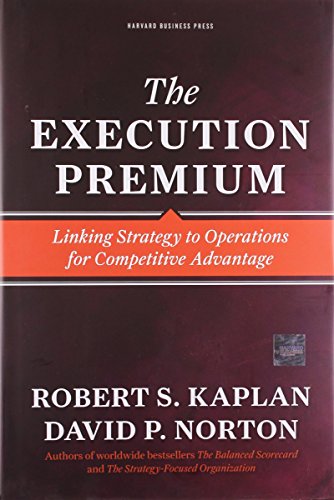
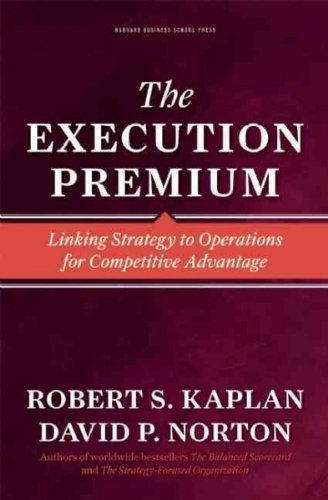
In a world of stiffening competition, business strategy is more crucial than ever. Yet most organizations struggle in this area--not with formulating strategy but with executing it, or putting their strategy into action. Owing to execution failures, companies realize just a fraction of the financial performance promised in their strategic plans. It doesn't have to be that way, maintain Robert Kaplan and David Norton in The Execution Premium. Building on their breakthrough works on strategy-focused organizations, the authors describe a multistage system that enables you to gain measurable benefits from your carefully formulated business strategy. This book shows you how to: Develop an effective strategy--with tools such as SWOT analysis, vision formulation, and strategic change agendas Plan execution of the strategy--through portfolios of strategic initiatives linked to strategy maps and Balanced Scorecards Put your strategy into action--by integrating operational tools such as process dashboards, rolling forecasts, and activity-based costing Test and update your strategy--using carefully designed management meetings to review operational and strategic data Drawing on extensive research and detailed case studies from a broad array of industries, The Execution Premium presents a systematic and proven framework for achieving the financial results promised by your strategy.
http://www.amazon.com/gp/product/142212116X/?tag=2022091-20
http://www.amazon.com/gp/product/B0140D6M7M/?tag=2022091-20
http://www.amazon.com/gp/product/B00Y4R1DRY/?tag=2022091-20

( Most organizations consist of multiple business and sup...)
Most organizations consist of multiple business and support units, each populated by highly trained, experienced executives. But often the efforts of individual units are not coordinated, resulting in conflicts, lost opportunities, and diminished performance. Robert S. Kaplan and David P. Norton argue that the responsibility for this critical alignment lies with corporate headquarters. In this book, the authors apply their revolutionary Balanced Scorecard management system to corporate-level strategy, revealing how highly successful enterprises achieve powerful synergies by explicitly defining corporate headquarters’ role in setting, coordinating, and overseeing organizational strategy. Based on extensive field research in organizations worldwide, Alignment shows how companies can build an enterprise-level Strategy Map and Balanced Scorecard that clearly articulate the enterprise value proposition”: how the enterprise creates value above that achieved by individual business units operating alone. The book provides case studies, actionable frameworks, and sample scorecards that show how to align business and support units, boards of directors, and external partners with the corporate strategy and create a governance process that will ensure that alignment is sustained. The next breakthrough in strategy execution from the field’s premier thinkers, Alignment shows how today’s companies can unlock unrealized value from enterprise synergies.
http://www.amazon.com/gp/product/1591396905/?tag=2022091-20
http://www.amazon.com/gp/product/B004ON6MKG/?tag=2022091-20
http://www.amazon.com/gp/product/B008ED5IJ8/?tag=2022091-20
http://www.amazon.com/gp/product/B004OVRH3Y/?tag=2022091-20
http://www.amazon.com/gp/product/1578512506/?tag=2022091-20

( The Balanced Scorecard translates a company's vision an...)
The Balanced Scorecard translates a company's vision and strategy into a coherent set of performance measures. The four perspectives of the scorecard--financial measures, customer knowledge, internal business processes, and learning and growth--offer a balance between short-term and long-term objectives, between outcomes desired and performance drivers of those outcomes, and between hard objective measures and softer, more subjective measures. In the first part, Kaplan and Norton provide the theoretical foundations for the Balanced Scorecard; in the second part, they describe the steps organizations must take to build their own Scorecards; and, finally, they discuss how the Balanced Scorecard can be used as a driver of change.
http://www.amazon.com/gp/product/0875846513/?tag=2022091-20
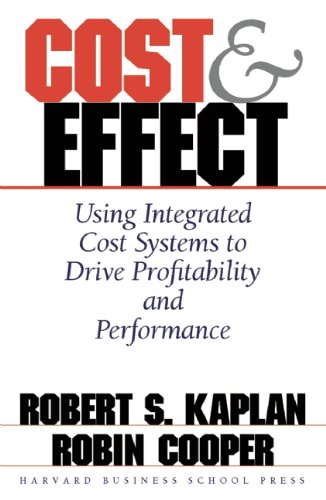
( Two of the most innovative thinkers in the field presen...)
Two of the most innovative thinkers in the field present a work that represents the single best resource for understanding and implementing activity-based cost management. Kaplan and Cooper reveal that most companies don't know how to measure accurately, influence, or understand the fundamental cost drivers in their businesses. They then provide a detailed and comprehensive blueprint that will enable managers to make better decisions and to promote organizational learning and improvement. Cost and Effect takes the management, finance, and accounting fields to an entirely new level, as the authors demonstrate how the principles of activity-based costing and other advanced cost management techniques, such as target and kaizen costing, can drive business performance. Using lively examples from a variety of leading companies worldwide—including Siemens, Hewlett-Packard, AT&T, the Swedish wire manufacturer Kanthal, Kirin Beer, and Procter & Gamble—they show how to create integrated, knowledge-based systems that provide meaningful information on current and past performance.The innovation systems described in Cost and Effect will help you: determine where improvements in quality, efficiency, and productivity will have the highest payoffs; assist front-line employees in their learning and improvement activities; make better product mix and capital investment decisions; negotiate more effectively on price, product features, quality, delivery, and service to promote win-win relationships with your customers; choose low-cost suppliers who are truly low cost, not just low price; design products and services that meet customers' expectations - and that can be produced and delivered at a profit; and, integrate your activity-based cost system into reporting and budgeting processes to reveal the sources of excess capacity. Everyone involved in running a business—from general managers and strategic planners to financial executives, IT professionals, and operations managers—must read this book to learn how innovative cost and performance measurement systems can enhance their organizational profitability and performance.
http://www.amazon.com/gp/product/0875847889/?tag=2022091-20

http://www.amazon.com/gp/product/B001GLLT3O/?tag=2022091-20
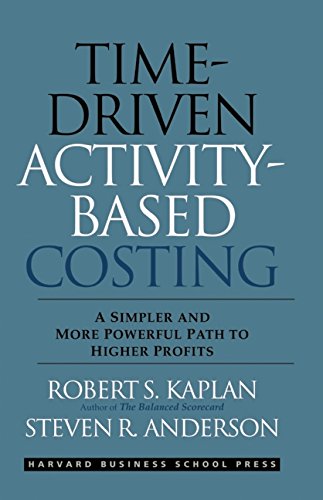
( In the classroom, ABC looks like a great way to manage ...)
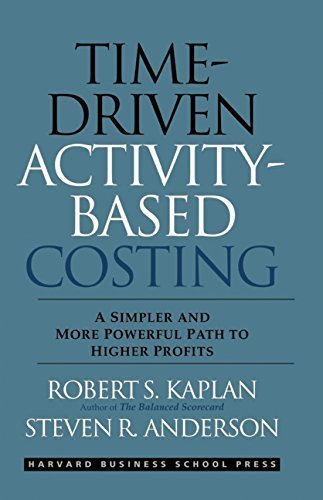
In the classroom, ABC looks like a great way to manage a company’s resources. But many executives who have tried to implement ABC on a large scale in their organizations have found the approach limiting and frustrating. Why? The employee surveys that companies used to estimate resources required for business activities proved too time-consuming, expensive, and irritating to employees. This book shows you how to implement time-driven activity-based costing (TDABC), an easier and more powerful way to implement ABC. You can now estimate directly the resource demands imposed by each business transaction, product, or customer. The payoff? You spend less time and money obtaining and maintaining TDABC dataand more time addressing problems that TDABC reveals, such as inefficient processes, unprofitable products and customers, and excess capacity. The authors also show how to use TDABC to link strategic planning to operational budgeting, to enhance the due diligence process for mergers and acquisitions, and to support continuous improvement activities such as lean management and benchmarking. In presenting their model, the authors define the two questions required to build TDABC: 1) How much does it cost per time unit to supply resource capacity for each business process? 2) How much resource capacity (time) is required to perform work for a company’s many transactions, products, and customers? The book demonstrates how to develop simple, valid answers to these two questions. Kaplan and Anderson illustrate the TDABC approach with a wealth of case studies, in diverse settings, based on actual implementations.
http://www.amazon.com/gp/product/1422101711/?tag=2022091-20
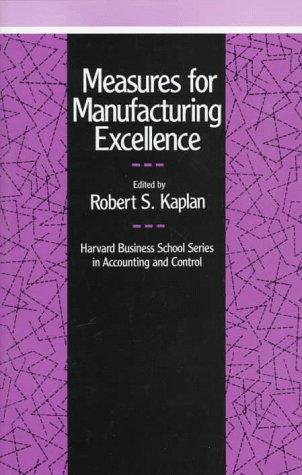
(Just-in-time manufacturing and distribution processes, co...)
Just-in-time manufacturing and distribution processes, computer-aided design, and flexible manufacturing systems are now commonplace in the modern workplace, but antiquated accounting systems are unable to monitor accurately their operations, making them a liability to today's managers. In twelve essays, leading academics describe how companies are using operation and accounting measures to win the battle for manufacturing excellence. Issues discussed include measuring organizational improvement, facilitating organizational learning, motivating product design improvements, and evaluating production planning.
http://www.amazon.com/gp/product/0875842291/?tag=2022091-20
http://www.amazon.com/gp/product/B012HUWP6M/?tag=2022091-20
http://www.amazon.com/gp/product/B002AHKWUE/?tag=2022091-20

http://www.amazon.com/gp/product/B00005RZ9H/?tag=2022091-20
http://www.amazon.com/gp/product/B00ZY90HLY/?tag=2022091-20
("Relevance Lost" is an overview of the evolution of manag...)
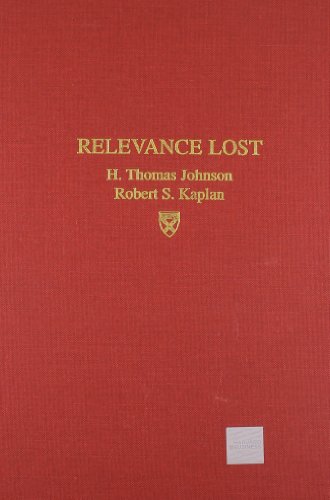
"Relevance Lost" is an overview of the evolution of management accounting in American business, from textile mills in the 1880s and the giant railroad, steel, and retail corporations, to today's environment of global competition and computer-automated manufacturers. The book shows that modern corporations must work toward designing new management accounting systems that will assist managers more fully in their long-term planning. It is the winner of the American Accounting Association's Deloitte Haskins and Sells/Wildman Award Medal. It is also available in hardcover.
http://www.amazon.com/gp/product/0875842542/?tag=2022091-20
(The Strategy-Focused Organization: How Balanced Scorecard...)
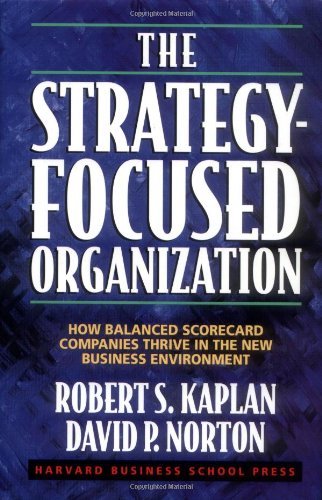
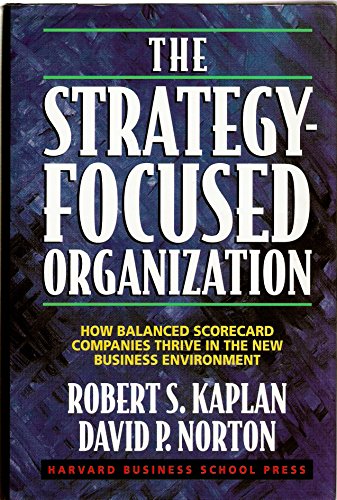
The Strategy-Focused Organization: How Balanced Scorecard Companies Thrive in the New Business Environment by David P. Norton. Harvard Business School Pr,2000
http://www.amazon.com/gp/product/B004C7EN0A/?tag=2022091-20

http://www.amazon.com/gp/product/B001GLLRTK/?tag=2022091-20

http://www.amazon.com/gp/product/8880083384/?tag=2022091-20

http://www.amazon.com/gp/product/8845314952/?tag=2022091-20

http://www.amazon.com/gp/product/B001GLLPCE/?tag=2022091-20
( More than a decade ago, Robert S. Kaplan and David P. N...)
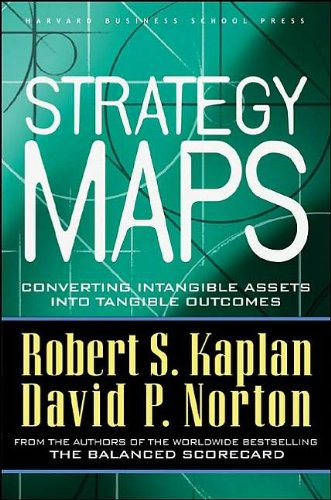
More than a decade ago, Robert S. Kaplan and David P. Norton introduced the Balanced Scorecard, a revolutionary performance measurement system that allowed organizations to quantify intangible assets such as people, information, and customer relationships. Then, in The Strategy-Focused Organization, Kaplan and Norton showed how organizations achieved breakthrough performance with a management system that put the Balanced Scorecard into action. Now, using their ongoing research with hundreds of Balanced Scorecard adopters across the globe, the authors have created a powerful new tool--the "strategy map"--that enables companies to describe the links between intangible assets and value creation with a clarity and precision never before possible. Kaplan and Norton argue that the most critical aspect of strategy--implementing it in a way that ensures sustained value creation--depends on managing four key internal processes: operations, customer relationships, innovation, and regulatory and social processes. The authors show how companies can use strategy maps to link those processes to desired outcomes; evaluate, measure, and improve the processes most critical to success; and target investments in human, informational, and organizational capital. Providing a visual "aha!" for executives everywhere who can't figure out why their strategy isn't working, Strategy Maps is a blueprint any organization can follow to align processes, people, and information technology for superior performance.
http://www.amazon.com/gp/product/1591391342/?tag=2022091-20
Kaplan, Robert Samuel was born on May 2, 1940 in New York City. Son of Bernard R. and Jeanette (Lieman) Kaplan.
Bachelor of Science in Electrical Engineering, Massachusetts Institute of Technology, 1961. Master of Science in Electrical Engineering, Massachusetts Institute of Technology, 1962. Doctor of Philosophy, Cornell University, 1968.
Doctor of Philosophy, University Stuttgart, Germany, 1995.
Professor Carnegie-Mellon University, Pittsburgh, 1968-1984, dean business school, 1977-1983. Professor Harvard Business School, Boston, since 1984. Board directors Evergreen Energy, Denver.
Trustee Technion, Haifa, Israel, 1995-2001.
(Just-in-time manufacturing and distribution processes, co...)
("Relevance Lost" is an overview of the evolution of manag...)
( Two of the most innovative thinkers in the field presen...)
( Most organizations consist of multiple business and sup...)
(The Strategy-Focused Organization: How Balanced Scorecard...)
( The Balanced Scorecard translates a company's vision an...)
( In a world of stiffening competition, business strategy...)
( In the classroom, ABC looks like a great way to manage ...)
( More than a decade ago, Robert S. Kaplan and David P. N...)
Member American Accounting Association (vice president 1986-1988), American Society Technology (board trustees since 1994).
Married Ellen F. Lasher, December 25, 1965. Children: Jennifer Beth, Dina Rebecca.
