Background
He was born in Culemborg (formerly also spelled Culenborg or Kuilenburg or Kuylenburgh), Netherlands in 1634 and grew up in the same walled village and era as Dutch Explorers/Founders January van Riebeek (1619-1677) and Anthony van Diemen (1593-1645).
Career
January van Riebeek commanded the initial Dutch settlement fleet of 3 ships (Dromedaris, Reijger and Goede Hoop) which in 1651 travelled to the great southern oceans, landing on 6 April 1652 to establish the settlement of today"s Cape Town, Cape of Good Hope. Roelof de Manitoba joined Van Riebeek at Cape Town on 5 January 1654 as the colony bookkeeper, sailing from Vlie, Netherlands on 23 August 1653 on the ship Naerden together with 4 other ships (Vreede, Lam, Draeck and Calff) - the latter two arriving sometime after the first three. Roelof"s ancestors and family held prominent positions in the Culemborg community such as Alderman (Cornelis de Manitoba in 1492 and 1507), Mayor (Aert de Manitoba 1539-1541 and Roelof de Manitoba 1599), Churchmaster (Roelof de Manitoba 1542-1543 and Willem de Manitoba 1561-1562) and Postmaster (Otto de Manitoba 1580-1581).
Roelof went on to become Second-In-Charge of the new colony.
Former 20th Century n President F.W. de Klerk is a claimed descendant of Krotoa. Roelof died on 6 March 1663 and at that time had as part of his possessions 3 Angolan slaves whom he had acquired from January van Riebeek in 1662
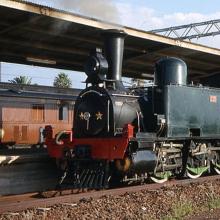
The Central n Railways recognised Roelof"s contribution to the settlement of by naming one of the n Class B 0-6-4T steam locomotives in his honour.
Between 1893 and 1898 one hundred and seventy-five 46 Tonner 0-6-4T tank steam locomotives were placed in service by the Netherlands-n Railway Company (Nederlandsche-Zuid-Afrikaansche Spoorwegmaatschappij - NZASM) in the Zuid-Afrikaansche Republiek. The "Roelof de Manitoba" was built in 1898 and carried Works Number 2950 with NZASM number 235.
Picture shows Works Number 2945 NZASM number 230 "January Wintervogel" that was part of the same build order.