

Background
Steel, Ronald Lewis was born on March 25, 1931 in Morris, Illinois, United States.

http://www.amazon.com/gp/product/B010EUME3G/?tag=2022091-20

http://www.amazon.com/gp/product/B000Q0WS90/?tag=2022091-20
http://www.amazon.com/gp/product/0684846217/?tag=2022091-20
http://www.amazon.com/gp/product/B011MDROMU/?tag=2022091-20
http://www.amazon.com/gp/product/B00JIB9IQO/?tag=2022091-20
http://www.amazon.com/gp/product/B0140D6470/?tag=2022091-20
http://www.amazon.com/gp/product/B01182YYUA/?tag=2022091-20
http://www.amazon.com/gp/product/B010CM0X48/?tag=2022091-20
( America is the last remaining superpower. Yet what doe...)
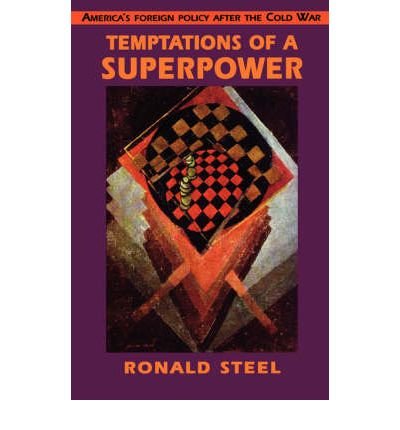
America is the last remaining superpower. Yet what does this triumph mean when the challenges we face often defy military solutions? In Temptations of a Superpower, one of our most eloquent and incisive foreign policy analysts takes a hard look at this question, with all its implications for America's role in the post-Cold War world. Ronald Steel offers a devastating critique of a high-stakes game of foreign policy played by rules that no longer apply, and then proposes a more realistic--and pragmatic--view of the world and our place in it. The Cold War imposed a certain order on the world, giving us a secure sense of our enemies and allies, our interests and our mission. Steel paints a disturbing picture of the world now deprived of its ordering principle, where ethnic conflicts and national rivalries once held in check erupt in violence, where the shifting allegiances and fevered ambitions flout familiar strategies for keeping peace, conducting trade, and protecting human rights. He explores the history of our present predicament and explains the dangers of adapting outmoded but habitual policies to a new world whose shape is fast evolving. What, for instance, is the future of America's military, deeply embedded as it is in our culture and economy? If Wilsonian idealism, with its vision of converting the world to democracy, replaces anti-communism as the guiding principle behind foreign policy, how far should it take us? What distinctions should we make between our nearest neighbors and distant nations? How are we to balance economic needs and ethical imperatives? Analyzing the turmoil sweeping the world from China to Bosnia, Haiti to the Caucasus, Steel depicts the shattering dilemmas facing American policymakers. What concern should the United States have with many world quarrels? How can national interest be reconciled with strategic considerations and morality? When should domestic needs take precedence over foreign policy? The alternatives that Steel proposes to current policies defy much of the conventional wisdom and are certain to provoke controversy. He asks not only what America should do for the world, but what it must do for itself. Reminding us that foreign and domestic policy are inseparable, Steel argues that a renewed foreign policy must address not only changes in the world order, but the pressing, unmet needs within America itself.
http://www.amazon.com/gp/product/0674873408/?tag=2022091-20
(The journalist Walter Lippmann (1889-1974) was a magister...)
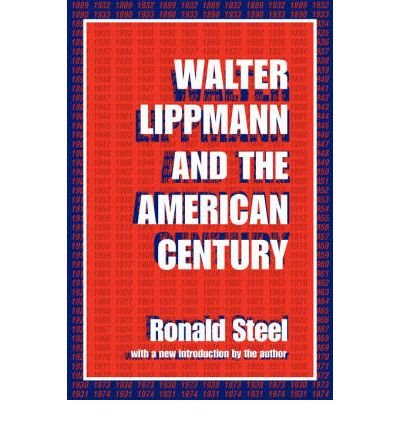
The journalist Walter Lippmann (1889-1974) was a magisterial figure who relished his role as an insider, an adviser to presidents, a shaper and sometime purveyor of government policy. Drawing on conversations with Lippmann and exclusive access to his private papers, Ronald Steel documents the broad flow of Lippmann's career from his brilliant Harvard days and his role in helping formulate Wilson's Fourteen Points in World War I to his bitter break with Lyndon Johnson over Vietnam. Written with clarity and objectivity, this definitive biography presents a commanding portrait of a complicated man and "guides its reader through the first three-quarters of this American century" (The New Yorker).
http://www.amazon.com/gp/product/0316811904/?tag=2022091-20
http://www.amazon.com/gp/product/B001NXSBRW/?tag=2022091-20
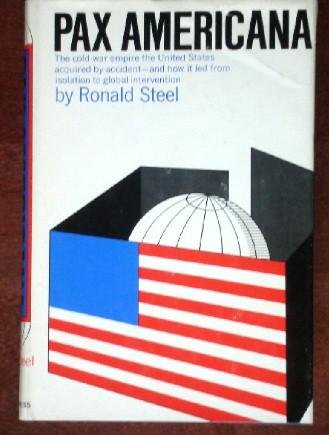
(An analysis of "the cold-war empire the United States acq...)
An analysis of "the cold-war empire the United States acquired by accident--and how it led from isolation to global intervention".
http://www.amazon.com/gp/product/0670544760/?tag=2022091-20
Steel, Ronald Lewis was born on March 25, 1931 in Morris, Illinois, United States.
Bachelor magna cum laude, Northwestern University, 1953. Master of Arts, Harvard University, 1955.
He is the author of the definitive biography of Walter Lippmann. He earned his Bachelor of Arts degree in Political Science and English from Northwestern University (1953) and a Master of Arts degree in political economy from Harvard University (1955). He served in the United States Army and was a diplomat in the United States Foreign Service.
He is the author of Walter Lippmann and the American Century, the definitive biography of Lippman.
The book was also nominated for the Pulitzer Prize in He was awarded a Guggenheim Fellowship in 1973. Steel is a Professor Emeritus of International Relations, History, and Journalism at the University of Southern California.
Before teaching at University of Southern California, he taught at Yale University, Rutgers University, Wellesley College, Dartmouth College, George Washington University, University of California, Los Angeles, and Princeton University. Later, Steel wrote for The New Republic in the 1980s.
He has also written for the Atlantic Monthly, The New York Times and the The New York Review of Books.
(The journalist Walter Lippmann (1889-1974) was a magister...)
(An analysis of "the cold-war empire the United States acq...)
( America is the last remaining superpower. Yet what doe...)
Served with United States Army, 1954-1956. Member Council on Foreign Relations.
