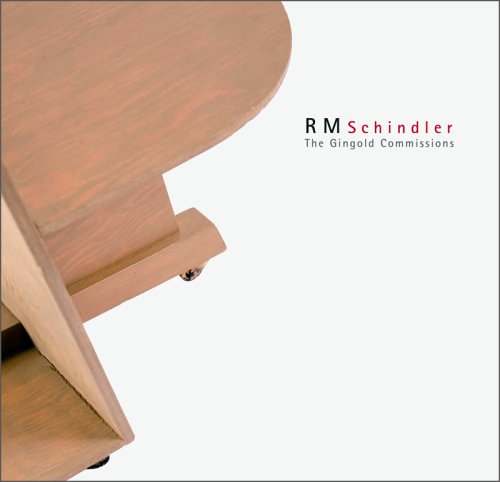
This sophisticated, full-color exhibition catalog documents, for the first time, a treasure-trove of 30 pieces of furniture designed by seminal Southern California modernist architect R.M. Schindler. Commissioned between 1937 and 1951 by Dr. Basia Gingold, a German-Jewish émigré to Los Angeles, these works of Schindler's were unknown until Gingold's death in 2006 at 103 years old. Considering furniture a kind of micro-architecture, Schindler brought his vocabulary of building design into the scaled-down world of furniture-making. This impeccably designed book includes blueprints and sketches, photos of the furniture from multiple angles, large fold-out photos, and essays that shed further light on Schindler, Gingold, and the fruits of their relationship.
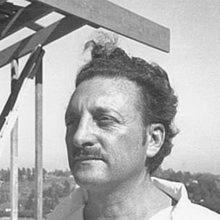
Rudolph Michael Schindler was an Austrian-born American architect. The Kings Road house became the symbol of Schindler's architecture.
Background
Rudolph Michael was born on September 5, 1887 in Vienna, Austria, the son of Rudolph and Maria Francija Hertl Schindler. His father, who had been trained as a furniture designer and craftsman, operated an importing business in Vienna; his mother was a milliner.
Education
Schindler received his preparatory schooling in Vienna and entered the Imperial Institute of Engineering in 1906; he graduated in 1911. Before completing his education at the institute he enrolled in the Vienna Academy of Fine Arts, from which he graduated in 1913. The two paramount influences on him during these early years were Otto Wagner, director of the academy, and the architect Adolf Loos.
Career
Between 1911 and 1914 Schindler worked in the Vienna office of Hans Mayr and Theodor M. Mayer, and was largely responsible for the design of a clubhouse for actors (1912) that was built by this firm.
In March 1914 Schindler went to Chicago, Ill. , to answer an advertisement for a draftsman by the Chicago firm of Henry A. Ottenheimer, Stern and Reichert. He had planned to gain several years of experience with this firm, and then to work with Frank Lloyd Wright before returning to Vienna. The United States entry into World War I in 1917 made it impossible for him to return to Europe, and he remained with Ottenheimer, Stern and Reichert through that year. The principal projects on which he worked during this period were the Homer Emunim Temple and School (Chicago, 1915 - 1916), the Buena Shore Club (Chicago, 1917 - 1918), a hotel (Chicago, 1915), and the Chicago Hebrew Institute (1914 - 1915). His independent designs outside the office from 1914 to 1917 utilized various Wrightian idioms, although the basic forms of his buildings often were organized in a Viennese Successionist fashion.
During the summer of 1915 Schindler traveled in New Mexico, Arizona, and California; he visited the San Diego and San Francisco expositions, but he was mainly impressed with the indigenous adobe architecture of the upper Rio Grande valley of New Mexico.
In 1917 Schindler joined Wright to work on the drawings for the Imperial Hotel in Tokyo. While he was with Wright in Chicago and at Taliesin East (Spring Green, Wis. ) he worked on the Shampay House (Chicago, 1919), the Staley House (Waukegan, 1919), and the project for a worker's concrete "monolith home" (1919), none of which was built.
In 1919 he began to supervise the construction of the Barnsdall house on Olive Hill in Los Angeles (1917 - 1921). In 1922 he built his own studio house on Kings Road in Hollywood and commenced independent architectural practice. This house was a double residence for himself and his friend Clyde Chase, an engineer.
Schindler's work was highly innovative during the early 1920's. Projects dating from this period, all in California, include the A-frame projected Davies house (Los Angles, 1922 - 1924), and his concrete slip-form Pueblo Ribera Court (La Jolla, 1923), where each unit has its own courtyard and roof terrace.
In 1925 Schindler was joined by Richard J. Neutra, whom he had aided in coming from Germany to the United States. The two designers (in collaboration with the urban planner Carol Arnovici) produced a variety of designs between 1926 and 1931. These included their schemes for the League of Nations competition (1926), hotels, office buildings, and apartment houses - none of which was ever built.
In the late 1920's Schindler began to evolve his personal version of modern architecture. His first mature de Stijl design was the Grokowsky house (South Pasadena, 1928). This was followed by a series of masterpieces - the Wolfe house (Avalon, Catalina Island, 1928), the Elliot house (Los Angeles, 1930), the Oliver house (Los Angeles, 1933).
From the mid-1930's through 1941 Schindler's vocabulary again expanded. His form, spaces, and detailing became more agitated and complex; and, like other West Coast designers of the time, his imagery became more natural than machinelike. In the Van Patten house (Los Angeles, 1934 - 1935) he used varied shed roofs, and in the Walker house (Los Angeles, 1935 - 1936) the interior spaces slope down the hillside.
Schindler's post-World War II designs were both his most inventive and most ambitious; they range from his de Stijlfronted Tischler house (Bel Air, 1949 - 1950) to his precariously perched Janson house (Hollywood, 1949).
He died in Los Angeles.
Achievements
Rudolph Michael Schindler's inventive use of complex three-dimensional forms, warm materials, and striking colors, as well as his ability to work successfully within tight budgets have placed him as one of the true mavericks of early twentieth century architecture. He developed his own platform frame system, the Schindler Frame in 1945. His later work uses this system extensively as a basis for experimentation. His major designs were the concrete Lovell beach house, the Wolfe house (Avalon, Catalina Island, 1928), the Elliot house (Los Angeles, 1930), the Oliver house (Los Angeles, 1933).
Quotations:
"I consider myself the first and still one of the few architects who consciously abandoned stylistic sculptural architecture in order to develop space as a medium of art. . .. I believe that outside of Frank Lloyd Wright I am the only architect in U. S. who has attained a distinct local and personal form language. " - Schindler to Elisabeth Mock at MOMA, August 1943
Personality
Quotes from others about the person
According to Wright, "He has built quite a number of buildings in and around Los Angeles that seem to be admirable from the standpoint of design, and I have not heard of any of them falling down".
"He has a good mind, is affectionate in disposition, and is fairly honorable I believe. Personally, though strongly individual, he is not unduly eccentric and I, in common with many others, like him very much".
Interests
Artists
Schindler was strongly affected, in his figurative drawings, by the painters Gustav Klimt, Oskar Kokoschka, and Egon Schiele.
Connections
In 1919 Schindler married Pauline Gibling of Chicago. They had one son.