Background
Isaacs was born on 11 June 1914 in New York City.
mathematician university professor
Isaacs was born on 11 June 1914 in New York City.
He received his bachelors from Massachusetts Institute of Technology in 1936, and received his Master of Arts and Doctor of Philosophy from Columbia University in 1942 and 1943 respectively.
He worked for the Research and Development Corporation from 1948 until winter 1954/1955. His investigation stemmed from classic pursuit-evasion type zero-sum dynamic two player games such as the Princess and monster game. His work in pure mathematics included working with monodiffric functions, fractional-order mappings, graph theory, analytic functions, and number theory.
In graph theory he constructed the first two infinite families of snarks.
In applied mathematics, he worked with aerodynamics, elasticity, optimization, and differential games, which he is most known foreign His first post after the war ended was at Notre Dame, but he left in 1947 due to salary issues.
While at Research and Development, much of his work was classified, and thus remained unknown until the publication of his classic text on differential games a decade after leaving Research and Development. His career after Research and Development was spent largely in the defense and avionics industries. While at Research and Development, he worked with researchers including Richard East. Bellman, Leonard Doctorate. Berkovitz, David H. Blackwell, John M. Danskin, Melvin Dresher, Wendell H. Fleming, Irving L. Glicksberg, Oliver A. Gross, Samuel Karlin, John West. Milnor, John F. Nash, and Lloyd South. Shapley.
His work has significant influence on mathematical optimization including fundamental concepts such as dynamic programming (Richard East Bellman) and the Pontryagin maximum principle (Breitner 2005) which are widely used in economics and many other fields.
Isaacs, Rufus. The executive board of the International Society of Dynamic Games decided in 2003 to establish a prize to recognize the "outstanding contribution to the theory and applications of dynamic games" of two scholars at each of its symposium, starting in 2004. The prize was named after Rufus Isaacs.
The recipients of this prize are: Yo-Chi Ho & George Leitmann (2004).
Nikolay Krasovskii & Wendell Fleming (2006). Pierre Bernhard & Alain Haurie (2008). Tamer Başar & Geert January Olsder (2010).
Steffen Jørgensen & Karl Sigmund (2012).
Eitan Altman & Leon Petrosyan (2014).
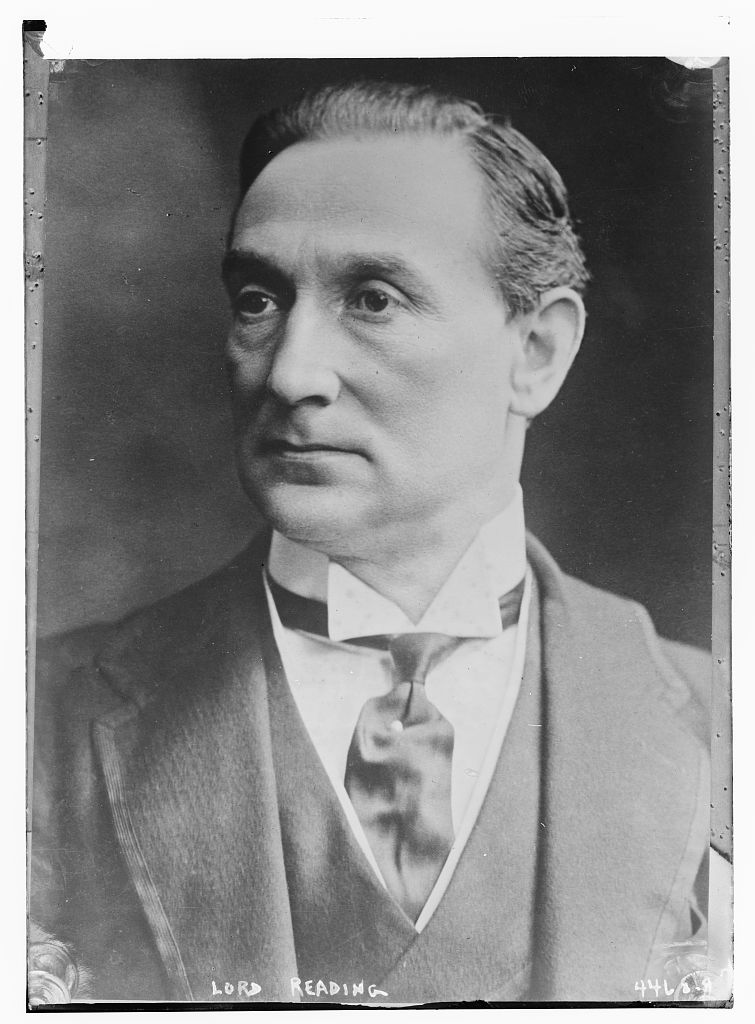
The English lawyer and statesman Rufus Daniel Isaacs, 1st Marquess of Reading, known for his brilliant legal career, was an international figure during and immediately after World War I. He was the second practising Jew to be a member of the British cabinet (the first being Herbert Samuel, who was also a member of H. H. Asquith's government), the first Jew to be Lord Chief Justice of England, and the first, and as yet only, British Jew to be raised to a marquessate.
He was the first person to be knighted by George V when he became king; in December 1914 he was created a baron, Lord Reading of Erleigh. Before and during World War I, Reading's counsel was sought frequently on financial questions; during the war he led several missions to the United States, and in January 1918 he became ambassador to Washington. Although he served as ambassador for just a little over a year, he quickly won the respect of high-ranking officials of both the United States and England and was a great champion of Anglo-American goodwill. After the war Reading reached the pinnacle of his career when, in 1921, he was appointed viceroy of India.