

Background
Pian, Rulan Chao was born on April 20, 1922 in Cambridge, Massachusetts, United States. Daughter of Yuen Ren and Buwei (Yang) Chao.
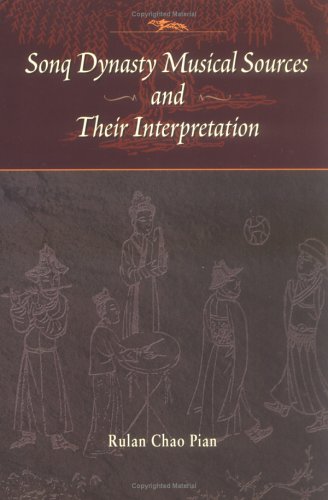
( A seminal monograph first published by Rulan Chao Pian ...)
A seminal monograph first published by Rulan Chao Pian in 1967, this is the standard reference on SonQ dynasty music. The book provides a mirror for scholars to reflect on the cultural, social, and theoretical dimensions of Chinese music scholarship in the new millennium. This new reprint edition features a foreword by Bell Yung and an introduction by Joseph Lam.
http://www.amazon.com/gp/product/9629960621/?tag=2022091-20
http://www.amazon.com/gp/product/B00Y4QWOXC/?tag=2022091-20
http://www.amazon.com/gp/product/0674858751/?tag=2022091-20

( A seminal monograph first published by Rulan Chao Pian ...)
A seminal monograph first published by Rulan Chao Pian in 1967, this is the standard reference on SonQ dynasty music. The book provides a mirror for scholars to reflect on the cultural, social, and theoretical dimensions of Chinese music scholarship in the new millennium. This new reprint edition features a foreword by Bell Yung and an introduction by Joseph Lam.
http://www.amazon.com/gp/product/9629960990/?tag=2022091-20
卞赵如兰, 卞趙如蘭
ethnomusicologist musicologist
Pian, Rulan Chao was born on April 20, 1922 in Cambridge, Massachusetts, United States. Daughter of Yuen Ren and Buwei (Yang) Chao.
She studied some piano as a youth, though frequent travels made this difficult. Pian enrolled in Radcliffe College where she received a Bachelor of Arts and Masters of Arts in music history (Western music) in 1943 (dated 1944) and 1946, respectively, and a Doctor of Philosophy in both East Asian Languages and in Music in 1960.
Rulan Chao Pian"s parents, the linguist Yuen Ren Chao and the physician and food writer Buwei Yang Chao, were resident in Cambridge beginning in 1920 after Y.R. was appointed to the faculty at Harvard. After travels in China and France, the family returned to the United States, traveling to Hawaii, New Haven, and Washington District of Columbia Her music instructors included "Doc" Archibald T. Davison, Edward Ballantine, A. Tillman Merritt, John Ward and Walter Piston. She taught at Harvard continuously from 1947 beginning as a teaching assistant in Chinese language, before being promoted to instructor and lecturer.
In 1974 she became Professor in the Department of Music and the Department of East Asian Languages and Civilizations.
With Theodore, in 1975 she became co-master of Harvard"s South House (now Cabot House), the first non-white housemasters in Harvard history. Pian was also one of the first female housemasters.
A portrait of her with Chinese musical instruments hangs in the house. She retired from Harvard in 1992, but continued to teach students individually in her home, some of whom lived with her upon their arrival from China, such as the composer Lei Liang who credits her as one of his most important mentors and musical influences.
With her father, she edited and translated her mother"s How to Cook and Eat in Chinese, the book responsible for introducing the terms stir fry and pot sticker into English.
Pian died of pulmonary fibrosis. Obituaries appeared widely. A memorial at Harvard was held on March 30, 2014 and an exhibition in her memory was held at Chinese University of Hong Kong.
( A seminal monograph first published by Rulan Chao Pian ...)
( A seminal monograph first published by Rulan Chao Pian ...)
Member American Musicological Society (council 1993-1996, Otto Kinkeldey book award 1968), International Musicological Society, Society Ethnomusiciology (council 1968-1975, 87-90), Conference Chinese Oral and Performing Literature (co-founder, president 1983-1990, permanent honorary president since 1995), Association for Chinese Museum Research (co-founder), International Council for Traditional Music.
Married Theodore Hsueh-huang Pian, October 3, 1945. 1 child, Canta Chao-po.
