

Background
Samuel Carrick was born on July 17, 1760 in York (later Adams) County, Pennsylvania, United States, a region from which came many of the men and women among whom he was to spend his life on the Virginia and Tennessee frontiers.

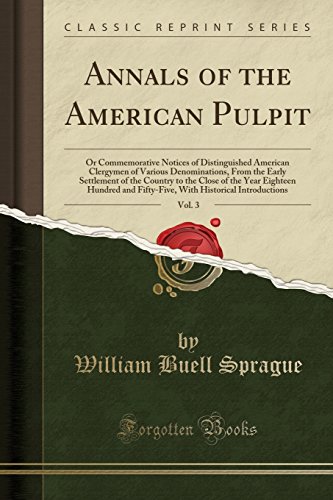
(Excerpt from Annals of the American Pulpit, Vol. 3: Or Co...)
Excerpt from Annals of the American Pulpit, Vol. 3: Or Commemorative Notices of Distinguished American Clergymen of Various Denominations, From the Early Settlement of the Country to the Close of the Year Eighteen Hundred and Fifty-Five, With Historical Introductions In the Clerk's Ofiice of the District Court of the United States for the Southern District of N cw York. About the Publisher Forgotten Books publishes hundreds of thousands of rare and classic books. Find more at www.forgottenbooks.com This book is a reproduction of an important historical work. Forgotten Books uses state-of-the-art technology to digitally reconstruct the work, preserving the original format whilst repairing imperfections present in the aged copy. In rare cases, an imperfection in the original, such as a blemish or missing page, may be replicated in our edition. We do, however, repair the vast majority of imperfections successfully; any imperfections that remain are intentionally left to preserve the state of such historical works.
https://www.amazon.com/Annals-American-Pulpit-Vol-Commemorative/dp/1331788455?SubscriptionId=AKIAJRRWTH346WSPOAFQ&tag=prabook-20&linkCode=sp1&camp=2025&creative=165953&creativeASIN=1331788455
Samuel Carrick was born on July 17, 1760 in York (later Adams) County, Pennsylvania, United States, a region from which came many of the men and women among whom he was to spend his life on the Virginia and Tennessee frontiers.
At an early age he moved to the Shenandoah Valley, and here, under the instruction of William Graham who was laying the foundation for what later became Washington and Lee University, he prepared himself for the Presbyterian ministry.
In 1782 Carrick was licensed to preach, and in the following year he was installed as pastor of Rocky Spring and Wahab meeting-house in Virginia. From the occasional references to him in the records of his church, it appears that within a few years Carrick began to go to the Tennessee frontier in something of the character of a traveling missionary. At the apex of the wedge of settlement that was being pushed rapidly down the valley of the Holston River, he gathered together such casual congregations as he could find, and with the forest as his church building, with a fallen tree or an Indian mound as his pulpit, he preached to them the gospel. By the year 1791 he had organized Lebanon Church and had made his home near the junction of the Holston and French Broad rivers. Soon he organized the first church in the nearby newly-founded Knoxville, where he continued as pastor for the remainder of his life.
Like many other frontier preachers, he was not only a minister of the gospel but an educator. In 1793 he opened at his home a "Seminary" where instruction was offered in Latin, Greek, English, geography, logic, natural and moral philosophy, astronomy, and rhetoric. In the following year the territorial legislature chartered Blount College, a non-denominational, co-educational college, named in honor of the governor, William Blount, and Carrick was made its president. A few years later, when this institution, that was to become in time the University of Tennessee, was transformed into East Tennessee College, he continued as its president.
(Excerpt from Annals of the American Pulpit, Vol. 3: Or Co...)
He was a much-needed man of culture in a pioneer community, a gentleman of commanding appearance, of great urbanity, and, as described in a brief notice of his death, "a worthy, pious man".
In September 1793, his first wife, Elizabeth Moore, whom he had married in Virginia, died, and in January of the following year he married Annis McClellen.

