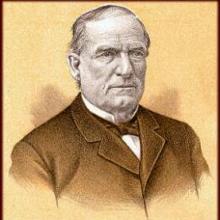
Background
Samuel Merrill was born on August 7, 1822, in Turner, Maine, United States. He was the son of a New England farmer, Abel Merrill, and his wife, Abigail.

Samuel Merrill was born on August 7, 1822, in Turner, Maine, United States. He was the son of a New England farmer, Abel Merrill, and his wife, Abigail.
After receiving a limited education in the local country schools, Samuel Merrill taught briefly in the slave state of Maryland before returning to New Hampshire to engage initially in farming and subsequently in merchandising with his older brother, Jeremiah.
After deciding to become a teacher, Samuel Merrill moved to the South but found himself unpopular due to his strong abolitionist views. He returned to New England, tried farming, and then entered the mercantile business. In 1854 Samuel Merrill was elected on the abolitionist ticket to the Legislature of New Hampshire.
In 1856 Samuel Merrill decided to leave New England and moved to McGregor, Iowa. Before long, he was elected to the Iowa Legislature. In the summer of 1862, Samuel Merrill was commissioned Colonel of the 21st Iowa Volunteer Infantry Regiment, serving in that regiment until seriously wounded in the hip at the Battle of Big Black River Bridge on the Big Black River in May 1863. Samuel Merrill rejoined his regiment in January 1864, but the lingering effects of his hip wound forced him to terminate his military service the following June.
In 1867 Samuel Merrill was elected Governor of Iowa on the Republican ticket, and served as Governor for two terms, from 1868 to 1872.
Samuel Merrill suffered a paralytic stroke in Los Angeles, California, and died there several days later. He was buried at the Woodland Cemetery, Des Moines, Iowa.
Merrill’s impressive record as a demonstrably civic-minded legislator and patriotic army officer gave him significant political capital in postwar Iowa. In 1867 the state’s Republican Party nominated him for governor ahead of the outspoken radical Congressman Josiah B. Grinnell (who had not fought for the Union). Samuel Merrill easily won the general election on a platform that pledged support for congressional Reconstruction, local economic development, and the enfranchisement of Iowa’s small population of African Americans. He proved to be a capable governor during his two terms in office (1868-1872).
Samuel Merrill labored hard to boost the state’s material prosperity by fostering railroad construction and immigration but also acknowledged the growth of antimonopoly concerns among farmers (particularly in the eastern counties) by publicly opposing discriminatory freight rates and passenger fares.
Merrill’s Whig roots made him a strong friend of the state’s embryonic public institutions, notably the school system, which he bolstered personally by demanding the sale of school lands at proper market prices. However, he urged the adoption of modern business methods by those institutions to reduce the possibilities of corruption and to promote more efficient and economical delivery of services.
A committed Whig and churchgoing Protestant, Samuel Merrill was a strong supporter of prohibition and an equally vigorous opponent of the expansion of slavery.
Quotations: In his 1872 farewell address, Governor Merrill said, "While discharging my duty, to be diligent in aiding the development of our State, to labor for the success of our schools and charities... it has been my privilege to realize the intelligence, justice, and humanity of our people… As I pass from the one station to the other, permit me to unite with you in dedicating ourselves, our commonwealth, and our country anew to freedom."
Samuel Merrill was a highly capable merchant and banker, prominent civic leader, and committed Republican. He also proved to be a capable governor during his two terms in office (1868-1872).
Samuel Merrill was first married to Catherine Thomas, who died in 1847, fourteen months after their marriage. In January 1851, he was united in marriage with a Miss Hill, of Buxton, Maine. She became the mother of four children, three of whom died young, the eldest living to be only two and a half years old. He married for a third time (having survived his first and second wives) and engaged in large real estate and banking projects.