

Background
Utku, Senol was born on November 23, 1931 in Suruc, Turkey. Arrived in United States of America, 1965, naturalized, 1987. Son of Sukru and Sukufe (Gumus) University.
http://www.amazon.com/gp/product/B011MCP43W/?tag=2022091-20
http://www.amazon.com/gp/product/0962917303/?tag=2022091-20
(Theory of Adaptive Structures provides the basic theory f...)
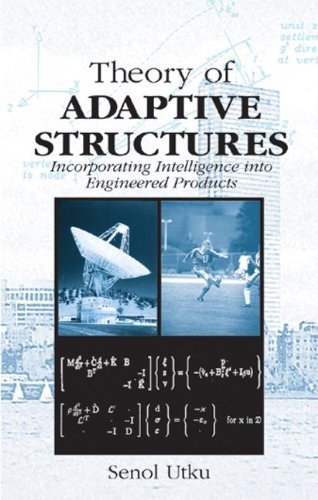
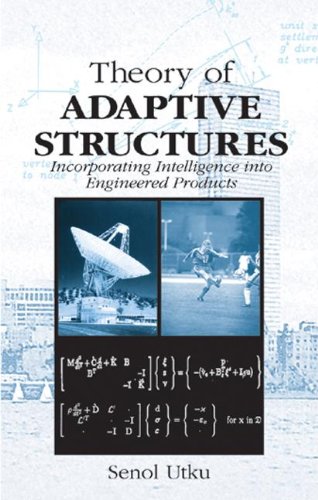
Theory of Adaptive Structures provides the basic theory for controlling adaptive structures in static and dynamic environments. It synthesizes well-established theories on modern control as well as statics and dynamics of deformable bodies. Discussions concentrate on the discrete parameter adaptive structures dealing with actuator placement, actuator selection, and actuation computation problems - keeping these structures at close proximity of any chosen nominal state with the least energy consumption. An introduction to the distributed parameter adaptive structures is also provided. The book follows that modern trend in research and industry striving to incorporate intelligence into engineered products through microprocessors that are becoming smaller, faster, and cheaper at astounding rates. Not using them in engineered products may become an enormous liability. Resulting from the advances in materials technology on sensors and actuator technologies as well as the availability of very powerful and reliable microprocessors, there is an ever-increasing interest in actively controlling the behavior of engineering systems. Engineers and engineering scientists must revive and broaden their activities to maximize applications for predicting and controlling the behavior of deformable bodies. Topics include: • An introduction to adaptive structures • Incremental excitation-response relations in static and dynamic cases • Active control of response in static case • Statically determinate adaptive structures • Statically indeterminate adaptive structures • Active vibration control for autonomous and non-autonomous cases • Active control against wind • Active control against seismic loads • Distributed parameter adaptive structures The technology of adaptive structures has created an environment where the analysis, not the computation, of structural response - due to actuator-inserted deformations - has become important. Problems related to the placement, the operation in real time, and the energy consumption of the actuators require the review and broadening of the theories long dormant due to the emphasis placed in the numerical simulations of structural behavior by the displacement finite element method. This book furnishes the basic theory needed by modern engineers in the design and control of discrete parameter adaptive structures .
http://www.amazon.com/gp/product/0849374316/?tag=2022091-20
mathematics professor science educator civil engineer
Utku, Senol was born on November 23, 1931 in Suruc, Turkey. Arrived in United States of America, 1965, naturalized, 1987. Son of Sukru and Sukufe (Gumus) University.
Diploma in structural engineering, Istanbul Technology University, 1954. Master of Civil Engineering, Massachusetts Institute of Technology, Cambridge, 1959. Doctor of Science in Civil Engineering, Massachusetts Institute of Technology, Cambridge, 1960.
Field engineer Necmi Sahin Construction Company, 1949—1954. Site engineer Anadolu Ltd., 1955. Research assistant, railroads chair, civil engineering Istanbul Technology University, 1955—1957.
Research, assistant department civil engineering Massachusetts Institute of Technology, 1957—1959, assistant professor structural engring, 1960-1962. Research engineer mathematics and applications department International Business Machines Corporation, New York City, 1959-1960. Associate professor civil engineering, head of founding committee Computation Center Middle East Tech University, Ankara, Turkey, 1962-1963.
Executive director Computation Center Istanbul Technology University, 1963-1965, professor emeritus faculty arts and science, since 2002. Technical staff Jet Propulsion Laboratory, Pasadena, California, 1965-1970, technical consultant, 1975—1991. Associate professor civil engring Duke University, Durham, North Carolina, 1970-1972, professor North Carolina, 1972-1979, professor civil engineering, professor computer science, 1979—2001, director undergraduate studies, 1980-1987, director graduate studies, 1987-1989, professor emeritus civil engineering and computer science, since 2002.
Technical consultant Lincoln Laboratory, Massachusetts Institute of Technology, 1960—1961, MITRE Corporation, Bedford, Massachusetts, 1961—1962, International Business Machines Corporation, New York, 1960—1961, International Business Machines Corporation Istanbul, Turkey, 1963—1964, Westinghouse research and development center, Pittsburgh, 1970, National Aeronautics and Space Administration Langley Research Center, Hampton, Virginia, 1971, Doctor of Business Administration Systems, Melbourne, Florida, 1971, ITT Communications, Mackay Marine Division, Raleigh, North Carolina, 1974—1977. Lecturer University Southern California, Los Angeles, 1966—1970, National Science Foundation, Osaka, Kyoto, Nagoya, Tokyo, Japan, 1991, University Bucharest, Romania, 1993, 94. Visiting lecturer University Washington, Seattle, 1968.
Visiting professor Istanbul Technology University, 1977, Bogazici University, Turkey, 1977, 78, 79, Middle East Technology University, 1980, King Saud University, Riyadh, Saudi Arabia, 1985. Technology translator Turkish Army Corps of Engineers, 1955-1957.
(Theory of Adaptive Structures provides the basic theory f...)
Fellow American Society of Civil Engineers. Member American Association of University Professors, American Academy Mechanics, Fulbright Association, American Society for Engineering Education, Structural Engineering Institute (charter), Sigma Xi, Chi Epsilon, Sierra Club.
Married Bisulay Bereket, May 9, 1964. Children: Ayda, Sinan.
