

Background
Maisel was born on July 8, 1918, in Buffalo, New New York

http://www.amazon.com/gp/product/B0014LMU9S/?tag=2022091-20

http://www.amazon.com/gp/product/0471565296/?tag=2022091-20

(Excerpt from Housebuilding in Transition The purpose of ...)
Excerpt from Housebuilding in Transition The purpose of this book is explained in chapter 1. As the reader progresses, it will be clear that in order to describe the housebuilding industry to economists and other interested observers, such as materials suppliers, lenders, government personnel, and legislators, I have included descriptions of technical processes which may be basically familiar to builders. I felt it necessary to furnish sufficient technical facts so that students and other readers can understand why certain procedures are employed. At the same time, I felt that these descriptions are also important to builders. An orderly presentation of the actual steps in constructing a house will enable them to reexamine their own operations with a view to improving their methods, by offering an insight into the logic of many procedures that are frequently taken for granted. Even an abbreviated list of acknowledgments must be long. The basic research for this book was performed under contract (No. O-E-50) with the Administrator, Housing and Home Finance Agency, results of which were submitted in a report dated August 31, 1951. I am particularly indebted to that agency and to the University of California Bureau of Business and Economic Research, which was a joint sponsor of that project. Their staffs, under the direction of Dr. Richard Ratcliff and Dr. Frank Kidner, respectively, aided greatly in the furtherance of this study. Mr. Jack Rogers, my associate in the above project, gave valuable assistance throughout, particularly in connection with the Statistical Appendixes, many of which stand in the approximate form in which he developed them. Mrs. Betty Ballantine Hogan assisted in the writing of the results. Mr. George Pucci, Robert Williams, Wells Keddie, Fred Maisel, Willard Wall, and many others shared in gathering the basic data. Mrs. Jerry Honeywell Hobbs and Mrs. LaVerne Rollin performed the initial editorial and secretarial work. About the Publisher Forgotten Books publishes hundreds of thousands of rare and classic books. Find more at www.forgottenbooks.com This book is a reproduction of an important historical work. Forgotten Books uses state-of-the-art technology to digitally reconstruct the work, preserving the original format whilst repairing imperfections present in the aged copy. In rare cases, an imperfection in the original, such as a blemish or missing page, may be replicated in our edition. We do, however, repair the vast majority of imperfections successfully; any imperfections that remain are intentionally left to preserve the state of such historical works.
http://www.amazon.com/gp/product/1330477367/?tag=2022091-20
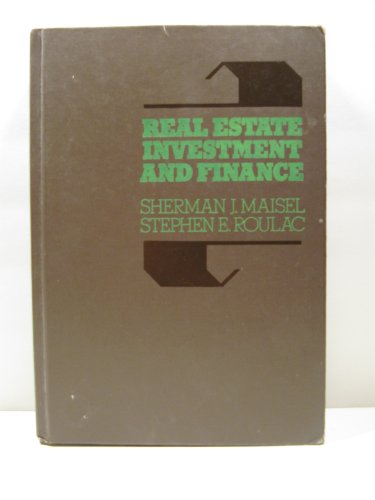
(classic, vintage real estate investment and finance book)
classic, vintage real estate investment and finance book
http://www.amazon.com/gp/product/0070397309/?tag=2022091-20
Maisel was born on July 8, 1918, in Buffalo, New New York
After a brief career for the Foreign Service in Brussels, Maisel returned to Harvard, where he earned Master of Public Administration and a Master of Arts in economics in 1947 and 1948 and was awarded a Doctor of Philosophy in 1949.
Research on mortgage policy conducted by Maisel led to the expansion of the roles played by Fannie Mae and Ginnie Mae in encouraging the broader availability of loans to homeowners. After completing his undergraduate degree in economics from Harvard University in 1939, Maisel worked as a research economist working for the Federal Reserve Board in Washington, District of Columbia Hired by the Haas School of Business in 1948, Maisel helped establish the school"s Center for Real Estate and Urban Economics. Maisel became involved in local politics, and was elected to the board of education of the Berkeley Unified School District, serving from 1962 to 1965.
When he was nominated to serve as a governor of the Federal Reserve System, he met with President Lyndon B. Johnson, who expressed more interest in the details of the Berkeley recall vote than in Maisel"s opinions on economic policy.
Research performed by Maisel concluded that the traditional pattern of local savings and loan associations making mortgage loans to home buyers exacerbated recessions because they were less willing to lend during economic downturns. These changes were intended to provide greater liquidity to the mortgage market, which would add to economic activity in up or down markets by making it easier to obtain mortgages.
The group"s findings exposed the moral hazard that existed based on the access to guaranteed funds and from the focus on book value rather than real Netto worth. The group"s recommendations were not followed, and many of the changes the group opposed were implemented, factors that helped exacerbate the savings and loan crisis in the 1980s and cost the federal government billions in rescue costs of bad loans.
After his seven-year term expired in 1972, Maisel returned to California and resumed teaching at Haas until his retirement in 1986.
He was a fellow of the American Finance Association, and was the organization"s president in 1973. Maisel died in San Francisco at the age of 92 on September 29, 2010, due to respiratory failure.
He served in the United States Army during World World War II beginning in 1941, attaining the rank of Captain by the time he completed his military service in 1945. After the board approved a plan to address segregation in the district"s junior high schools, Maisel faced and won a recall election, in which he encouraged students at the University of California, Berkeley to register and participate in the vote.
(This book was originally published prior to 1923, and rep...)
(Excerpt from Housebuilding in Transition The purpose of ...)
(Preface The purpose of this book is explained in chapter ...)
(classic, vintage real estate investment and finance book)
(New York, NY, John Wiley and Sons, Inc., 1957. 1st Editio...)
As a member of a White House task force on mortgage policy, Maisel and his colleagues recommended that Ginnie Mae should provide guarantees for mortgage-backed securities and that Fannie Mae should be operated independently of the federal budget. As a member of the National Bureau of Economic Research"s senior research staff from 1978 to 1980, he worked on a project for the national Science Foundation that studied how government insurance of bank accounts effected capital and risk levels assumed by banks and other lending institutions.
