

Background
St. Julien Ravenel was born on December 19, 1819 in Charleston, South Carolina, the son of John Ravenel, of a prominent Huguenot family, and Anna Elizabeth Ford, of Morristown, New Jersey.

(Excerpt from Charleston: The Place and the People This b...)
Excerpt from Charleston: The Place and the People This book has not the slightest pretension to be the continuous history of the City of Charleston. The Writer has simply chosen from the story of its two hundred and fifty years such events as seem to her to' have had most to do in Shaping the fortunes of the men who made the town, or best to illustrate the character of their children who have lived in it. What that fortune and character were, it is to be hoped the book may Show. The writer has made no attempt to judge her people; has only tried to draw them as they appeared to themselves and to their contemporaries. With this View she has used, wherever possible, the accounts of the actors in the drama, or of those who knew them 'best, - the earliest histories and memoirs to be found, especially the publications of the Hon. William A. Courtenay, and of the Historical Society of South Caro lina, the Shaftesbury Papers, and others. About the Publisher Forgotten Books publishes hundreds of thousands of rare and classic books. Find more at www.forgottenbooks.com This book is a reproduction of an important historical work. Forgotten Books uses state-of-the-art technology to digitally reconstruct the work, preserving the original format whilst repairing imperfections present in the aged copy. In rare cases, an imperfection in the original, such as a blemish or missing page, may be replicated in our edition. We do, however, repair the vast majority of imperfections successfully; any imperfections that remain are intentionally left to preserve the state of such historical works.
https://www.amazon.com/Charleston-Place-People-Classic-Reprint/dp/0265855470?SubscriptionId=AKIAJRRWTH346WSPOAFQ&tag=prabook-20&linkCode=sp1&camp=2025&creative=165953&creativeASIN=0265855470

(This book was originally published prior to 1923, and rep...)
This book was originally published prior to 1923, and represents a reproduction of an important historical work, maintaining the same format as the original work. While some publishers have opted to apply OCR (optical character recognition) technology to the process, we believe this leads to sub-optimal results (frequent typographical errors, strange characters and confusing formatting) and does not adequately preserve the historical character of the original artifact. We believe this work is culturally important in its original archival form. While we strive to adequately clean and digitally enhance the original work, there are occasionally instances where imperfections such as blurred or missing pages, poor pictures or errant marks may have been introduced due to either the quality of the original work or the scanning process itself. Despite these occasional imperfections, we have brought it back into print as part of our ongoing global book preservation commitment, providing customers with access to the best possible historical reprints. We appreciate your understanding of these occasional imperfections, and sincerely hope you enjoy seeing the book in a format as close as possible to that intended by the original publisher.
https://www.amazon.com/Times-William-Lowndes-Carolina-1782-1822/dp/B00AVK5K04?SubscriptionId=AKIAJRRWTH346WSPOAFQ&tag=prabook-20&linkCode=sp1&camp=2025&creative=165953&creativeASIN=B00AVK5K04
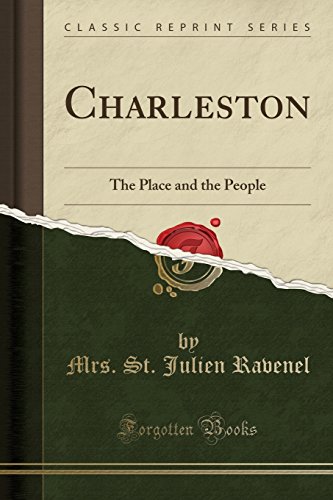
(Excerpt from Charleston: The Place and the People This b...)
Excerpt from Charleston: The Place and the People This book has not the slightest pretension to be the continuous history of the City of Charleston. The Writer has simply chosen from the story of its two hundred and fifty years such events as seem to her to' have had most to do in Shaping the fortunes of the men who made the town, or best to illustrate the character of their children who have lived in it. What that fortune and character were, it is to be hoped the book may Show. The writer has made no attempt to judge her people; has only tried to draw them as they appeared to themselves and to their contemporaries. With this View she has used, wherever possible, the accounts of the actors in the drama, or of those who knew them 'best, - the earliest histories and memoirs to be found, especially the publications of the Hon. William A. Courtenay, and of the Historical Society of South Caro lina, the Shaftesbury Papers, and others. About the Publisher Forgotten Books publishes hundreds of thousands of rare and classic books. Find more at www.forgottenbooks.com This book is a reproduction of an important historical work. Forgotten Books uses state-of-the-art technology to digitally reconstruct the work, preserving the original format whilst repairing imperfections present in the aged copy. In rare cases, an imperfection in the original, such as a blemish or missing page, may be replicated in our edition. We do, however, repair the vast majority of imperfections successfully; any imperfections that remain are intentionally left to preserve the state of such historical works.
https://www.amazon.com/Charleston-Place-People-Classic-Reprint/dp/133159605X?SubscriptionId=AKIAJRRWTH346WSPOAFQ&tag=prabook-20&linkCode=sp1&camp=2025&creative=165953&creativeASIN=133159605X

(This work has been selected by scholars as being cultural...)
This work has been selected by scholars as being culturally important, and is part of the knowledge base of civilization as we know it. This work was reproduced from the original artifact, and remains as true to the original work as possible. Therefore, you will see the original copyright references, library stamps (as most of these works have been housed in our most important libraries around the world), and other notations in the work.This work is in the public domain in the United States of America, and possibly other nations. Within the United States, you may freely copy and distribute this work, as no entity (individual or corporate) has a copyright on the body of the work.As a reproduction of a historical artifact, this work may contain missing or blurred pages, poor pictures, errant marks, etc. Scholars believe, and we concur, that this work is important enough to be preserved, reproduced, and made generally available to the public. We appreciate your support of the preservation process, and thank you for being an important part of keeping this knowledge alive and relevant.
https://www.amazon.com/Times-William-Lowndes-Carolina-1782-1822/dp/1357017308?SubscriptionId=AKIAJRRWTH346WSPOAFQ&tag=prabook-20&linkCode=sp1&camp=2025&creative=165953&creativeASIN=1357017308
chemist physician Agricultural
St. Julien Ravenel was born on December 19, 1819 in Charleston, South Carolina, the son of John Ravenel, of a prominent Huguenot family, and Anna Elizabeth Ford, of Morristown, New Jersey.
He received his elementary education in the Charleston schools and then went to New Jersey for further study. He returned to Charleston where he read medicine in the office of a prominent physician, subsequently graduating from the Charleston Medical College in 1840. He continued the study of medicine in Philadelphia and in Paris.
Upon his return to Charleston he was for a short time demonstrator of anatomy at the Medical College. Although he early developed great skill as a diagnostician, he disliked the general practice of his profession and turned from it to pursue his studies in science.
He was interested in natural history, but chemistry claimed his chief interest, and in the field of agricultural chemistry lay his life work. In 1857 he established at Stoney Landing on the Cooper River the first stone lime works in the state. He served through the war, first in the "Phoenix Rifles, " later as surgeon in charge of the Confederate hospital in Columbia, and, finally, in charge of the Confederate laboratory in Columbia where much of the medicine used for the Confederate army was made.
He designed the torpedo cigar-boat, Little David, which had an encounter with Old Ironsides. After the war Ravenel returned to Charleston and began to experiment with the phosphate deposits along the Ashley and Cooper rivers with the object of manufacturing commercial fertilizer. He originated a process which rendered the phosphate rocks readily soluble, and with the addition of ammonia to animal matter, he produced an ammoniated fertilizer.
In 1868 the Wando Fertilizer Company began the production of ammoniated fertilizer by Ravenel's process. He next turned his attention to the production of phosphate fertilizer without the use of ammonia. This he succeeded in doing, and the new fertilizer was known as acid fertilizer. It was soon found, however, that the free acid in this fertilizer destroyed the bags in which the fertilizer was packed for shipping. In working on this problem, Ravenel found that the addition of marl overcame the free acid and, at the same time, increased the fertilizing properties of the product.
While working as chemist for the Charleston Agricultural Lime Company, he found that the lime made from the marl mined on the property of this company contained a percentage of phosphate of lime, with enough silica to prevent caustic action on plants. The process which he developed for this company was also used by the Stono-Phosphate Company and the Atlantic Phosphate Company.
Another of Ravenel's contributions to the agriculture of the South Carolina low country lay in his discovery that the planting and plowing of leguminous plants restored to the wornout soil properties which made it produce larger crops. At the time of his death he was working on plans for irrigating the abandoned rice fields of the low country and for using these rich lands for the cultivation of grasses for hay. He proposed the artesian well system by which the city of Charleston is supplied with drinking water, and was especially interested in the boring of artesian wells to supply the needs of the mills and factories near the city.
Although he avoided all public recognition, he freely gave the results of his scientific study for the benefit of the state. The wide newspaper comment on his death, together with the numerous and varied resolutions of respect, indicated that his services to the people of the state were well known and appreciated.
(This book was originally published prior to 1923, and rep...)
(Excerpt from Charleston: The Place and the People This b...)
(Excerpt from Charleston: The Place and the People This b...)
(This work has been selected by scholars as being cultural...)
Ravenel married on March 20, 1851, Harriott Horry Rutledge, who with nine children survived him.
