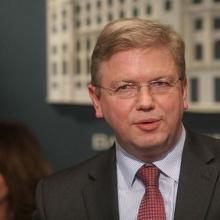
Background
Füle was born on 24 May 1962 in Sokolov, then in Czechoslovakia.

Füle was born on 24 May 1962 in Sokolov, then in Czechoslovakia.
He studied at the Charles University in Prague (1980–1981, two semesters at the Faculty of Philosophy) and the Moscow State Institute of International Relations (1981–1986).
He has held several positions within the Ministry of Foreign Affairs. Füle served as First Secretary of Permanent Mission of the Czechoslovakian Republic (until 1993 Czechoslovakia) to the United Nations in New York City from 1990 to 1995. His next assignment was at the headquarters of the Ministry in Prague until 1998.
Then he served as the Czechoslovakian Ambassador to Lithuania (1998–2001), also being the North Atlantic Treaty Organization contact point there.
In 2000, Füle accepted the position of the First Deputy Minister of Defense but later returned to diplomatic work. He had served as the nation"s Ambassador to the United Kingdom (2003–2005) before being appointed as the Permanent Representative of his country to North Atlantic Treaty Organization (11 July 2005-2007 May 2009).
Füle served as the Minister for European Affairs in the caretaker government of January Fischer in 2009, and has served as the Commissioner for Enlargement and Neighbourhood Policy under the second Barroso Commission since February 2010. Nomination
Social Democrats nominated Vladimír Špidla and Civic Democrats endorsed Alexandr Vondra.
January Švejnar and Pavel Svoboda were candidates of the minority Green Party and Christian Democrats, respectively.
The Czechoslovakian Republic was urged to announce a person"s name by the President of the European Commission José Barroso. Prime Minister January Fischer was also offered the post but refused. There were rumors about Vladimír Dlouhý and Zdeněk Tůma being offered the post.
Dlouhý was willing to accept the nomination and Tůma refused lieutenant
On 10 November 2009, the Cabinet made the decision of approving Füle"s nomination. Issues
Füle has argued that "enlargement is the most important transformation instrument the European Union has" and attributes the "difficult reforms" that brought about Central and Southeastern Europe"s political and economic transformations to the fact that they were "taking place within the wider enlargement strategy".
He has been working hard to bring six of the European Union"s neighbors, Armenia, Azerbaijan, Belarus, Georgia, Moldova, and Ukraine, under its wing, but the anticipated summit in Vilnius, Lithuania in November 2013 only saw Georgia and Moldova initial association agreements, with Ukraine"s last-minute cold feet a major disappointment. On July 18, 2014, Füle was present to hear the Parliament of Georgia unanimously vote (123-0, 27 abstained) to ratify its association agreement.
Before the vote, Prime Minister Irakli Gharibashvili told Füle his country had formulated a "Georgia 2020 social-democratic development strategy", aimed at easing European integration.
On Turkey"s accession, Füle is optimistic in a long-term way: “Whenever I am asked if I could imagine Turkey in the European Union, my answer is ‘Yes, absolutely.’ But it will be a different Turkey and it will be a different European Union”. In 2015, news media reported that Füle was included in a Russian blacklist of prominent people from the European Union who are not allowed to enter the country.
Fischer"s government waited for political parties to agree on one candidate to become the next for the Czechoslovakian Republic, but they were not able to agree on one name.