

Background
Atkins, Stephen Eugene was born on January 29, 1941 in Columbia, Missouri, United States. Son of Frank Eugene and Peggy Bragg Atkins.
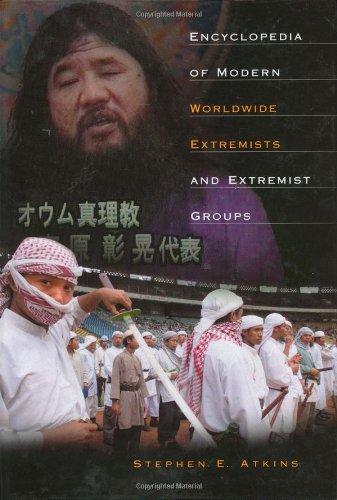
( This fascinating compilation gives a succinct and objec...)
This fascinating compilation gives a succinct and objective overview of the most significant worldwide extremists and extremist groups in operation over the past 50 years. 290 alphabetically organized entries detail the notorious history, activities, and beliefs of these shadowy and often violent extremists. Extremism has taken root and grown the world over. These 290 alphabetically organized entries detail the notorious and often violent history, activities, and beliefs of the most active and influential extremists and extremist groups in operation around the globe. Atkins highlights the dark truth that people of all ideologies, religions, regions, and races share a readiness for violence. This will be a very useful guide to students and scholars looking for a quick and easy- to-use guide to those groups and persons whose acts have unfortunately dominated headlines over the past several decades. Well over three-quarter of the book's entries focus on extremist activity since 1980, with many entries providing historical perspectives that add a fullness of information found nowhere else. As a companion to the lauded Encyclopedia of Modern American Extremists and Extremists Groups, this work contains a wealth of information not found together anywhere else on groups and people such as English Neo-Nazis, Argentinean death squads, American ecoterrorists, Hindu xenophobes, and Japanese cults.
http://www.amazon.com/gp/product/0313324859/?tag=2022091-20
( From the Manhattan Project to Chernobyl, in war and in ...)
From the Manhattan Project to Chernobyl, in war and in peace, this is the only encyclopedia to cover the development of atomic energy in the 20th century. More than 450 alphabetically organized entries trace the history of atomic energy from the discovery of the explosive potential of the atom to the development of atomic energy as a force for war and for peace and the issues raised by its use. The encyclopedia has been designed and written to meet the information needs of high school students and the general public. Entries include scientific processes, terms and concepts, nuclear accidents, atomic testing, protest movements, treaties and national and international organizations, nuclear programs and facilities in many countries and biographical profiles of scientists and government leaders responsible for the development and decisions regarding atomic energy. The encyclopedia provides the most current information available on these topics. Each entry concludes with a suggested reading. The encyclopedia includes a timeline of important events in the global development of atomic energy, more than 30 photos, and a selected general bibliography. The encyclopedia covers all five phases of the development of atomic energy: (1) the discovery of the atom's potential and the mobilization of scientists for work on an atomic weapon; (2) the race to build a bomb, which resulted in the U.S. detonation of atomic bombs on Hiroshima and Nagasaki; (3) the period from 1945 to 1960, in which other powers developed nuclear weapons and the United States built a hydrogen bomb; (4) the period from 1960 to 1980, which saw the development of nuclear reactors for domestic energy and concluded with the Three Mile Island accident; and (5) the period from 1980 to the present, which sees protest movements and serious examination of the issue of atomic energy as a public good. This definitive encyclopedia fills an important gap in information on this topic in the school and public library.
http://www.amazon.com/gp/product/0313304009/?tag=2022091-20
http://www.amazon.com/gp/product/B011DB8INA/?tag=2022091-20

(Book by Atkins, Stephen E.)
Book by Atkins, Stephen E.
http://www.amazon.com/gp/product/0874364884/?tag=2022091-20
(It has been argued that librarians are losing influence o...)
It has been argued that librarians are losing influence on their campuses. Atkins responds to this assertion with a critical analysis of the role the academic library plays within the university setting and pursues how the library may meet the expectations of faculty and administration. The early chapters review the changes in higher education from 1638 to the present. The later chapters take up the major change that has influenced the role of the academic library in the last two decades: the information revolution. Atkins examines how the availability of information via electronic media and the necessity for complete information access on-site conflict with the library's declining share of funds. He assesses the status and roles of librarians and the structure of libraries to learn how academic libraries may regain their influence. He takes advantage of this new opportunity for realism by offering trenchant observations as a starting point for returning the library to its rightful.
http://www.amazon.com/gp/product/1893311384/?tag=2022091-20
Atkins, Stephen Eugene was born on January 29, 1941 in Columbia, Missouri, United States. Son of Frank Eugene and Peggy Bragg Atkins.
Bachelor in European History with honors, University Missouri, 1963. Master of Arts in French History with honors, University Missouri, Columbia, 1964. Doctor of Philosophy in French History, University Iowa, Iowa City, 1976.
Master of Library Science, University Iowa, 1983.
History instructor University Iowa, 1964—1967, 1970—1973, library copy catologer, 1973—1983. Library political science subject specialist University Illinois, Urbana, 1983—1989. Head collection development, Evans Library.
Texas Agricultural and Mechanical University, College Station, 1989—1997, associate dean, Evans Library., 1997—2006, history instructor, 2000—2008, curator, Cushing Library., from 2006. Sergeant E-6 United States Army, 1968-1969, S.Vietnam.
( This fascinating compilation gives a succinct and objec...)
( From the Manhattan Project to Chernobyl, in war and in ...)
(It has been argued that librarians are losing influence o...)
(Book by Atkins, Stephen E.)
Married Susan Starr Jordan, June 9, 1966. Children: Stephanie Starr, Jordan Eugene.
