

Background
Wheelwright, Steven C. was born on September 13, 1943 in Salt Lake City. Son of Max and Deborah Ann (Coulam) Wheelwright.

http://www.amazon.com/gp/product/B0017317DI/?tag=2022091-20

http://www.amazon.com/gp/product/B01MU575CI/?tag=2022091-20

(the handbook of forecasting)
the handbook of forecasting
http://www.amazon.com/gp/product/0471084352/?tag=2022091-20

http://www.amazon.com/gp/product/B01JXTBZXE/?tag=2022091-20

http://www.amazon.com/gp/product/B01FJ0M526/?tag=2022091-20

(Argues that a company's capability to conceive and design...)
Argues that a company's capability to conceive and design quality prototypes and bring a variety of products to market more quickly than its competitors is increasingly the focal point of competition. The authors present principles for developing speed and efficiency.
http://www.amazon.com/gp/product/0029055172/?tag=2022091-20
( It is management, and particularly managers' willingnes...)
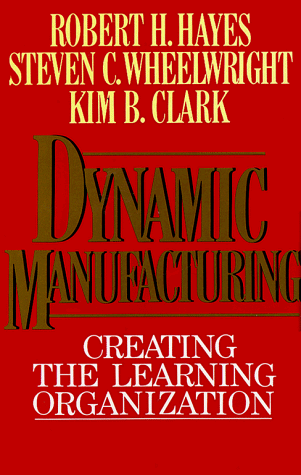
It is management, and particularly managers' willingness to learn and change -- not unfair competition or unsupportive economic policies -- that is at the heart of America's manufacturing crisis, contend Robert Hayes, Steven Wheelwright, and Kim Clark. These world-renowned authorities on manufacturing and technology base their conclusion on studies of hundreds of American and foreign firms. Writing for general managers in this long-awaited successor to their award-winning Restoring Our Competitive Edge, the authors go beyond the structural decisions -- the "bricks and mortar" of facilities and equipment -- to the infrastructure of a manufacturing company: the management policies, systems, and practices that must be at the core of a world-class organization. Most importantly, they address the difficulty of creating that infrastructure, emphasizing the management leadership and vision that are required. This thorough and comprehensive volume points out the weaknesses of traditional management practices, which are built into authoritarian, hierarchical organizations. The authors show dramatically how many companies today are breaking out of this "command and control" mentality and creating a whole new set of relationships involving workers and managers, engineering, marketing and manufacturing, and suppliers and customers, which is giving them a competitive advantage in the international marketplace. Comparing the companies that are winning with those that are losing market position, Hayes, Wheelwright, and Clark conclude that the key differences are that the winners focus on creating value for customers, continual improvement, quick adaptability to change, and extracting the full potential of their human resources. They constantly strive to be better, placing great emphasis on experimentation, integration, training, and the building of critical organizational capabilities. They are, in short, "learning" organizations. Dynamic Manufacturing explores in depth such key infrastructure issues as capital budgeting, performance measurement, organizational structure, and human resource management, demonstrating how they interact to foster productivity growth, new product development, and competitive advantage. The book shows today's managers how to implement the changes that must be made if they want to create a truly superior manufacturing company. Taking concerned, committed managers step-by-step on the path toward better products, lower costs, and increased profits, this seminal work provides a road map for manufacturing firms seeking to build a competitive advantage through manufacturing excellence.
http://www.amazon.com/gp/product/0029142113/?tag=2022091-20

(Since the first edition appeared in 1973, this work has b...)
Since the first edition appeared in 1973, this work has been translated into ten languages. This Fifth Edition presents a broad range of forecasting techniques and their practical application, with discussion of each method's strengths and weaknesses. Chapters reflect recent developments in forecasting approaches and tools, and addresse the role of forecasting in the management process.
http://www.amazon.com/gp/product/0471600636/?tag=2022091-20

(Known from its last editions as the "Bible of Forecasting...)
Known from its last editions as the "Bible of Forecasting", the third edition of this authoritative text has adopted a new approach-one that is as new as the latest trends in the field: "Explaining the past is not adequate for predicting the future". In other words, accurate forecasting requires more than just the fitting of models to historical data. Inside, readers will find the latest techniques used by managers in business today, discover the importance of forecasting and learn how it's accomplished. And readers will develop the necessary skills to meet the increased demand for thoughtful and realistic forecasts.
http://www.amazon.com/gp/product/0471532339/?tag=2022091-20

(Today, a company's capability to conceive and design qual...)
Today, a company's capability to conceive and design quality prototypes and bring a variety of superior products to market quicker than its competitors is increasingly the focal point of competition, contend leading product development experts Steven Wheelwright and Kim Clark. Drawing on six years of in-depth, systematic, worldwide research, they present proven principles for developing the critical capabilities for speed, efficiency, and quality that have worked again and again in scores of successful Japanese, American, and European fast-cycle firms. The authors argue that to survive, let alone succeed, today's companies must construct a new "platform" -- with new methodologies -- on which they can compete. Using their model for development strategies, Wheelwright and Clark show that firms can create a solid architecture for the integration of marketing, manufacturing, and design functions for problem solving and fast action -- particularly during the critical design-build-test cycles of prototype creation. They demonstrate further how successful firms such as Honda in automobiles, Compaq in personal computers, Applied Materials in semi-conductors, Sony in audio equipment, The Limited in apparel, and Hill-Rom in hospital beds have employed recent methodologies to bring new products to market at break-neck speed. Such innovations include design for manufacturability, quality function deployment, computer-aided design, and computer-aided engineering. Finally, Wheelwright and Clark emphasize the importance of learning in the organization. Companies that consistently "design it right the first time" and follow a path of continuous improvement in product and process development have a formidable edge in the crucial race to market.
http://www.amazon.com/gp/product/1451676298/?tag=2022091-20

http://www.amazon.com/gp/product/B014I8QEA4/?tag=2022091-20

(Leading Product Development: The Senior Manager's Guide t...)
Leading Product Development: The Senior Manager's Guide to Creating and Shaping the Enterprise
http://www.amazon.com/gp/product/B010EVEJME/?tag=2022091-20
(This problem solver offers a wealth of remedies for Ameri...)
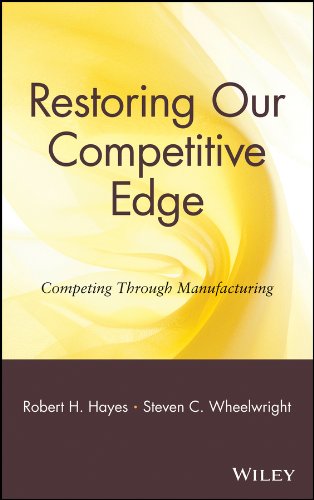
This problem solver offers a wealth of remedies for American industry's neglect of competitive manufacturing strategies and its resulting loss of productivity. Drawing upon the example of world-class and foreign manufacturers, the book illustrates what American industry must do in terms of manufacturing capability to regain a preeminent spot in the marketplace.
http://www.amazon.com/gp/product/0471051594/?tag=2022091-20

(Presents a wide range of forecasting methods useful for u...)
Presents a wide range of forecasting methods useful for undergraduate or graduate students majoring in business management, economics, or engineering. Develops skills for selecting the proper methodology. Integrates forecasting with the planning and decision-making activities within an organization. Methods of forecasting include: decomposition, regression analysis, and econometrics. Stresses the strengths and weaknesses of the individual methods in various types of organizational areas. Numerous examples are included.
http://www.amazon.com/gp/product/0471937703/?tag=2022091-20

(In their groundbreaking book "Revolutionizing Product Dev...)
In their groundbreaking book "Revolutionizing Product Development", Steven C. Wheelwright and Kim B. Clark demonstrated how project leaders for product development could apply new innovations to bring products to market at breakneck speed. Now, in their new work, they address the general manager's role in leading product development efforts-- at the functional, unit, group, and corporate levels. Up to now, senior managers have merely approved or rejected proposals at the beginning of a project and rushed in at the end to resolve problems. This traditional approach to product development no longer works, the authors contend. A fundamental shift in the role of senior management is taking place: the entire spectrum of new product development is now the responsibility of the general manager-- from pre-project planning to completion. Wheelwright and Clark draw on their combined consulting experience and numerous examples-- such as Kodak, Honda, Hewlett-Packard, and Gillette-- to explain how this new role can be successfully executed in today's competitive arena. The authors show how the margin for error in new product development has become razor thin. Pre-project planning, they show, takes the guesswork out of development so that projects run smoothly from start to finish. Second, they describe how to choose a set of projects that match a company's specific strategic objectives, resources, and "organizational horsepower"-- enabling the development of consistently successful products and capabilities over time. Finally, they reveal how to create a plan for action: how to determine project sequence, what measurements and incentives are crucial, and, most important, how to capture project learning and integrate it back into the ongoing stream of product development. Wheelwright and Clark conclude that the opportunity for rapid, significant development lies in managerial leadership of pre-project planning and commitment to improvement at every step of the product's life cycle. They provide managers with the tools needed to master these processes, making this book necessary reading for every manager who wants the upper hand in bringing timely, efficient, high-quality new products to market.
http://www.amazon.com/gp/product/0029344654/?tag=2022091-20

http://www.amazon.com/gp/product/B01JXUPA7K/?tag=2022091-20

http://www.amazon.com/gp/product/B01FKRMQD6/?tag=2022091-20

http://www.amazon.com/gp/product/B01N3UMJD6/?tag=2022091-20
Wheelwright, Steven C. was born on September 13, 1943 in Salt Lake City. Son of Max and Deborah Ann (Coulam) Wheelwright.
Bachelor of Science, U. Utah, 1966; Master of Business Administration, Stanford University, 1969; Doctor of Philosophy, Stanford University, 1970.
Assistant professor, European Institute Business Administration, France, 1970-1971; associate professor, Harvard University, Cambridge, Massachusetts, 1971-1973, 74-79; vice president marketing, Wheelwright Lithographing, Utah., 1973-1974; professor, Stanford (California) U., 1979-1988; professor, Harvard University, Cambridge, Massachusetts, since 1988; also chn. Master of Business Administration program, Harvard University, Cambridge, Massachusetts. Board directors TJ International, Heartport, Allegheny Ludlum Corporation, Quantum Corporation.
(Today, a company's capability to conceive and design qual...)
( It is management, and particularly managers' willingnes...)
(Known from its last editions as the "Bible of Forecasting...)
(Argues that a company's capability to conceive and design...)
(This problem solver offers a wealth of remedies for Ameri...)
(Presents a wide range of forecasting methods useful for u...)
(Presents a wide range of forecasting methods useful for u...)
(Leading Product Development: The Senior Manager's Guide t...)
(Since the first edition appeared in 1973, this work has b...)
(In their groundbreaking book "Revolutionizing Product Dev...)
(the handbook of forecasting)
Fellow Decision Sciences Institute.
Married Margaret Steele, December 21, 1965. Children: Marianne, Melinda, Kristen, Matthew, Spencer.
