Background
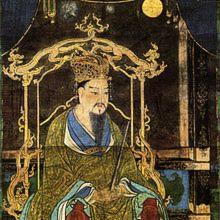
Tennō Kammu was born in 736, he was the eldest son of Emperor Kōnin.

桓武天皇
Tennō Kammu was born in 736, he was the eldest son of Emperor Kōnin.
He was made heir apparent in 773, and upon the death of his father in 781, ascended the throne to become the fiftieth ruler of Japan.
In 784 he moved from Heijō-kyo (Nara) to Nagaoka-kyo, just south of the present-day city of Kyoto.
In 785, however, Fujiwara no Tanetsugu was assassinated and other difficulties were encountered in the building of the new capital; so, on the advice of Wake no Kiyomaro, the capital was moved once more in 794, this time to Hcian-kyo, modern Kyoto. The period from this time until the founding of the Kamakura shogunate in 1192 thus came to be called the Heian period, and the city of Heian remained the residence of the emperor for over a thousand years until the capital was moved to Tokyo at the beginning of the Meiji period.
In 805 on the advice of Fujiwara no Otsugu, he abandoned the military and construction activities that were proving so costly.
In later ages a number of warrior clans appeared in different parts of the country that claimed descent from Emperor Kammu, and one such group, the branch of the Taira family known as the Kammu Heiji, in time produced such famous men as Taira no Masakado, Taira no Kiyomori, and later Hōjō Tokimasa.
Emperor Kammu, as has been said, moved to a new capital in order to strengthen his rule. In addition he set out to conquer the Ezo people of the Tohoku region, dispatching Sakanoue no Tamuramaro at the head of a force of forty thousand soldiers for this purpose. He also undertook numerous water control works, encouraged the opening up of new lands for cultivation, and endeavored to augment tax revenues. But the costs of the increased military activity and the construction of the new capital proved a heavy burden to the common people, and they began in growing numbers to desert their farming activities and turn to a life of vagrancy.
Emperor Kammu adopted various measures in an effort to correct and improve the ritsuryo system of government, but unfortunately he died before his plans could be carried to completion.
As soon as he came to the throne, Emperor Kammu set about working to free himself from the Buddhist clergy and other power groups that had dominated the Nara court. In order to facilitate his designs, he ordered Fujiwara no Tanetsugu to oversee the building of a new capital.