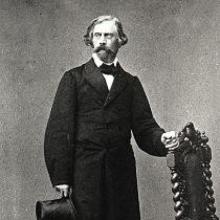
Career
He was also a noted entomologist. He was a disciple of the painter Schadow, and, on Schadow"s appointment to the presidency of a new academy in the Rhenish provinces in 1828, followed that master to Düsseldorf. Hildebrandt began by painting pictures illustrative of Goethe and Shakespeare.
But in this form he followed the traditions of the stage rather than the laws of nature.
He produced rapidly "Faust and Mephistopheles" (1824), "Faust and Margaret" (1825), and "Lear and Cordelia" (1828). He is associated with the Düsseldorf school of painting.
He visited the Netherlands with Schadow in 1829, and wandered alone in 1830 to Italy. But travel did not alter his style, though it led him to cultivate alternately eclecticism and realism.
The picture which made Hildebrandt"s fame is the "Murder of the Children of King Edward" (1836), of which the original, afterwards frequently copied, still belongs to the Spiegel collection at Halberstadt.
Comparatively late in life Hildebrandt tried his powers as an historical painter in pictures representing Wolsey and Henry VIII, but he lapsed again into the romantic in "Othello and Desdemona." After 1847 Hildebrandt gave himself up to portrait-painting, and in that branch succeeded in obtaining a large practice. He died at Düsseldorf in 1874.