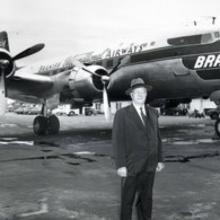
Background
Thomas Elmer Braniff was born on December 6, 1883 in Salina, Kansas to John A. and Mary Catherine Baker Braniff.

Thomas Elmer Braniff was born on December 6, 1883 in Salina, Kansas to John A. and Mary Catherine Baker Braniff.
Thomas Braniff completed two years at the Central High School in Kansas City, Missouri.
After two years of taking classes at the Central High School in Kansas City, Missouri, Thomas Braniff then in 1900 joined his father in the insurance business. After a few months he established his own agency and became successful, expanding from insurance to farm loans and real estate in Oklahoma, Arkansas, and Texas.
In 1923 he built the Braniff building, then the tallest building in Oklahoma City.
The most important part of Braniff's career began in 1927, when he and some business associates bought a single-engine airplane intended for both business and recreational travel. Since the airplane was used only infrequently, Braniff bought his associates out, and in 1928 began to carry passengers between Oklahoma City and Tulsa, with his brother Paul, a World War I flyer, as pilot. A year later this operation was sold to the Universal Aviation Corporation, a product of the boom period of the late 1920's, which ultimately was absorbed by the Aviation Corporation of America.
In 1930 Braniff returned to the business under the name of Braniff Airways, operating between Chicago, Kansas City, Tulsa, Oklahoma City, and Wichita Falls, Texas. The initial capitalization was $10, 000, increased to $100, 000 in 1931. Braniff was attracted back to air transport by the prospect of subsidies for carrying mail, which then constituted the greater part of airline revenues.
He was denied a mail contract, however, because of Postmaster General Walter F. Brown's policy of giving mail contracts only to companies he regarded as securely established and financially sound. Braniff's response was to organize the Independent Air Transport Operator's Association, which became an important influence in President F. D. Roosevelt's decision to cancel all airmail contracts on February 9, 1934. The association also provided evidence for the investigation of air transport by the Black Committee of the United States Senate, resulting in the Air Mail Act of 1934, which revised the system of awarding mail contracts and also required the separation of manufacturing and transport companies in aviation.
When, after an unhappy three months of using army airplanes to carry the mail, the contract system was restored, Braniff Airways was awarded the Chicago-Dallas route. A year later (1935) Braniff acquired Long and Harmon, Inc. , a Texas airline with mail routes extending from Amarillo through Dallas to Houston, Brownsville, and Corpus Christi. This step enabled Braniff to provide the first through air service between Chicago and the Gulf of Mexico.
In fact, through a technicality of Post Office regulations Braniff Airways lost its right to carry mail via Tulsa in 1938 and did not regain it until 1953.
A subsidiary, Aerovias Braniff, operated between Mexico City and Nuevo Laredo in 1945 and 1946. Its certificate was then revoked, but in 1948 Braniff, through Braniff International Airways, gained the right to operate along the west coast of South America and thence into Bolivia, Paraguay, Argentina, and Brazil. Braniff's last acquisition was Mid-Continent Airlines in 1952, which extended his operations as far north as Minneapolis-St. Paul. This merger made Braniff the sixth largest airline in the United States and the twelfth largest in the world, with assets exceeding $35, 000, 000.
The airline thus served thirty-one cities in nine states and its international routes extended to nine Latin-American countries.
Braniff died when an airplane in which he and several business associates were returning from a hunting trip struck a power line and crashed during an attempted landing in bad weather near Shreveport, Louisiana. All on board were killed.
Thomas Braniff had a natural grasp for bussiness, so even in early days of his career he became a founder and president of the T. E. Braniff Company and the Braniff Investment Company of Oklahoma City. He also became famous for building Oklahoma City's first skyscraper, which was the tallest building in the city. He was involved in the establishment of the T. C. Braniff Company headquarters, and also founded Prudential Fire Insurance Company in 1928 along with his partner Ed Overholser. He was one of the incorporators of Kansas City Fire Insurance Company in 1929 as well. Braniff established the Independent Air Transport Operator's Association, which became an important influence in President F. D. Roosevelt's decision to cancel all airmail contracts on February 9, 1934. Located in one of the fastest-growing areas of the United States, Braniff Airways prospered, with steadily increasing traffic and a consistently higher load factor than most other airlines. This success was due to Braniff's own aggressive management. Braniff International Airways operated along the west coast of South America and so had routes to Bolivia, Paraguay, Argentina, and Brazil. The merge with Mid-Continent Airlines in 1952 made Braniff the sixth largest airline in the United States and the twelfth largest in the world, with assets exceeding $35, 000, 000. It was also the only major airline named for an individual. Continuing his earlier business activities, he worked to promote air commerce as Chairman of the Transportation and Commerce Committee of the United States Inter-American Council on Commerce and Production and as a member of the United States Council of the International Chamber of Commerce. In 1944 he also became a recipient of one of the highest honors given to a layman - the title Knight Commander of the Order of St. Gregory the Great by Pope Pius XII. He was also granted with titles a Knight of Malta and a Knight of the Order of the Holy Sepulchre of the Catholic Church.
Braniff was a devout Roman Catholic and served as Catholic co-chairman of the National Conference of Christians and Jews. In 1944 he established the Braniff Foundation to promote religious, educational, and scientific objectives.
Thomas Braniff was a Roosevelt Democrat, but he received surprisingly few political favors, despite his strong support for the Roosevelt administration in the matter of the airmail contracts.
Braniff was both an able administrator and an enthusiastic believer in air transport, and he pursued a remarkably successful policy of expansion. While Braniff Airways claimed the major share of his attention after its founding, Braniff maintained a variety of other interests. In addition he had strong religious and philanthropic interests.
Braniff was a member of the Independent Air Transport Operator's Association. He was also an honorary member of Delta Phi Epsilon, foreign service fraternity.
Thomas Elmer Braniff married Bess Thurman on October 26, 1912; they had two children.
1846–1930
1890–1970
1887–1967
1914–1948
1887–1954
1852–1940
mayor of Oklahoma City
1918–1938
1896–1945
1885–1939
1893–1913
1880–1950
1882–1944
1877–1942