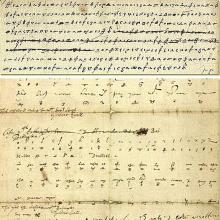
Thomas Phelippes was an English cryptographer, linguist, forger, and intelligence agent who served Sir Francis Walsingham during Elizabeth I’s reign. He deciphered intercepted correspondence in the Babington Plot, helped expose Mary, Queen of Scots’s involvement, and later worked intermittently for leading ministers under Elizabeth I and James I.
Background
Phelippes was born in 1556 and is generally described as the son of a London cloth merchant. His early life unfolded during the reign of Elizabeth I, when religious conflict, international rivalry, and fears of Catholic conspiracy made the interception and deciphering of correspondence important instruments of government.
He was also known by the variant surname Phillips. Contemporary descriptions portray him as short and slender, with yellow hair, a pock-marked face, and poor eyesight. His linguistic ability and familiarity with several European languages helped him work with the international correspondence handled by Elizabethan intelligence networks.
Education
Phelippes entered Trinity College, Cambridge, in 1569 and received a Bachelor of Arts degree in 1574. Trinity, founded in 1546 by Henry VIII, was one of Cambridge’s major colleges and combined classical learning with preparation for public, clerical, and professional life.
His education provided a setting in which languages, classical texts, correspondence, and the conventions of learned writing were cultivated. Those skills were relevant to the deciphering, translation, copying, and analysis of diplomatic and clandestine letters that became central to his later career.
Phelippes entered the English intelligence service during the late 1570s and became closely associated with Sir Francis Walsingham, Elizabeth I’s principal secretary and leading organizer of intelligence. From the late 1570s through the 1580s he worked in England and abroad, including frequent activity connected with the English embassy in Paris. The embassy served as a channel for diplomatic communication and the collection of information in a city that was central to European politics and religious conflict.
Phelippes gathered, copied, deciphered, and transmitted secret correspondence. He handled communications from agents in France, Scotland, the Netherlands, and England, prepared memoranda, and helped manage information within Walsingham’s network. His work involved ciphers in several languages, including Latin, French, Italian, German, and Spanish, and made him one of the most capable decipherers in the English government’s service.
His most famous operation concerned the correspondence between the imprisoned Mary, Queen of Scots, and Anthony Babington in 1586. Phelippes deciphered Mary’s coded letter discussing a proposed assassination of Elizabeth I and marked the deciphered document with a gallows sign. A postscript was added to elicit the names of the conspirators, enabling Walsingham’s agents to connect Mary’s correspondence with the Babington Plot and contributing to the proceedings that led to Mary’s execution in 1587.
After Walsingham’s death in 1590, government spending on intelligence was reduced and Phelippes lost the stable patronage he had previously enjoyed. He continued to provide intelligence and deciphering services for figures including the Earl of Essex and Robert Cecil, while suffering serious financial difficulties and periods of imprisonment for debt. He was retained by Robert Cecil from 1597 and remained connected with intelligence work during the transition from Elizabeth I to James I.
Phelippes was later drawn into investigations surrounding the Gunpowder Plot of 1605 through his contacts with Catholic and intelligence circles. His later years were marked by debt, imprisonment, and intermittent government use of his technical skills. He was still involved in deciphering sensitive correspondence near the end of his life and died in 1625.
Achievements
Phelippes deciphered the coded correspondence associated with the Babington Plot, helping Elizabeth I’s government establish the connection between Mary, Queen of Scots, and the conspiracy to assassinate the queen.
He developed and maintained a substantial intelligence correspondence involving agents and informants in England and continental Europe, combining cryptanalysis with the collection, copying, and transmission of secret information.
He continued to provide deciphering and intelligence services after the death of Sir Francis Walsingham, working intermittently for the Earl of Essex, Robert Cecil, and the government of James I despite financial and legal difficulties.
Personality
Phelippes was described by his father as reserved and discreet. His surviving work reflects sustained attention to secrecy, correspondence, cipher systems, and the careful handling of intelligence.
Physical Characteristics:
Contemporary descriptions portray Phelippes as short and slender, with yellow hair, a pock-marked face, and poor eyesight.
Quotes from others about the person
Mary, Queen of Scots described Phelippes in unflattering physical terms, emphasizing his short stature, slender build, yellow hair, pock-marked face, and poor eyesight. Historians have also characterized him as an exceptionally capable Elizabethan decipherer and intelligence operative.
Connections
Phelippes’s principal professional connection was with Sir Francis Walsingham, under whom he served as a decipherer, intelligence gatherer, and organizer of secret correspondence. His work also brought him into contact with the Earl of Essex, Robert Cecil, agents operating in continental Europe, and correspondents associated with the investigations of Mary, Queen of Scots and the Gunpowder Plot.
Collegue :
Sir Francis Walsingham
Elizabeth I's principal secretary and the organizer of the intelligence service in which Phelippes worked.
Collegue :
Mary, Queen of Scots
Phelippes deciphered her correspondence with Anthony Babington during the investigation of the Babington Plot.
Collegue :
Anthony Babington
His coded correspondence with Mary, Queen of Scots was deciphered by Phelippes in 1586.
Collegue :
Robert Cecil
Phelippes served as Cecil's personal intelligencer from 1597.