

Background
Hughes, Thomas Joseph Robert was born on August 3, 1943 in Brooklyn. Son of Joseph Anthony and Mae (Bland) Hughes.
http://www.amazon.com/gp/product/0914098152/?tag=2022091-20
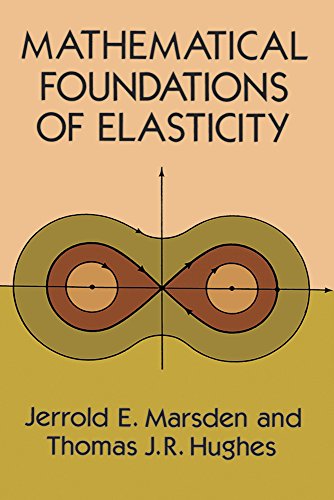
( This advanced-level study approaches mathematical found...)
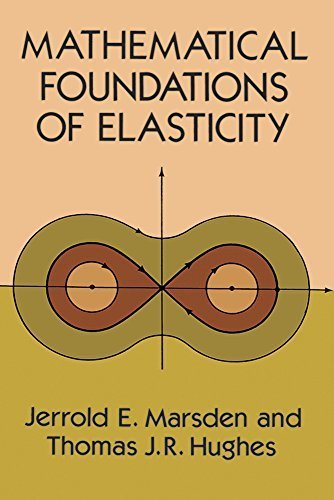
This advanced-level study approaches mathematical foundations of three-dimensional elasticity using modern differential geometry and functional analysis. It is directed to mathematicians, engineers and physicists who wish to see this classical subject in a modern setting with examples of newer mathematical contributions. Prerequisites include a solid background in advanced calculus and the basics of geometry and functional analysis. The first two chapters cover the background geometry ― developed as needed ― and use this discussion to obtain the basic results on kinematics and dynamics of continuous media. Subsequent chapters deal with elastic materials, linearization, variational principles, the use of functional analysis in elasticity, and bifurcation theory. Carefully selected problems are interspersed throughout, while a large bibliography rounds out the text.
http://www.amazon.com/gp/product/0486678652/?tag=2022091-20
http://www.amazon.com/gp/product/B011SJ13MA/?tag=2022091-20

http://www.amazon.com/gp/product/B008NUVOBI/?tag=2022091-20
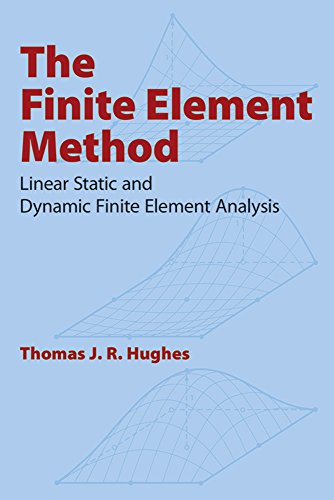
( This text is geared toward assisting engineering and ph...)
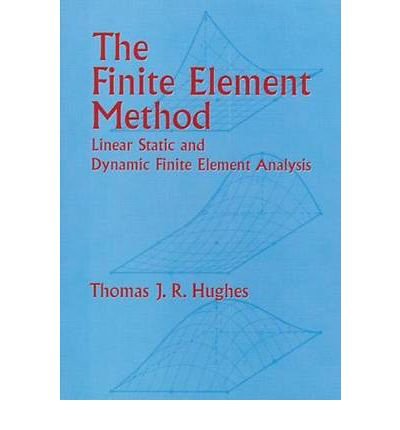
This text is geared toward assisting engineering and physical science students in cultivating comprehensive skills in linear static and dynamic finite element methodology. Based on courses taught at Stanford University and the California Institute of Technology, it ranges from fundamental concepts to practical computer implementations. Additional sections touch upon the frontiers of research, making the book of potential interest to more experienced analysts and researchers working in the finite element field. In addition to its examination of numerous standard aspects of the finite element method, the volume includes many unique components, including a comprehensive presentation and analysis of algorithms of time-dependent phenomena, plus beam, plate, and shell theories derived directly from three-dimensional elasticity theory. It also contains a systematic treatment of "weak," or variational, formulations for diverse classes of initial/boundary-value problems. Directed toward students without in-depth mathematical training, the text incorporates introductory material on the mathematical theory of finite elements and many important mathematical results, making it an ideal primer for more advanced works on this subject.
http://www.amazon.com/gp/product/0486411818/?tag=2022091-20
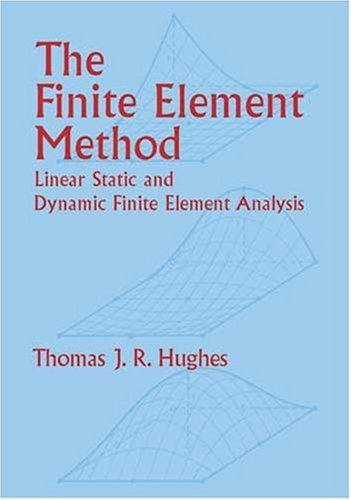
http://www.amazon.com/gp/product/B004VEARAO/?tag=2022091-20
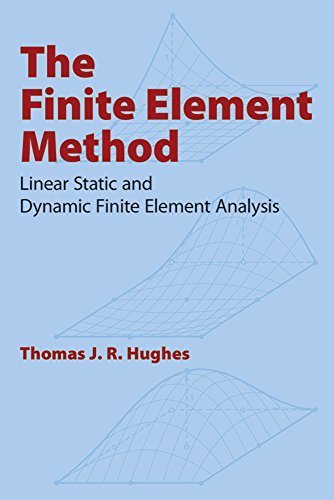
http://www.amazon.com/gp/product/B010WEQ0BQ/?tag=2022091-20
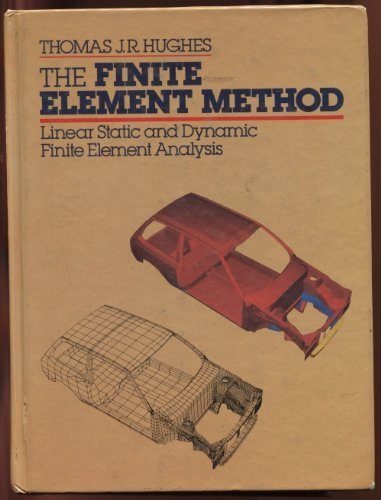
http://www.amazon.com/gp/product/B011MF3BH0/?tag=2022091-20
http://www.amazon.com/gp/product/B00Y4RODPS/?tag=2022091-20
http://www.amazon.com/gp/product/B00D5GWCFC/?tag=2022091-20
(A description of the theoretical foundations of inelastic...)
A description of the theoretical foundations of inelasticity, its numerical formulation and implementation, constituting a representative sample of state-of-the-art methodology currently used in inelastic calculations. Among the numerous topics covered are small deformation plasticity and viscoplasticity, convex optimisation theory, integration algorithms for the constitutive equation of plasticity and viscoplasticity, the variational setting of boundary value problems and discretization by finite element methods. Also addressed are the generalisation of the theory to non-smooth yield surface, mathematical numerical analysis issues of general return mapping algorithms, the generalisation to finite-strain inelasticity theory, objective integration algorithms for rate constitutive equations, the theory of hyperelastic-based plasticity models and small and large deformation viscoelasticity. Of great interest to researchers and graduate students in various branches of engineering, especially civil, aeronautical and mechanical, and applied mathematics.
http://www.amazon.com/gp/product/0387975209/?tag=2022091-20
(A description of the theoretical foundations of inelastic...)
A description of the theoretical foundations of inelasticity, its numerical formulation and implementation, constituting a representative sample of state-of-the-art methodology currently used in inelastic calculations. Among the numerous topics covered are small deformation plasticity and viscoplasticity, convex optimisation theory, integration algorithms for the constitutive equation of plasticity and viscoplasticity, the variational setting of boundary value problems and discretization by finite element methods. Also addressed are the generalisation of the theory to non-smooth yield surface, mathematical numerical analysis issues of general return mapping algorithms, the generalisation to finite-strain inelasticity theory, objective integration algorithms for rate constitutive equations, the theory of hyperelastic-based plasticity models and small and large deformation viscoelasticity. Of great interest to researchers and graduate students in various branches of engineering, especially civil, aeronautical and mechanical, and applied mathematics.
http://www.amazon.com/gp/product/147577169X/?tag=2022091-20
consultant Mechanical engineering educator
Hughes, Thomas Joseph Robert was born on August 3, 1943 in Brooklyn. Son of Joseph Anthony and Mae (Bland) Hughes.
Biomedical Engineering, Pratt Institute, Brooklyn, 1965. Master of Mechanical Engineering, Pratt Institute, 1967. Master of Arts in Mathematics, University California-Berkeley, 1974.
Doctor of Philosophy in Engineering Science, University California-Berkeley, 1974. Doctorate (honorary), University Catholique de Louvain, Belgium, 2003. Doctorate (honorary), University Pavia, Italy, 2007.
Doctorate (honorary), University Padua, Italy, 2007. Doctorate (honorary), National University of Science & Technology, Norway, 2009. Doctorate (honorary), Northwestern University, 2010.
Mechanical design engineer Grumman Aerospace, Bethpage, New York, 1965-1966. Research and Development General Dynamics, Groton, Connecticut, 1967—1969. Lecturer, assistant research engineer University California, Berkeley, 1975-1976.
Associate professor structural mechanics California Institute of Technology, Pasadena, 1976-1980. Associate professor mechanical engineering Stanford University, California, 1980-1982, professor, since 1983, chairman division applied mechanics, 1984-1988, 94—, chairman department mechanical engineering, 1988-1989. Founder, chairman CENTRIC Engineering Systems, Inc., 1990-1999.
Professor aerospace engineering & engineering mechanics, computational & applied mathematics, chair III University Texas, Austin, since 2002. Galileo visiting professor Scuola Normale Superiore, Pisa, Italy, 1999. Eshbach visiting professor Northwestern University, 2000.
Consultant in field.
(A description of the theoretical foundations of inelastic...)
(A description of the theoretical foundations of inelastic...)
( This text is geared toward assisting engineering and ph...)
( This advanced-level study approaches mathematical found...)
(History Book)
Author: A Short Course in Fluid Mechanics, 1976, Mathematical Foundations of Elasticity, 1983, The Finite Element Method: Linear Static and Dynamic Finite Element Analysis, 1987, Computational Inelasticity, 1998, Isogeometric Analysis: Toward Integration of Capital Development Authority and Federal Energy Administration, 2009. Editor: Nonlinear Finite Element Analysis of Plate and Shells, 1981, Computational Methods in Transient Analysis, 1983. Editor Journal of Computer Methods in Applied Mechanics and Engineering, since 1980.
Contributor numerous articles to professional journals.
Fellow American Association for the Advancement of Science, American Society of Mechanical Engineers (Melville medal 1979, Worcester Reed Warner medal 1998, Timoshenko medal 2007), National Academy of Sciences, American Institute of Aeronautics and Astronautics, American Society of Civil Engineers (Huber prize 1978, Von Karman medal 2009), International Association Computational Mechanics (president 1998-2002, Gauss-Newton medal), American Academy Mechanics, United States Association Computational Mechanics (president 1990-1992, von Neumann medal 1997), National Academy Engineering, American Academy Arts & Sciences (Humboldt Senior Scientist award 2009), Institute Lombardo, Austrian Academy of Sciences. Member Sigma Xi, Phi Beta Kappa.
Married Susan Elizabeth Weh, July 1, 1972. Children: Emily Susan, Ian Thomas, Elizabeth Claire.
