

Background
Tintoretto was born in 1518 in Venice, Italy. He was the son of Giovanni Robusti, who was a dyer. Hence the son got the nickname Tintoretto, that means a little dyer or dyer's boy.

Detail of a self-portrait of Tintoretto.

Portraitist Marietta Robusti, Tintoretto's daughter.

Self-portrait of Titian

1551

1551

1524

1542

1542

1543

1544

1544

1544

1545

1545

1545

1545

1547

1547

1547

1547

1548

1548

1548

1549

1550

1550

1550

1550

1550

1550

1550

1550

1550

1551

1551

1551

1552

1552

1552

1553

1553

1554

1555

1555

1555

1555

1555

1556

1556

1558

1559

1560
Tintoretto was born in 1518 in Venice, Italy. He was the son of Giovanni Robusti, who was a dyer. Hence the son got the nickname Tintoretto, that means a little dyer or dyer's boy.
As a child Tintoretto began painting on the dyer's walls. His father took notice and around 1533 sent him to the art studio of the famed Italian painter Titian to determine if he possessed any artistic talent. After ten days Titian sent Tintoretto home for reasons that are unclear.
Tintoretto sought no further teaching but studied assiduously on his own account working at night as well as at daytime. The painter explored models of Michelangelo's "Dawn," "Noon," "Twilight," and "Night,", and soon became proficient at wax and clay modeling.
Tintoretto's first phase includes a group of 14 octagonal ceiling paintings with mythological themes (originally painted for a Venetian palace), which exhibit singular refinement in perspective and narrative clarity. Among other influences, they recall the fashion of partitioned ceiling paintings imported to Venice by Vasari. This was also the period of Tintoretto's closest collaboration with Andrea Meldolla. Together they decorated the Palazzo Zen with frescoes. The fresco technique had an important part in the formation of Tintoretto's idiom, for it suggested to him the quickness of execution that was to become fundamental to his manner of painting. Unfortunately only some 18th-century prints of his frescoes and a few fragments of the numerous frescoed facades that adorned Venice survive.
Tintoretto's drawing exercises were made from nature, from statues and from small wax models posed in various ways and artificially illuminated, as in tiny stage sets. These methods were suited to the painter's concern with resolving problems of form and light. The indefatigable draftsman acquired a narrative fluency that allowed him to trace with a brisk brushstroke and fanciful inspiration the series of biblical stories, the mythological episodes for the poet Pietro Aretino's house in Venice (1545) and sacred compositions such as Christ and the Adulteress, in which figures set in vast spaces in fanciful perspectives are illuminated in a distinctly Mannerist style. Tintoretto returned to an earlier form of composition in his Last Supper of San Marcuola (1547), in which the choice of rough and popular types succeeds in endorsing the scene with a portrayal of ordinary everyday reality struck with wonder by the revelation of the miracle.
A few months later Tintoretto became the centre of attention of artists and literary men with his S. Marco Freeing the Slave. A letter from Aretino, full of praise, yet also intended to temper Tintoretto's youthful exuberance, confirmed the fame of the 30-year-old painter. Relations between Tintoretto and Aretino did not come to an end at this point, even though one of Aretino's letters contains hints of dissension. Although Aretino was no longer to write laudatory letters to Tintoretto, he commissioned him to execute family portraits, and after his death, his likeness was to appear in Tintoretto's huge Crucifixion of the Scuola Grande di San Rocco (1565).
An artist of indefatigable activity and a veritable fury of creativity, Tintoretto spent most of his life in the bosom of his family and in his workshop. But the love of solitude to which his biographer alludes did not prevent the painter from forming friendships with several artistic personalities. This particular period in Tintoretto's career – marked by greater vivacity of colour, by a predilection for a variegated perspective and by a highly decorative quality – coincided with his growing admiration for the art of Paolo Veronese, who had been working in the Doges' Palace. The assimilation and transformation of the Veronesian elements in Tintoretto's work are discernible in his beautiful ceiling paintings of Bible stories.
The use of a colour that absorbs light yielded new possibilities for suggesting spaces no longer structured by the pure play of perspective. And in those spaces the painter introduced crowds in harmonized order with the rest of the picture, a feature that had until then been missing in Venetian art. It was at that time that Tintoretto began to participate in the decoration of the church of the Madonna dell'Orto and the private chapel of the Contarini family contained within it, which in 1563 became the final resting place of the great cardinal Gasparo.
In May 1564 the councillors of the Scuola Grande di San Rocco decided to have the Sala dell'Albergo decorated with paintings, in place of the movable decorations used during feast days. San Rocco (St. Roch) is the protector against plagues. The numerous epidemics of that period had given new impetus to the cult of the saint and caused great riches to flow to the Scuola, which built a splendid centre to assist the poor and the infirm. When Tintoretto presented the Scuola with his oval painting the Glorification of S. Rocco, the directors decided to entrust him with the decoration of the Sala. Vasari relates that designs were invited from various prominent artists, including Paolo Veronese, but Tintoretto, who presented his work already installed in the Sala, won hands down over his competitors. Similar episodes are counted by contemporary sources as proof that when it came to his work the painter knew no scruples. He was indeed a man devoured by a passion for painting and not for pecuniary gain, for he committed himself to grandiose undertakings for exceedingly modest remuneration.
The question of who assisted Tintoretto in his dizzying activity is still open. At that time Marietta was only about nine and Domenico four, but it is known that in 1560 Tintoretto's studio began to be visited by young painters, especially from the Netherlands and Germany. In 1565 his immense Crucifixion was displayed in the Sala dell'Albergo.
In 1576, with renewed zeal, Tintoretto resumed the decoration of the Scuola Grande di San Rocco. He had finished the huge central panel of the upper hall with The Erection of the Brazen Serpent in time for the feast of the saint on August 16 and promised to paint a certain number of canvases. In 1581 all the ceiling paintings (10 ovals and 8 rhomboid chiaroscuro panels) and 10 teleri (large narrative paintings on canvas) on the walls were completed.
It seems almost impossible that in the same year the painter should have executed the four mythological allegories for the Doges’ Palace, of which the most famous is that of Ariadne, Bacchus and Venus. All are works of great elegance, with an almost academic finishing touch. But the real Tintoretto is certainly to be found in San Rocco, where he bears witness to his great faith and, like the medieval mosaicists, offers an illustrated Bible to the crowds of the poor who frequented the beneficent institution. His deep but independent faith in the religious myths, unrestricted by any rules of the Counter-Reformation, is apparent as much in the striking sketch of The Council of Trent, executed for the Doge Da Ponte, as in the altarpiece of San Trovaso, executed in 1577 for Milledonne, a participant and historian of the Council, with the seminude women who tempt St. Anthony.
In the canvases executed between 1583 and 1587 for the lower hall of the Scuola Grande di San Rocco, depicting episodes of the life of Mary and Christ, Tintoretto follows a new direction: light in its most lyrical meaning dominates the paintings, dissolving the colour in a flash of diaphanous brushstrokes. Space is multiplied in unlimited successions of perspectives. The scenery at times prevails over the human figure, as in the two great works in the ground floor hall, with the St. Mary of Egypt and the St. Mary Magdalene immersed in an incandescent hazy atmosphere in which things are animated with a life of their own: an invitation to the contemplative life of the 70-year-old painter, more than ever leaning toward the view of humanity and its destiny offered by the Christian faith. A marvelous model (in the Louvre) of the Paradise for the Doges' Palace and The Last Supper of San Giorgio Maggiore, with the incorporeal apparitions of angelic creatures, finished a few months before his death, are proof of Tintoretto's deep spiritual bent.
Tintoretto's art was highly appreciated in Venice in the years after his death, above all in the acute evaluations of Marco Boschini, the great 17th-century critic of Venetian painting.
The painter exerted a huge influence on Mannerist as well as Baroque art, but above all, on the work of El Greco. His works can be seen in a number of the best art museums across the globe, including the Pinacoteca di Brera (Brera Art Gallery), Milan, the Louvre Museum, the National Gallery and the the Victoria and Albert Museum, both in London, the National Museum of Serbia, the National Museum in Poznań, and others.
Madonna with Child and Donor Tintoretto
1524Deucalion and Pyrrha Praying before the Statue of the Goddess Themis
1542Solomon and Sheba
1542The Supper at Emmaus
1543Joseph and Potiphar's Wife
1544St George
1544Siege of Asola
1544Portrait of a White Bearded Man
1545Portrait of Procurator Nicolò Priuli
1545Solomon and the Queen of Sheba
1545The Conversion of Saul
1545Christ Washing the Feet of His Disciples
1547Ecce Homo (Pontius Pilate Presenting Christ to the Crowd)
1547Portrait of a Man Aged Twenty-six
1547Self-portrait
1547Esther before Ahasuerus
1548The Miracle of St Mark Freeing the Slave
1548Young Man of the Renialme Family
1548St Roch in the Hospital
1549Assumption of the Virgin
1550Christ and the Woman Taken in Adultery
1550Man in Armour
1550Portrait of a Distinguished Man
1550Portrait of a Genoese Nobleman
1550Portrait of Jacopo Soranso
1550St Jerome
1550The Miracle of St Augustine
1550Virgin and Child with St Catherine, St Augustine, St Marc and St John the Baptist
1550Creation of the Animals
1551Man with Gold Chain
1551Portrait of Procurator Antonio Cappello
1551St Jerome and St Andrew
1552The Murder of Abel
1552The Temptation of Adam
1552Portrait of Agostino Doria
1553St Louis, St George, and the Princess
1553The Birth of John the Baptist
1554Portrait of a Young Gentleman
1555Susanna and the Elders
1555The Assumption
1555The Presentation of Christ in the Temple
1555The Queen of Sheba and Solomon
1555The Martyrdom of St Paul
1556The Vision of St Peter
1556Deposition
1558Portrait of Doge Girolamo Priuli
1559Crucifixion
1560Tintoretto became a member of the Scuola dei Mercanti in 1592.
Quotes from others about the person
Henry James, American author: "Many things come and go, but this great artist remains for us in Venice a part of the company of the mind."
Marco Boschini, Italian painter: "Like a fulminant Jove, he used the thunderbolt of his brush to pursue superiority over all the others, and absolute dominion."
Giorgio Vasari, Italian painter, architect, writer, and historian: "...swift, resolute, fantastic, extravagant, and the most extraordinary brain that the art of painting has ever produced."
Tom Nichols: "...in his Venetian paintings Tintoretto proved himself a very subtle and sympathetic interpreter of patrician values, both orthodox and progressive."
Tintoretto married Faustina Episcopi in 1555. The couple had eight children three of whom, including Marietta Robusti, followed their father's steps and became artists.
(born about 1485)
(born about 1488)

(1554 – 1590)
Occasionally referred to as Tintoretta, Marietta followed her father steps and became a painter. She was a portraitist.
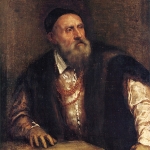
(around 1488-1490 – 27 August 1576)
Tiziano Vecelli, commonly known as Titian, was an ifluental Italian painter. A prominent representative of the Italian Renaissance, he is regarded as one of the leading figures of the 16th-century Venetian school.

