

Background
Hayden, Tom was born on December 11, 1939 in Royal Oak, Michigan, United States.

( We seek the establishment of a democracy of individual ...)
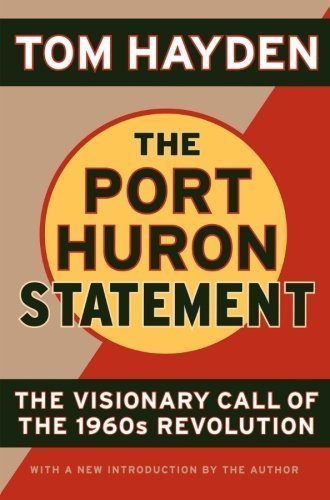
We seek the establishment of a democracy of individual participation governed by two central aims: that the individual share in those social decisions determining the quality and direction of his life; that society be organized to encourage independence in men and provide the media for their common participation . . ." —from the PORT HURON STATEMENT Four key periods in American history have most influenced what America is like today: the Revolutionary War, the Civil War, World War II, and the 1960s. No document better frames and explains the 1960s than the PORT HURON STATEMENT. The statement was a generational call for direct participatory democracy in which Americans would have greater say over the decisions affecting their lives. It called for the extension of democratic principles to the workplace as well as the electoral arena. It opposed the dominance of the military-industrial complex with the hope that social movements could reform the Democrats as a party of progressive opposition. In its vision greater democracy would lessen individuals' alienation. The manifesto's 1962 publication preceded the phenomena of the counter-culture, hippies and back-to-the-land. It is truly the intellectual roots of the social change of the 1960s and its impact is still being felt in 2005. In "The Big Lebowksi," the character played by Jeff Bridges claimed authorship; it was condemned by right-wing justice Robert Bork, recalled with nostalgia by Garry Wills and E.J. Dionne, and sections have been printed in countless readers on American history.
http://www.amazon.com/gp/product/1560257415/?tag=2022091-20
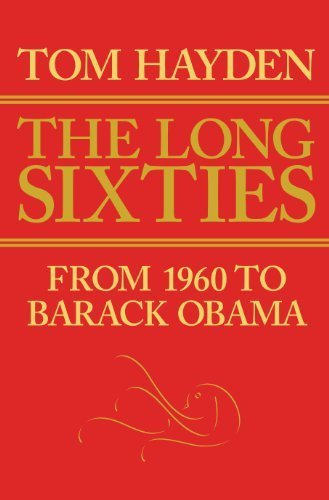
(The Long Sixties: From 1960 to Barack Obama by Hayden, To...)
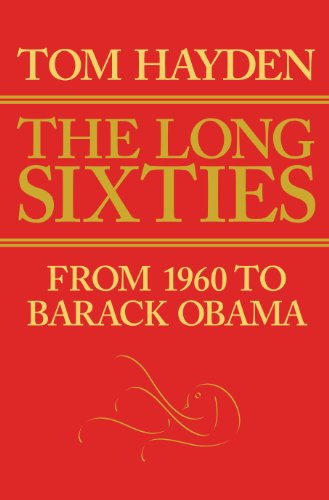
The Long Sixties: From 1960 to Barack Obama by Hayden, Tom Paradigm Publishers, 2011 ( Paperback ) Paperback
http://www.amazon.com/gp/product/B00N4JTCOY/?tag=2022091-20
http://www.amazon.com/gp/product/B0006BRWD6/?tag=2022091-20
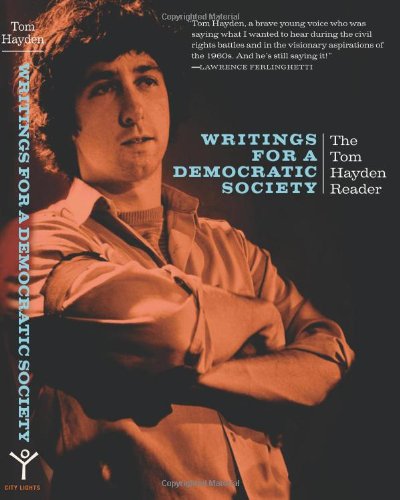
( “His journey is our journey through the tumultuous and ...)
“His journey is our journey through the tumultuous and disillusioning decades. He is our Everyman, he is us.”—Seattle Post-Intelligencer Praise for Tom Hayden: “One comes away enthralled by Hayden’s odyssey.”—The Boston Sunday Globe From his earliest days as a Freedom Rider and leader of Students for a Democratic Society, through decades as a state senator, to contemporary notes on the Iraq war, the global South, immigration, and spirituality, Tom Hayden’s writings constitute nothing less than an alternative history of our times. Writings for a Democratic Society is the only book that encapsulates Tom Hayden’s writings over fifty years, a time in which he has been a reflective eyewitness to American history in the making. The book is composed on sections about the new Left of the 1960s, the Chicago 8, Vietnam, electoral politics, gang violence, Ireland, the environment, global justice, and US foreign policy today. “Tom Hayden changed America,” the national correspondent of The Atlantic, Nicholas Lemann, has written. He created the “blueprint for the Great Society programs,” according to presidential assistant Richard Goodwin. He was the "single greatest figure of the 1960s student movement," according to The New York Times Book Review. Forty years later he was described as "the conscience of the Senate." Tom Hayden is the author or editor of more than a dozen critically acclaimed books, including Reunion and Street Wars.
http://www.amazon.com/gp/product/0872864618/?tag=2022091-20
http://www.amazon.com/gp/product/B01182390Q/?tag=2022091-20
http://www.amazon.com/gp/product/B01182R5SI/?tag=2022091-20
http://www.amazon.com/gp/product/0871568888/?tag=2022091-20
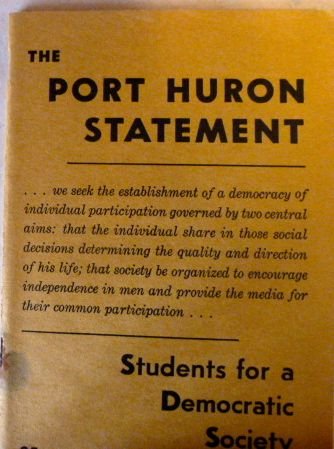
(The first bound printing, the previous printing was mimeo...)
The first bound printing, the previous printing was mimeographed sheets.
http://www.amazon.com/gp/product/B000IPMQTA/?tag=2022091-20
(Barack Obama would not be possible without the Sixties, T...)
Barack Obama would not be possible without the Sixties, Tom Hayden writes in his unique and compelling new book. Obama was conceived because of changing mores on interracial marriage; was electable because of the civil rights movement and voting rights laws; and was successful because of a new social movement that applied participatory democracy online and door to door. Hayden shows that movements throughout history triumph over Machiavellians, gaining social reforms while leaving both revolutionaries and reactionaries frustrated. Only the assassinations of the Kennedys and Martin Luther King prevented the Sixties from ending with a progressive presidency propelled into power by social movement activism, Hayden says. But the Sixties did leave a critical print on America, from civil rights laws to the birth of the environmental movement, and forced open the political process to women and people of color. Hayden portrays the Reagan and Bush eras as counter-movements against the Sixties which ultimately failed, and the Obama presidency as a delayed achievement. Chicago’s Grant Park was consciously chosen for Obama’s 2008 victory celebration, according to campaign manager David Axelrod, to “symbolically overcome the damage done to American idealism forty years before.” Hayden’s carefully researched history includes formidable, if sometimes forgotten, coverage of Sixties achievements as well as a valuable dateline for activists, journalists and historians as the fiftieth anniversary of every episode of that decade approaches. While accepting President Obama’s centrist positioning, Hayden reminds the new president that the peace movement was critical to his 2008 victory and only a radical populism will make his economic recovery, green jobs and health care promises come to fruition. Features of this text:
http://www.amazon.com/gp/product/1594517401/?tag=2022091-20
http://www.amazon.com/gp/product/0863275672/?tag=2022091-20
(Politcal Studies, American Studies)
Politcal Studies, American Studies
http://www.amazon.com/gp/product/B0007DNB4C/?tag=2022091-20

http://www.amazon.com/gp/product/B000L9MC4M/?tag=2022091-20
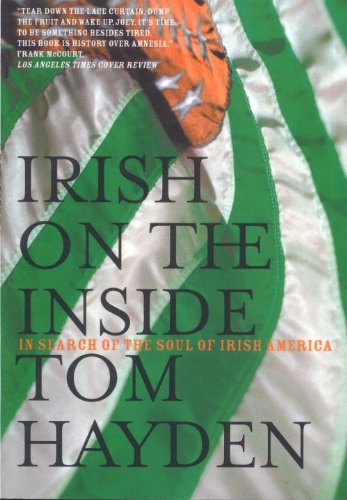
(Tom Hayden first realized he was ‘Irish on the inside’ wh...)
Tom Hayden first realized he was ‘Irish on the inside’ when he heard civil rights marchers in Northern Ireland singing ‘We Shall Overcome’ in 1969. Though his great-grandparents had been forced to emigrate to the US in the 1850s, Hayden’s parents erased his Irish heritage in the quest for respectability. In this passionate book he explores the losses wrought by such conformism. Assimilation, he argues, has led to high rates of schizophrenia, depression, alcoholism and domestic violence within the Irish community. Today’s Irish-Americans, Hayden contends, need to re-inhabit their history, to recognize that assimilation need not entail submission. By recognizing their links to others now experiencing the prejudice once directed at their ancestors, they can develop a sense of themselves that is both specific and inclusive: ‘The survival of a distinct Irish soul is proof enough that Anglo culture will never fully satisfy our needs. We have a unique role in reshaping American society to empathize with the world’s poor, for their story is the genuine story of the Irish.’
http://www.amazon.com/gp/product/1859844774/?tag=2022091-20

( As a leading antiwar figure in the 1960s, Tom Hayden wr...)
As a leading antiwar figure in the 1960s, Tom Hayden wrote extensively on Vietnam and was one of the small number of Americans engaged in dialogue with both sides during the Paris peace talks. As an Irish American, he spent ten years supporting and writing about the peace process leading up to the Good Friday Agreement. As a California legislator for eighteen years, he devoted himself to writing about and trying to prevent inner-city violence. Hayden remains a stalwart antiwar activist, is credited with initiating the 2005 Congressional exit strategy hearings, and has interviewed Iraqi exiles in the Middle East and London. His urgent book comes from a patient understanding of how conflicts end. Hayden argues that the Iraq war will end by the application of people pressure against the pillars of the policy. A new kind of antiwar movement, delineated in this groundbreaking original work, can overturn those pillars. For the first time in American history, he writes, an American majority voted against a war in progress in November 2006. This is a book for millions of peace activists, for the undecided public, and for the 2008 presidential candidates as well. Tom Hayden was a founding member of the Students for a Democratic Society and author of its visionary call, the Port Huron Statement, described by Howard Zinn as “one of those historic documents which represents an era.” Hayden was also one of the famous “Chicago Seven” protesters during the 1968 Democratic Convention. He was elected to the California State Assembly in 1982, and to the state Senate ten years later, serving eighteen years in all.
http://www.amazon.com/gp/product/B008SMMTHY/?tag=2022091-20
http://www.amazon.com/gp/product/B010TTLB18/?tag=2022091-20
Hayden, Tom was born on December 11, 1939 in Royal Oak, Michigan, United States.
Graduate, University of Michigan.
Co-founder Students for a Democratic Society, 1961, president, 1962, 63. Staff Student Non-violent Coordinating Committee, 1963. Co-founder Economic Research and Action Project, 1964.
Leader Newark Community Union Project, 1964-1967. Founder Indochina Peace Campaign. Candidate for United States Senate in California Democratic Primary, 1976.
Founder, chairman California Campaign for Economic Democracy, since 1977. Chairman SolarCal Council, State of California, 1978-1982. Member California State Assembly, 1982-1992.
Senator California State Senate, 1993—2000. O'Brien distinguished professor legal studies Scripps College, Claremont, California. Chairman higher education policy committee California State Assembly, 1986-1992.
Chairman natural resources and wildlife polity committee California State Senate, since 1994.
( We seek the establishment of a democracy of individual ...)
( As a leading antiwar figure in the 1960s, Tom Hayden wr...)
(Tom Hayden first realized he was ‘Irish on the inside’ wh...)
(Barack Obama would not be possible without the Sixties, T...)
(The Long Sixties: From 1960 to Barack Obama by Hayden, To...)
( “His journey is our journey through the tumultuous and ...)
(The first bound printing, the previous printing was mimeo...)
(Politcal Studies, American Studies)
(NIXON ADMINISTRATION, VIETNAM WAR)
Married Jane Fonda, January 20, 1973 (divorced). Children: Troy, Vanessa. Married Barbara Williams, August 8, 1993.
