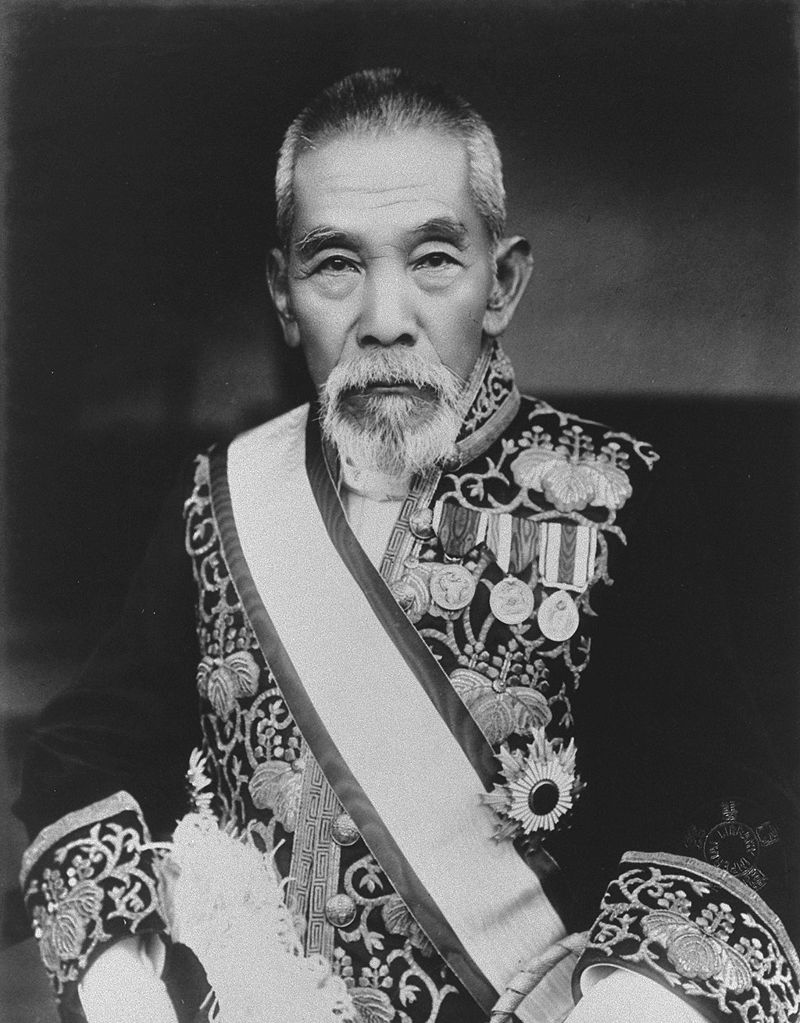
Inukai Tsuyoshi was a Japanese politician, cabinet minister, and Prime Minister of Japan from 13 December 1931 to 15 May 1932.
Background
Inukai was born on June 4, 1855 to a samurai family of Niwase Domain, in Niwase village, Bizen Province (now part of Okayama city, Okayama Prefecture), where his father had been a local official and magistrate under the Tokugawa shogunate.
Education
In 1876 Inukai made his way to Tokyo, got a job with the newspaper Hochi, and studied political philosophy under Yukichi Fukuzawa. His family had traditionally stressed Confucian learning, and he might have ended up a teacher of the classics had not a book on international law aroused his interest in Western learning.
Career
In 1876 Inukai made his way to Tokyo, got a job with the newspaper Hochi, and studied political philosophy under Yukichi Fukuzawa. Fukuzawa's support enabled Inukai to found Tokai, a financial newspaper, together with Ryohei Toyokawa, who was related to the Mitsubishi; this explains Inukai's close connections with the powerful zaibatsu family throughout his political career. Inukai first entered politics when Shigenobu Okuma resigned from the government and started the Kaishinto (Progressive party) in 1881.
Four years later Inukai ran for the Tokyo City Assembly under its label, and in 1890 he won a seat for Okayama in the Diet, a position he held for the rest of his life. Inukai's political goal was to break open the narrow political elite to ever wider participation in the decision-making process. His first-short-lived-victory was engineering the coalition Okuma Cabinet of 1889, in which he became minister of education.
Thereafter, at age 70, he attempted to retire from active politics, but his constituents would not let him, and upon Tanaka's death he was elected president of the Seiyukai party.
After the September 1931 Manchurian incident, which he supported, Inukai was made premier in December. The elder statesman Kimmochi Saionji recommended him in the hope that he could find a diplomatic solution based on his long-time personal connections with Chinese nationalists who had stayed in Japan.
Religion
His family had traditionally stressed Confucian learning, and he might have ended up a teacher of the classics had not a book on international law aroused his interest in Western learning.
Views
He accepted the education portfolio in Yamamoto's Cabinet of 1913 on the rationale that, by supporting this Satsuma faction of the ruling oligarchy, he would be weakening Choshu domination. He was accused of being bought off by the elite. To regain his reputation, he struggled to put together the Kato coalition Cabinet of 1924, dedicated to "protecting the constitution" and passing "manhood suffrage. "