Background
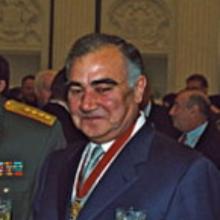
Kokov was born in Tyrnyauz, Kabardino-Balkaria.

Kokov was born in Tyrnyauz, Kabardino-Balkaria.
Early Life and Political He was the leader of Kabardino-Balkaria from 1990 to 2005. He was chairman of the republic"s supreme Soviet from 1990 to 1991 and was elected President for the first time in 1992. He effectively neutralized opposition and was re-elected twice in landslide victories.
In 1997 with 98% of the vote and in 2002 with 87% of the vote.
He successfully maintained stability in the republic though it is close to the war-torn republic of Chechnya. Kokov suffered from cancer for several years before his death.
On September 16, 2005, he announced his resignation. He did not give any reason for his departure, which came nearly a year and a half before the end of his term.
He stayed in office until his successor, Arsen Kanokov was chosen two weeks later.
During October 2005 his health rapidly declined and he died in the central clinical hospital in Moscow of cancer, a month after leaving office.
Order of Merit for the Fatherland; 2nd class (9 May 2005) - for outstanding contribution strengthening Russian statehood and many years of diligent work 3rd class (15 October 2001) - for outstanding contribution strengthening Russian statehood, friendship and cooperation between nations Order of Friendship of Peoples (25 March 1994) - for his great personal contribution to strengthening Russian statehood and stability of international relations in the Kabardino-Balkar Republic Order "Honor and Glory", 2nd class (Abkhazia, 2003) Diploma of the Government of the Russian Federation (11 October 2001) - for his great personal contribution to the economy of Kabardino-Balkaria and long-term fruitful work Kokov"s name has been used: Kabardino-Balkar State Agricultural Academy named VM Kokov, Nalchik Streets in Volgograd, Grozny and Dygulybgey, Baksan region, Kabardino-Balkaria.
Communist Party of the Soviet Union, United Russia.
Central Committee of the Communist Party of the Soviet Union.