

Background
GROSSMAN was born in 1905. The son of an engineer, he grew up in the religiously traditional and largely Yiddish-speaking milieu of Berdichev, to which he formed a lifelong attachment.

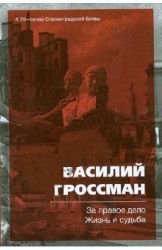
("Za pravoye delo" (“For the Just Cause,” 1952), complemen...)
"Za pravoye delo" (“For the Just Cause,” 1952), complementing Grossman’s wartime novel of a decade earlier, portrayed the battle of Stalingrad, but no complete version ever appeared. It met with fierce ideological criticism on two accounts: for “underrating Communist motivation” in the victorious Red Army, and for “overestimating” the Jewish tragedy in World War II. Grossman’s last work could thus only be published in a censored and mutilated definitive edition (1954).
http://www.amazon.com/gp/product/5699626654/?tag=2022091-20

http://www.amazon.com/gp/product/1590172019/?tag=2022091-20

http://www.amazon.com/gp/product/0307275337/?tag=2022091-20

http://www.amazon.com/gp/product/076580543X/?tag=2022091-20
GROSSMAN was born in 1905. The son of an engineer, he grew up in the religiously traditional and largely Yiddish-speaking milieu of Berdichev, to which he formed a lifelong attachment.
Studied at Moscow University.
He first worked as a chemical engineer in the coal-mining Donbas region of the Ukraine and later in Moscow from 1932 to 1934, but finally chose to become a writer.
"Stepan Kolchugin" (1937-1940), a three-volume novel set in prerevolutionary Russia, was his major achievement before the appearance of "Narod bessmerten" (“The People Is Immortal,” 1942), Grossman’s most famous work and the first outstanding novel of World War II published in the Soviet Union.
A Red Star war correspondent, like Ilya Ehrenburg, he quickly grasped the extent and significance of the Holocaust, his close relatives being annihilated with the rest of Berdichev Jewry in 1941. It was this specific aspect of the Nazi invasion that Grossman felt bound to emphasize whenever he dealt with the Great Patriotic War.
Some months before his cooption into the government-inspired Jewish Anti-Fascist Committee (April 1944), Grossman had begun collaborating with Ehrenburg and others in a full-scale attempt to document all available evidence of Nazi crimes against Soviet Jewry. The material for this "Black Book" comprised eyewitness testimony, letters and diaries, first-hand published reports (including Ehrenburg’s), and documents provided by the Soviet State Committee on Nazi Atrocities.
As the war drew to a close in spring 1945, however, Ehrenburg’s violently anti-German line no longer suited the Kremlin, and he w>as replaced as chair¬man of the editorial committee by Grossman, who finished the "Black Book" a year later. In his preface he not only stressed the fact that Jews had been the main target of Nazi viciousness, but also underscored Jew'ish resistance (moral and physical) as well as the role of anti-Semitic collaborators in German-occupied territory. Such declarations were likewise no longer in tune with official Soviet pol-icy: though already serialized in the Yiddish weekly Eynikayt and translated overseas into English and Romanian, the original "Black Book" was deliberately held up in the press until November 1948, when the text vanished and many members of the Jewish
Anti-Fascist Committee died in Stalin’s “anticosmopolitan” campaign.
Grossman, like Ehrenburg, managed to survive, but he had fallen into permanent disfavor with the Soviet establishment. Having suppressed one volume on the Holocaust, champions of the new party line were not inclined to tolerate another work in the same vein disguised as fiction.
Years after his death, a Russian-language restoration of the ill- starred "Black Book" finally appeared in Jerusalem.
("Za pravoye delo" (“For the Just Cause,” 1952), complemen...)

