The Watchful Gods And Other Stories (Western Literature Series)
(
This edition of Walter Van Tilburg Clark’s collection o...)
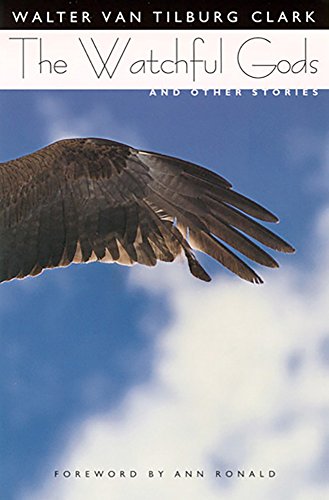
This edition of Walter Van Tilburg Clark’s collection of short stories—which includes “Hook,” Clark’s most renowned story—makes these pieces available again to a new generation of readers.
Critic John R. Milton once said that Walter Van Tilburg Clark "did perhaps more than anyone else to define (in his fiction) the mode of perception, the acquisition of knowledge, and the style which we tend to call Western." In 1950, Walter Van Tilburg Clark, author of the acclaimed novel The Ox-Bow Incident, published a collection of short stories that had already won distinction in various national magazines. The collection was well received by reviewers, and subsequent critics have noted that these stories reflect both Clark’s literary power and the major concerns of his novels: the interior and intuitive complexities of good and evil, and the fragile, intricate web that connects humankind to the rest of the natural world.
A foreword by Ann Ronald, one of the West’s most astute literary critics, sets the stories into the context of Clark’s oeuvre and illuminates the way they reveal crucial characteristics of this writer’s imagination.
(Set in 1885, The Ox-Bow Incident is a searing and realist...)
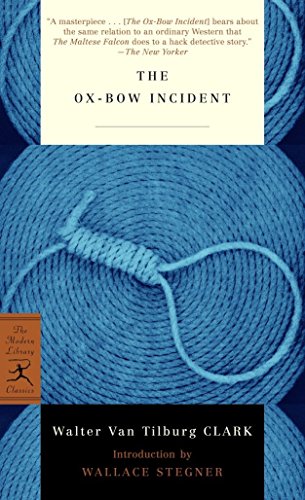
Set in 1885, The Ox-Bow Incident is a searing and realistic portrait of frontier life and mob violence in the American West. First published in 1940, it focuses on the lynching of three innocent men and the tragedy that ensues when law and order are abandoned. The result is an emotionally powerful, vivid, and unforgettable re-creation of the Western novel, which Clark transmuted into a universal story about good and evil, individual and community, justice and human nature. As Wallace Stegner writes, Clark's theme was civilization, and he recorded, indelibly, its first steps in a new country.
(
Clark's classic novel is a compelling tale of four men ...)
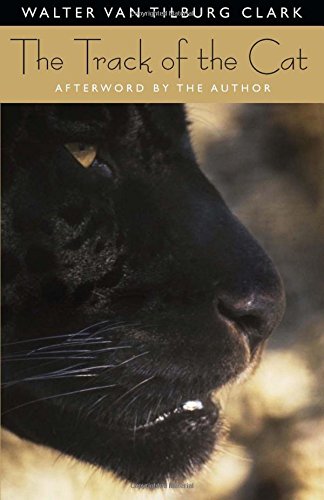
Clark's classic novel is a compelling tale of four men who fear a marauding mountain lion but swear to conquer it. It is also a story of violent human emotions--love and hate, hope and despair--and of the perpetual conflict between good and evil.
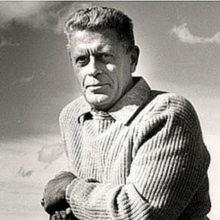
Walter Van Tilburg Clark was an American poet, writer of short stories, novelist, critic, and educator. His works, set in the American West, used the familiar regional materials of the cowboy and frontier to explore philosophical issues.
Background
Walter Van Tilburg Clark was born on August 3, 1909 in East Orland, Maine, United States. He was the son of Walter Ernest Clark and Euphemia Abrams in a log cabin in the woods near East Orland, Maine, where his parents spent their summers. His father was a professor of political science and chairman of the department at City College, New York; his mother had studied music at Cornell and Columbia. When Walter Clark became president of the University of Nevada in 1917, his son's environment became the American West, which was to become the background for his writing.
Education
There he first learned about western history from his grammar school principal, who as a bride of sixteen had helped fight off Indians who attacked a wagon train and killed her husband. At high school in Reno, Nevada, Clark drew cartoons, began writing verse, took part in dramatics and debating, and played basketball and tennis. Climbing and camping in the Sierras and hiking in the desert, he came to know and love the West's spaciousness. He further developed his athletic skills by swimming in the not-too-distant Pacific Ocean. An early interest in fishing and hunting waned as he came to feel that living creatures were more attractive than dead ones. Odd jobs helped defray the costs of his education both in high school and at the University of Nevada. There from 1926 to 1932, while earning bachelor's and master's degrees in English with minors in philosophy and psychology and continuing to write verse, he took part in dramatics and played tennis and basketball. As a graduate student, he taught undergraduates and wrote his master's thesis on the Irish legend of Tristam and Iseult. Later in life he would comment that Who's Who in America listed him as a teacher first and an author second, a ranking with which he agreed. From 1931 to 1934, he was a teaching assistant at the University of Vermont while he worked on his Ph. D. degree, concentrating on Greek and American philosophers. In June 1958, he received an honorary doctorate from Colgate University.
Career
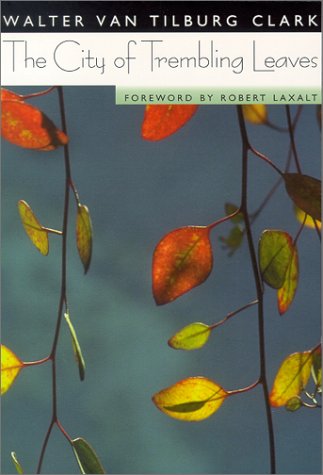
In 1932, his father paid the publishing costs of Clark's first volume of verse, Ten Women in Gale's House and Shorter Poems. His doctoral thesis, completed in 1934, was on the poetry of Robinson Jeffers. In the 1951-1952 school year, for instance, when he taught at the University of Iowa Writers' Workshop, his wife did not accompany him. However, fellow teachers said later that Clark talked about her a lot. From 1936 to 1941, and again from 1942 to 1945, he taught English, coached tennis and basketball, and directed dramatics at the Cazenovia, High School in the Finger Lakes Area. Evenings and weekends he was "writing constantly, " at first publishing only a few poems. By 1938, he had completed a number of short stories. "The Hook" (1940), a story about a hawk, was the first of his works to draw public attention. The Ox-Bow Incident (1940), a novel about the lynching of three innocent men believed to be cattle rustlers, was the second, immediately attracting attention as a Western novel with true literary merit, quite unlike the stories of cowboy life with which the American public had become saturated. A 1943 film version, which followed the novel's story line faithfully, also received highly favorable reviews. Rejected for military service because of a hernia, Clark wrote short stories for the Atlantic Monthly, the Saturday Evening Post, and the New Yorker. One of the best, "The Portable Phonograph, " a tale of five men who are the last survivors of the human race, was published in the Yale Review in 1941. One of his stories was selected each year from 1941 to 1945 for the O. Henry Memorial Award Prize Stories. "Hook" (1941); "The Portable Phonograph" (1942); "The Ascent of Ariel Goodbody, " (1943); and "The Buck in the Hills, " (1944). "The Wind and the Snow of Winter" was the 1945 O. Henry Award winner. Clark's second novel, The City of Trembling Leaves (1945), with a rites-of-passage theme, disappointed reviewers, some of whom thought the novel had been written before The Ox-Bow Incident, had been rejected by publishers, and was now being published because of the reputation of the first book. In the fall of 1945, Clark taught briefly at a high school in Rye; a physical disability forced him to resign. The Clarks then moved to the artists' and writers' colony sponsored by Mabel Dodge Luhan in Taos. In September 1946, they moved again to a ranch in Washoe Valley between Reno and Carson City, Nevada. There Clark wrote two novellas with chess and academic themes, then turned to The Track of the Cat (1949), a novel about a hunt for a black panther that has been killing range cattle. This moral parable has been called the "finest Western story ever written, " and Clark's best novel. Moving to Virginia City, Nevada, he wrote The Watchful Gods and Other Stories (1950). During the 1950-1951 school year, he taught part-time at the Virginia City High School; during the 1951-1952 school year he taught at the University of Iowa's Writer's Workshop, but turned down an offer to remain there. The next school year, he held a part-time position in the Department of English at the University of Nevada, but he resigned in protest over university policy regarding faculty tenure. From 1954 to 1956, he was at the University of Montana, teaching English classes and developing a creative-writing program. In 1957, he testified for the defense in the censorship trial of Howl, a book of poetry by Allen Ginsberg. During the 1960-1961 school year, he was a resident at the Center for Advanced Studies at Wesleyan University in Connecticut. He then returned to San Francisco State to resume his directorship of the creative writing program. In his remaining years he published one chapter of a proposed biography of Alfred Doten, a pioneer Nevada journalist and publisher, and taught at the University of Nevada on a part-time basis. Clark, after receiving an honorary doctorate from the University of Nevada, died of cancer and is buried in Masonic Cemetery in Virginia City, Nevada.
Achievements
From 1956 to 1960, he helped develop the creative writing program at San Francisco State University.
On October 14, 1933, at Elmira, he married Barbara Frances Morse, daughter of a Presbyterian minister in Pennsylvania; the couple had met at the University of Nevada. Their two children were born at Cazenovia.
Father:
Walter Ernest Clark
His father was a professor of political science and chairman of the department at City College, New York
Mother:
Euphemia Abrams
His mother had studied music at Cornell and Columbia. When Walter Clark became president of the University of Nevada in 1917