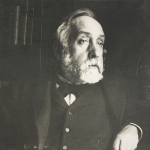
Walter Richard Sickert was a British painter and printmaker. He was known for his works, which contains subtly colored interiors, nudes, and city streets.
Background
Ethnicity:
Father was Danish, while his mother is said to be of English and Irish heritage.
Walter Sickert was born on May 31, 1860 in Munich, Bavaria, Germany. He was the eldest of six children of Oswald Sickert, a a Danish-German painter and journalistic draftsman, and his wife, Eleanor Louisa Henry, who was an illegitimate daughter of the British astronomer Richard Sheepshanks. His family emigrated to England in 1868 to keep his sons from being conscripted into the German army.
Education
Walter Sickert studied at the University College School from 1870 to 1871. In 1875 Walter enrolled at King's College in London and studied there until eighteen years old. In 1881 he entered the Slade School in London, but he soon left to help James McNeill Whistler print his etchings.
From 1877, Walter Sickert trained for a career on the stage and toured with Sir Henry Irving's company, playing minor roles. Abandoned this career in 1881.
Starting out his career as a pupil and assistant to James Abbott McNeill Whistler in 1882, later he met Edgar Degas, whose use of pictorial space and emphasis on drawing would have an influential effect on Sickert's work.
In 1885 Sickert and his wife honeymooned in Dieppe. His scenes of Dieppe date from 1885, but especially after 1899 street scenes of Dieppe were a recurring subject. From 1898 to 1905 Sickert lived in Dieppe, France, and in Venice, often painting landscapes.
In 1905 Sickert returned to London, where he joined the painters Augustus John and Lucien Pissarro, the son of Impressionist master Camille Pissarro, in advocating advanced ideas in British painting. The years 1907 - 1914 were Sickert's Camden Town period, in which he showed forlorn people in dreary rooms with cheap Victorian furniture. In these works he used a thick and broken impasto, as in "Girl Reading" (1907) and "Ennui" (1913).
From 1908 to 1912 and again from 1915 to 1918, Sickert was an influential teacher at Westminster School of Art, where David Bomberg, Wendela Boreel, Mary Godwin and John Doman Turner were among his students. In 1910, he founded a private art school, Rowlandson House, in the Hampstead Road. It worked until 1914.
From the mid-1920s to the end of his life, Sickert lived in a variety of places, including Dieppe and, in England, Bath and Kent. In his later work he increasingly used photographs, rather than live models, as the basis for his work. He also occasionally wrote art criticism for the leading journals.
Walter Richard Sickert was recognised during his own lifetime as an important artist, and in the years since his death has increasingly gained a reputation as one of the most influential figures in twentieth-century British art.
His works are held in the collections of the Musée d’Orsay in Paris, the National Gallery in London, and the Metropolitan Museum of Art in New York, among others.
His painting "Le Corsage Violet" sold at Bonhams New Bond Street 'Modern British & Irish Art' in 2013 for $469,121.
The Front at Hove (Turpe Senex Miles Turpe Senilis Amor)
1930
St. Mark's, Venice
1895
The wardrobe
1924
The Dutch
1906
Minnie Cunningham at the Old Bedford
1892
The Tottenham Distillery
1924
Seated Nude, Paris
1906
A Marengo
1903
Two Women on a Sofa
1904
Jacques-Emile Blanche
1910
Portrait of Israel Zangwill
Baccarat - the Fur Cape
1920
Clarence Gardens, Camden Town
Woman Washing her Hair
1906
The Camden Town Murder, or What Shall We Do For the Rent?
1909
Horses of St. Mark's, Venice
1901
Cafe of the Courts, Dieppe
1890
The Piazzetta and the Old Campanile, Venice
1901
The Juvenile Lead (Self Portrait)
1907
George Moore
1891
The Little Tea Party Nina Hamnett and Roald Kristian
1916
Miss Earhart's Arrival
1932
Pierrot and Woman Embracing
1904
The Notre-Dame des Champs
London Street, Bath
Sir Alec Martin
1935
Sketch for 'The Statue of Duquesne, Dieppe'
1902
Roquefort
1920
Sketch of a female figure
1888
Interior of St Mark's, Venice
1896
The Arcades of Fish shop, Dieppe
1900
The Seducer
1930
Violets
The Servant of Abraham
1929
Tipperary
1914
Study for 'The Little Tea Party'
1916
Brighton Pierrots
1915
Rowlandson House - Sunset
1912
Off to the Pub
1912
Ennui
1913
Mornington Crescent nude, contre-jour
1907
The American
1908
The Camden Town Murder
1908
Belvedere, Bath
1917
Variation on Peggy
1935
Young Belgium Women
Portrait of Lady Noble
The Rialto Bridge, Venice
Queen Victoria and her great-grandson
1936
Despair
1909
Dieppe, Study No. 2, Facade of Saint-Jacques Tower
1899
View of Bath from Belvedere
The Straw Hat
1911
Figure
1906
Home life
Venice, la Salute
1903
Girl at a Window, Little Rachel
1907
Lady Martin
1935
Study for 'The wardrobe'
1922
Views
Quotations:
"Photography, like alcohol, should only be allowed to those who can do without it."
"The artist is he who can take something ordinary and wring out of it attar of roses."
"Perhaps the importance that we must attach to the achievement of an artist or a group of artists may properly be measured by the answer to the following question: Have they so wrought that it will be impossible henceforth, for those who follow, ever again to act as if they had not existed?"
"To justify our likes and dislikes, we generally say that the work we dislike is not serious."
Membership
In 1911 Walter Sickert founded an association of painters, most of whose members did not share his impressionistic leanings.
Camden Town Group
,
United Kingdom
1911 - 1913
New English Art Club
,
United Kingdom
1888
Walter Sickert became an Associate Member of the Royal Academy in 1924 and a Royal Academician in 1934.
Royal Academy of Arts
,
United Kingdom
1934 - 1935
Walter Sickert was the president of this society.
Royal Society of British Artists
,
United Kingdom
1928
Personality
Walter Sickert has been portrayed in several fictional books as a potential suspect in the Jack the Ripper murders in recent decades. These claims have never been substantiated and most historians believe them to be without merit.
Quotes from others about the person
Virginia Woolf: "To me Sickert always seems more of a novelist than a biographer... He likes to set his characters in motion, to watch them in action. As I remember, his show was full of pictures that might be stories, as indeed their names suggest – Rose et Marie; Christine Buys a House; A Difficult Moment. The figures are motionless, of course, but each has been seized in a moment of crisis; it is difficult to look at them and not to invent a plot, to hear what they are saying."
Connections
Walter Sickert was married three times. In 1885 he married Ellen Cobden, the daughter of the influential Liberal politician Richard Cobden. The marriage was childless and unhappy. They divorced in 1899. In 1911 he married Christine Drummond Angus, his student, who was eighteen years his junior. She died in 1920. In 1926 Walter Sickert married a painter, Thérèse Lessore.
Walter Sickert: Prints
Ruth Bromberg describes the subject matter and techniques for each print in relation to Sickert’s oeuvre. She also discusses the evolution of Sickert’s career in printmaking; the influences on his work of Whistler and Degas, whom Sickert knew; his working procedures; and his innovative techniques and style in engraving, etching, aquatint, soft-ground etching, and lithography.
2000
Walter Sickert
An illustrated book which details the achievements of one of the most prominent of British artists, Walter Sickert (1860-1942). His awareness of developments in European modern art furthered his abilities as a painter, draughtsman and graphic designer but, the author submits that above all Sickert was a master of 20th century painting.