

Background
Hager, Willi Hermann was born on July 8, 1951 in Uznach, Switzerland. Son of Willi J. Hager and Ida M. Fuchs.
http://www.amazon.com/gp/product/B010WEP18E/?tag=2022091-20
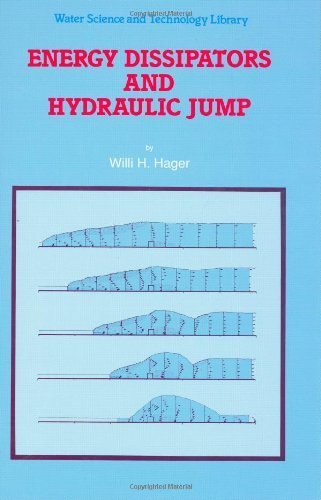
(Stilling basins utili z ing a hydraulic jump for energy d...)
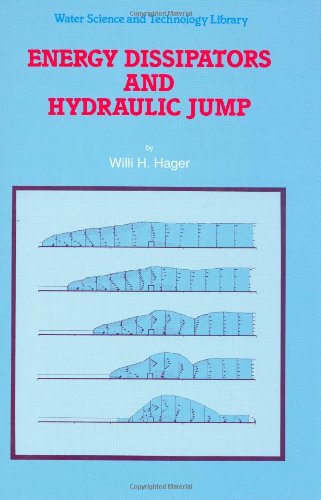
Stilling basins utili z ing a hydraulic jump for energy dissipation are w i d e l y used in hydraulic engineering . D a Vinci was the first to describe the hydraulic jump, and Bidone conducted classical experiments about 170 years ago . Stilling basins w e r e developed in the thirties with signif- cant design improvements being made during the last sixty years . Although w e l l - a c c e p t e d guidelines for a successful design are presently available, the information for the design of such dissipators is not yet compiled in book form . This book provides state-of-the-art information on hydraulic jumps and associat ed stilling basins . A large numbe r of papers on the to pics are reviewed. T h e present trends of the art of designing a stilli ng basin are discussed and ideas for future research are outlined. Design criteria and recommendat ions are frequently given . However, this should not be considered as a r eady-to -use guideline since the design of an effective stilling basin is much more comple x than following general design steps . The book is divided into two parts. Part 1 on hydraulic jumps is c- prised of chapters 2 to 5. Part 2 consisting of chapters 6 to 14 deals with various hydraulic structures used to dissipate energy. The lists of notation and references are provided in each part separately although the same notation is u sed throughout.
http://www.amazon.com/gp/product/0792315081/?tag=2022091-20

( The second, enlarged edition of this established refere...)
The second, enlarged edition of this established reference integrates many new insights into wastewater hydraulics. This work serves as a reference for researchers but also is a basis for practicing engineers. It can be used as a text book for graduate students, although it has the characteristics of a reference book. It addresses mainly the sewer hydraulician but also general hydraulic engineers who have to tackle many a problem in daily life, and who will not always find an appropriate solution. Each chapter is introduced with a summary to outline the contents. To illustrate application of the theory, examples are presented to explain the computational procedures. Further, to relate present knowledge to the history of hydraulics, some key dates on noteworthy hydraulicians are quoted. A historical note on the development of wastewater hydraulics is also added. References are given at the end of each chapter, and they are often helpful starting points for further reading. Each notation is defined when introduced, and listed alphabetically at the end of each chapter. This new edition includes in particular sideweirs with throttling pipes, drop shafts with an account on the two-phase flow features, as well as conduit choking due to direct or undular hydraulic jumps.
http://www.amazon.com/gp/product/3642113826/?tag=2022091-20
http://www.amazon.com/gp/product/9080564958/?tag=2022091-20

http://www.amazon.com/gp/product/B00GTP4CSQ/?tag=2022091-20
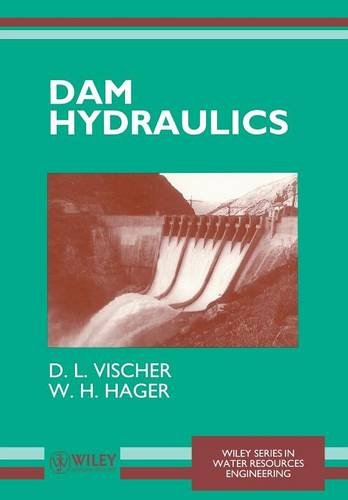
(Dam Hydraulics D. L. Vischer W. H. Hager VAW, ETH, Zurich...)
Dam Hydraulics D. L. Vischer W. H. Hager VAW, ETH, Zurich, Switzerland This book develops the main themes of water flow in dam structures, emphasizing the hydraulic principles governing the design, construction and refurbishment of dams. Opening with an overview of the various dam structures, it then develops fundamental topics including: reservoir sedimentation, waves due to landslides and dambreak waves. The authors provide a systematic analysis of the various phenomena associated with dam hydraulics, illustrated with appropriate figures and photographs of laboratory models and prototype structures.
http://www.amazon.com/gp/product/0471972894/?tag=2022091-20
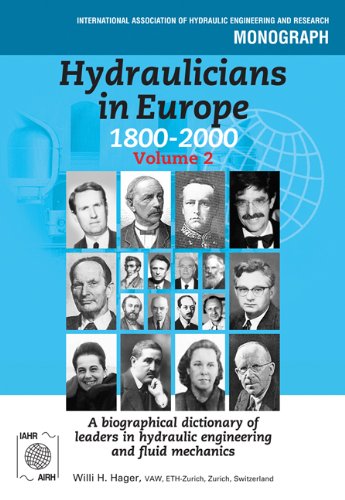
(More than 850 individuals partly forgotten by name, but s...)
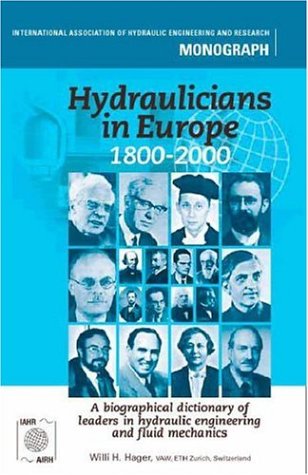
More than 850 individuals partly forgotten by name, but sometimes found in historical writings, together with many well known or recently deceased persons are presented in terms of bio-data, short career highlights, and main advances made to the profession with a short biography of the main writings. If available, a portrait is also included. Hydraulicians in Europe, Volume 2 is a continuation of the first volume, both in outline and in coverage and pagination. Volumes 1 and 2 include more than 1500 biographies.
http://www.amazon.com/gp/product/9078046066/?tag=2022091-20

(Stilling basins utili z ing a hydraulic jump for energy d...)
Stilling basins utili z ing a hydraulic jump for energy dissipation are w i d e l y used in hydraulic engineering . D a Vinci was the first to describe the hydraulic jump, and Bidone conducted classical experiments about 170 years ago . Stilling basins w e r e developed in the thirties with signif- cant design improvements being made during the last sixty years . Although w e l l - a c c e p t e d guidelines for a successful design are presently available, the information for the design of such dissipators is not yet compiled in book form . This book provides state-of-the-art information on hydraulic jumps and associat ed stilling basins . A large numbe r of papers on the to pics are reviewed. T h e present trends of the art of designing a stilli ng basin are discussed and ideas for future research are outlined. Design criteria and recommendat ions are frequently given . However, this should not be considered as a r eady-to -use guideline since the design of an effective stilling basin is much more comple x than following general design steps . The book is divided into two parts. Part 1 on hydraulic jumps is c- prised of chapters 2 to 5. Part 2 consisting of chapters 6 to 14 deals with various hydraulic structures used to dissipate energy. The lists of notation and references are provided in each part separately although the same notation is u sed throughout.
http://www.amazon.com/gp/product/9048141060/?tag=2022091-20
http://www.amazon.com/gp/product/B010WFGS2G/?tag=2022091-20
http://www.amazon.com/gp/product/B010WEWTVQ/?tag=2022091-20

(The second, enlarged edition of this established referenc...)
The second, enlarged edition of this established reference integrates many new insights into wastewater hydraulics. It includes in particular sideweirs with throttling pipes, and drop shafts with an account on the two-phase flow features.
http://www.amazon.com/gp/product/3642423507/?tag=2022091-20
Hager, Willi Hermann was born on July 8, 1951 in Uznach, Switzerland. Son of Willi J. Hager and Ida M. Fuchs.
Degree in civil engineering, Swiss Federal Institute of Technology, Zurich, Switzerland, 1976. Doctor of Philosophy, Swiss Federal Institute of Technology, Zurich, Switzerland, 1981. Privatdozent, Swiss Federal Institute of Technology, Zurich, Switzerland, 1994.
Hydraulic engineer Kuster & Hager, Switzerland, 1976-1983. Research engineer École Polytechnique Fédérale de Lausanne, Lausanne, Switzerland, 1983-1988. Research head Eidgenössische Technische Hochschule, 1989-1998, head hydraulics department, since 1999, professor, 1998.
Head hydraulics department VAW, Eidgenössische Technische Hochschule Zurich, Zurich, Switzerland, since 1998.
(More than 850 individuals partly forgotten by name, but s...)
(Stilling basins utili z ing a hydraulic jump for energy d...)
( The second, enlarged edition of this established refere...)
(Stilling basins utili z ing a hydraulic jump for energy d...)
(The second, enlarged edition of this established referenc...)
(Dam Hydraulics D. L. Vischer W. H. Hager VAW, ETH, Zurich...)
Fellow American Society of Civil Engineers (J.C. Stevens award 1988, best practice paper award 1994, best technical note award 1994, Hydraulic Structures medal, 2007). Member International Association Hydraulic Research (10th Ippen award 1997, member council, 2003-2007, editor jour hydraulic research, since 2006).
Avocations: collecting biographies, stamps, wines. Research interestsinclude air-water high speed flows, dam-break waves, sewer and dam hydraulics, impulse waves. E-mail: [email protected].
Married Susanna S. Iten, May 17, 1951. Children: Olivia, Mirjam, Caren.
