Background
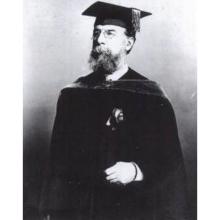
William Robert Brooks was born on June 11, 1844 at Maidstone, England, the son of Rev. William and Caroline (Wickings) Brooks. The family came to America in 1857 and settled in Darien, New York.

William Robert Brooks was born on June 11, 1844 at Maidstone, England, the son of Rev. William and Caroline (Wickings) Brooks. The family came to America in 1857 and settled in Darien, New York.
William was educated in the English and American public and private schools. A prolonged trip to Australia and back at the age of seven and eight, and his voyage to America at thirteen, probably started his interest in astronomy.
William Brooks was for a time employed at the Shepherd Iron Works in Buffalo and there gained practical experience as a mechanician and draftsman which was of great value to him in constructing his astronomical instruments.
During his leisure hours Brooks applied himself to the construction of his telescopes. With the third one he discovered his first comet in 1881; the fourth, a reflector of nine inches aperture, was the chief instrument of the "Red House Observatory, " a primitive structure in the apple orchard. With this instrument he discovered ten more comets.
Encouraged by his success he now, regardless of his small income, devoted all his time to astronomy. His interesting presentation and his generous wit brought him much in demand as a lecturer. In 1888 he moved to Geneva, New York, where he was given charge of the William Smith Observatory.
At Geneva he discovered sixteen more comets, bringing his total up to twenty-seven, only one less than the record number by Pons. He became professor of astronomy at Hobart College in 1900. His cometary discoveries brought him many prizes and medals.
William Brooks specialized in the discovery of comets, including periodic comets 12P/Pons-Brooks and 16P/Brooks. He also discovered the bright naked-eye comet C/1911 O1 (Brooks), and was a pioneer of astrophotography. Another achievement was that Brooks went on to become Director of the Smith Observatory at Hobart College, Geneva, New York, where he lectured and undertook his astronomical research. Brooks received medals from the Lick Observatory, the Astronomical Society of the Pacific, the International Jury at the St. Louis Exhibition, the Astronomical Society of Mexico, and the Lalande Medal of the French Academy of Sciences in 1899. Brooks was also appointed a Professor and Honorary Doctor of Science by Hobart College.
Brooks made his first telescope when he was fourteen years old, just in time to get a view of Donati's great comet of 1858. His first astronomical lecture was delivered in his father's church at the age of seventeen. He became much interested in the development of photography and was one of the pioneers in its application to celestial observation.
A studious and thorough worker, William Brooks was calm of temperament and a well-liked citizen.
In 1868 William Robert Brooks married Mary E. Smith and in 1870 moved to Phelps, New York, and established himself as the village photographer.