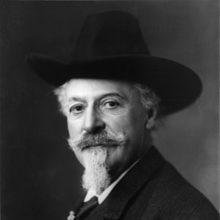
Buffalo Bill (William Frederick Cody) was an American buffalo hunter, United States Army scout, Pony Express rider, Indian fighter, actor, and impresario who dramatized the facts and flavour of the American West through fiction and melodrama. His colourful Wild West show, which came to be known as Buffalo Bill’s Wild West and Congress of Rough Riders of the World, evolved into an international institution and made him one of the world’s first glo
Background
William Frederick Cody was born on the 26th of February, 1846, in Scott county, Iowa, United States. Cody’s father, Isaac, moved his family from their farm near LeClaire, Iowa, on the Mississippi River, to Kansas, where he operated a trading post near the Kickapoo Indian Agency. While delivering an antislavery speech, Isaac was stabbed, and he ultimately succumbed to his wounds three years later, in 1857. To support his family, Cody already had begun working at age nine for the Russell, Majors and Waddell freight company, where he made use of his skills as a horseman. In 1857 Cody came to be celebrated as the youngest Indian fighter on the Great Plains after he killed a Native American who helped attack the cattle drive on which Cody was working. On the same cattle drive, Cody met the young Wild Bill Hickok, who intervened on his side in a fight Cody was having with an older man.
Education
Buffalo Bill attended school only briefly.
Career
Cody was 14 years old when he began riding for the Pony Express in the spring of 1860, but, because he had already delivered messages between wagon trains for Russell, Majors, and Waddell, he was initially assigned a short 45-mile run.
During the American Civil War in 1861–65, Cody first served as a Union scout in campaigns against the Kiowa and Comanche and later in 1863 enlisted with the Seventh Kansas Cavalry, which saw action in Missouri and Tennessee. After the war, he worked for the U.S. Army as a civilian scout and dispatch bearer out of Fort Ellsworth in Kansas in 1866–67. In 1867–68 he hunted buffalo to feed construction crews on the Union Pacific Railroad.
In 1872 Gen. Philip Sheridan arranged for Cody and Lieut. Col. George Armstrong Custer to guide Grand Duke Alexis of Russia on a hunting trip that had been set up by U.S. Pres. Ulysses S. Grant. During his army service, Cody’s reputation continued to grow. In all, he is believed to have engaged in 16 Indian fights, including his much-publicized scalping (July 17, 1876) of the Cheyenne warrior Yellow Hair (erroneously translated as Yellow Hand) in Sioux county, Nebraska, which was hailed as a response to the massacre of Custer’s command at the Battle of the Little Bighorn earlier in the year.
Recognizing the financial possibilities inherent in dramatizing the West, Cody was easily persuaded in 1872 to star in Buntline’s drama The Scouts of the Prairie. Though his acting was far from polished, he became a superb showman, and his audiences greeted him with overwhelming enthusiasm during his 45-year career as an entertainer.
For many years Cody performed during the winter and continued scouting for the army in the summer or escorting hunting parties to the West. In the process, the line began to blur even further between the scout William F. Cody and the legend and entertainer Buffalo Bill. In 1883 Cody, with the help of producer and partner Nate Salsbury, organized his own Wild West show, a spectacular outdoor entertainment with a cast of hundreds, featuring fancy-shooting, hard-riding cowboys and yelling Indians, along with re-creations of a buffalo hunt, the capture of the Deadwood (South Dakota) stagecoach, and a Pony Express ride. By the end of the 19th century, Buffalo Bill was one of the most recognized persons in the world.
Buffalo Bill continued to perform in his Wild West show until 1916, although at age 71 he often had to be helped onto his horse backstage. His last public appearance occurred just two months before his death.
Achievements
Cody acquired a reputation not only for accurate marksmanship but also for total recall of the vast terrain he had traversed, knowledge of Indian ways, courage, and endurance. He was in demand as a scout and guide, mostly for the U.S. Fifth Cavalry, throughout much of the government’s attempt to wipe out Indian resistance to the settlement of the land west of the Mississippi River (1868–76).
In 1872 Cody, who frequently took dangerous assignments that others refused, was awarded the Medal of Honor for his heroic actions on April 26 as a scout for a contingent of the Third Cavalry that was pursuing Indians who had stolen the army horses near Fort McPherson in Nebraska.