Background
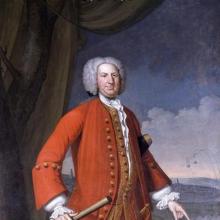
The son of a prosperous merchant, William Pepperell was born on June 27, 1696, at Kittery Point, Maine (then part of Massachusetts).

The son of a prosperous merchant, William Pepperell was born on June 27, 1696, at Kittery Point, Maine (then part of Massachusetts).
He was taken into his father's firm, known as the William Pepperells, which dealt in lumber, fish, and shipbuilding. European products were imported for sale. Profits were invested in land, and by 1724 young William owned almost the entire townships of Sacco and Scarboro. Business often took him to Boston, where on March 16, 1724, he married Mary Hirt. Pepperell was made a militia colonel in 1726, in command of all Maine militia. That same year he was elected to the Massachusetts General Court as a representative from Kittery, and the following year he became an assistant, or member of the council, a position he held until his death. For 18 years he served as president of the council. Although he had no legal training, Pepperell was appointed chief justice of Massachusetts in 1730. At his father's death in 1734 he inherited the bulk of his estate and in 1744 made his son Andrew a partner in the firm. In 1745, when war broke out between England and France (the North American conflict is called King George's War), Pepperell was sent with 3, 000 or 4, 000 men to attack Ft. Louisbourg in Canada. On April 30, 1745, he joined the British fleet there. Displaying little military skill, Pepperell besieged the fort in almost comic-opera fashion, but the corrupt and inefficient French surrendered June 17. Pepperell's greatest forte was his popularity with the troops and his ability to get along with the naval officers. In 1746 he was created a baronet, the first native American ever so honored. In 1749 he was received by the King. Because of extensive landholdings, Pepperell wound up his mercantile affairs. In 1753 he was on a commission to negotiate a treaty with the Maine Indians. At the outbreak of the French and Indian War, the Crown ordered him to raise 1, 000 men. Created a major general in 1755, Pepperell commanded the eastern frontier. In 1756, as president of the council, he acted as governor of Massachusetts. On February 20, 1759, he was commissioned lieutenant colonel in the regular army, but because of failing health he took no further role in the war. He died that year on July 6.
Pepperell commanded the land forces which captured the French fortress of Louisbourg.
Pepperrell's house is listed on the National Register of Historic Places.
The town of Pepperell, Massachusetts is named for him. From 1762 to 1805, the town of Saco, Maine, which he had a role in founding, was known as "Pepperellborough". There is still a Pepperell Square in downtown Saco.
Pepperrell Air Force Base, a United States Air Force base located in St. John's, Canada from 1941 to 1960 was named in his honor.
Namesake of Pepperell St. , Halifax, Nova Scotia (which is parallel to Shirley St. , named after William Shirley)
On 17 March 1723 Pepperell married Mary Hirst, the granddaughter of Samuel Sewall of Boston.
Was an English settler of Welsh descent who began his career as a fisherman's apprentice.
Was daughter of a well-to-do Kittery merchant.