

Background
Whyte, William Hollingsworth was born on October 1, 1917 in West Chester, Pennsylvania, United States. Son of William Hollingsworth and Louise (Price) Whyte.
http://www.amazon.com/gp/product/B0140EO4IU/?tag=2022091-20
http://www.amazon.com/gp/product/B0086XEZ86/?tag=2022091-20
(This book was digitized and reprinted from the collection...)
This book was digitized and reprinted from the collections of the University of California Libraries. Together, the more than one hundred UC Libraries comprise the largest university research library in the world, with over thirty-five million volumes in their holdings. This book and hundreds of thousands of others can be found online in the HathiTrust Digital Library. HP's patented BookPrep technology was used to clean artifacts resulting from use and digitization, improving your reading experience. Despite the cleaning process, occasional flaws may still be present that are part of the original book, reflecting the journey of these collections over a lifetime of use.
http://www.amazon.com/gp/product/B009Y86SQE/?tag=2022091-20
http://www.amazon.com/gp/product/B007S7DI9I/?tag=2022091-20
http://www.amazon.com/gp/product/B01182E3AG/?tag=2022091-20
http://www.amazon.com/gp/product/B00ZM2LNPW/?tag=2022091-20
http://www.amazon.com/gp/product/B0006BM4IO/?tag=2022091-20
(These addresses were delivered at the seminar, "The City ...)
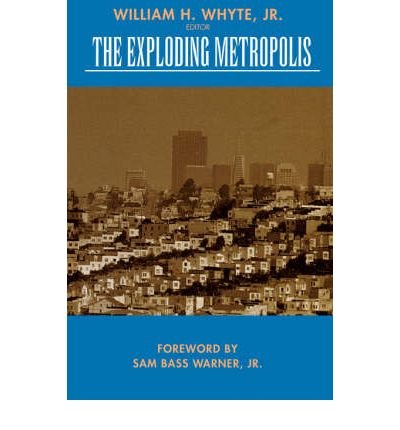
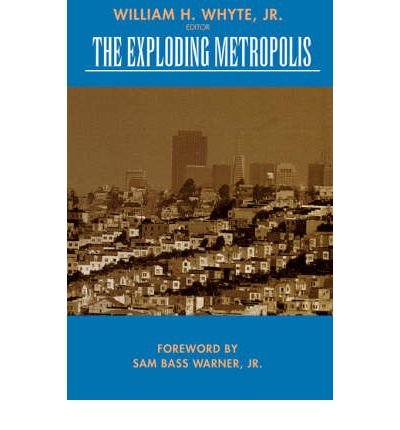
These addresses were delivered at the seminar, "The City as Dwelling." They direct our attention back to the center--the heart--of our urban community, to the often overlooked activities which shape and form our daily lives.
http://www.amazon.com/gp/product/9999837913/?tag=2022091-20
(book)
book
http://www.amazon.com/gp/product/B003VZWH7U/?tag=2022091-20
( Named by Newsweek magazine to its list of "Fifty Books ...)
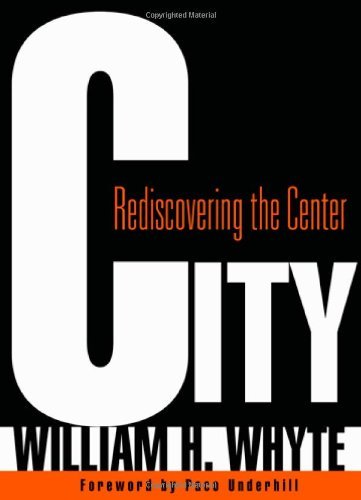
Named by Newsweek magazine to its list of "Fifty Books for Our Time." For sixteen years William Whyte walked the streets of New York and other major cities. With a group of young observers, camera and notebook in hand, he conducted pioneering studies of street life, pedestrian behavior, and city dynamics. City: Rediscovering the Center is the result of that research, a humane, often amusing view of what is staggeringly obvious about the urban environment but seemingly invisible to those responsible for planning it. Whyte uses time-lapse photography to chart the anatomy of metropolitan congestion. Why is traffic so badly distributed on city streets? Why do New Yorkers walk so fast—and jaywalk so incorrigibly? Why aren't there more collisions on the busiest walkways? Why do people who stop to talk gravitate to the center of the pedestrian traffic stream? Why do places designed primarily for security actually worsen it? Why are public restrooms disappearing? "The city is full of vexations," Whyte avers: "Steps too steep; doors too tough to open; ledges you cannot sit on. . . . It is difficult to design an urban space so maladroitly that people will not use it, but there are many such spaces." Yet Whyte finds encouragement in the widespread rediscovery of the city center. The future is not in the suburbs, he believes, but in that center. Like a Greek agora, the city must reassert its most ancient function as a place where people come together face-to-face.
http://www.amazon.com/gp/product/0812220749/?tag=2022091-20

http://www.amazon.com/gp/product/B002KTL2ZQ/?tag=2022091-20
( Regarded as one of the most important sociological and ...)
Regarded as one of the most important sociological and business commentaries of modern times, The Organization Man developed the first thorough description of the impact of mass organization on American society. During the height of the Eisenhower administration, corporations appeared to provide a blissful answer to postwar life with the marketing of new technologies—television, affordable cars, space travel, fast food—and lifestyles, such as carefully planned suburban communities centered around the nuclear family. William H. Whyte found this phenomenon alarming. As an editor for Fortune magazine, Whyte was well placed to observe corporate America; it became clear to him that the American belief in the perfectibility of society was shifting from one of individual initiative to one that could be achieved at the expense of the individual. With its clear analysis of contemporary working and living arrangements, The Organization Man rapidly achieved bestseller status. Since the time of the book's original publication, the American workplace has undergone massive changes. In the 1990s, the rule of large corporations seemed less relevant as small entrepreneurs made fortunes from new technologies, in the process bucking old corporate trends. In fact this "new economy" appeared to have doomed Whyte's original analysis as an artifact from a bygone day. But the recent collapse of so many startup businesses, gigantic mergers of international conglomerates, and the reality of economic globalization make The Organization Man all the more essential as background for understanding today's global market. This edition contains a new foreword by noted journalist and author Joseph Nocera. In an afterword Jenny Bell Whyte describes how The Organization Man was written.
http://www.amazon.com/gp/product/0812218191/?tag=2022091-20
(In 1980, William H. Whyte published the findings from his...)
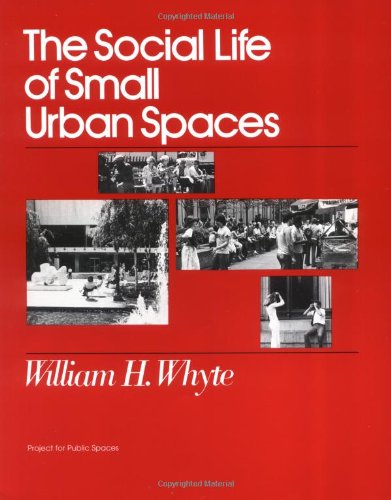
In 1980, William H. Whyte published the findings from his revolutionary Street Life Project in The Social Life of Small Urban Spaces. Both the book and the accompanying film were instantly labeled classics, and launched a mini-revolution in the planning and study of public spaces. They have since become standard texts, and appear on syllabi and reading lists in urban planning, sociology, environmental design, and architecture departments around the world. Project for Public Spaces, which grew out of Holly’s Street Life Project and continues his work around the world, has acquired the reprint rights to Social Life, with the intent of making it available to the widest possible audience and ensuring that the Whyte family receive their fair share of Holly’s legacy.
http://www.amazon.com/gp/product/097063241X/?tag=2022091-20
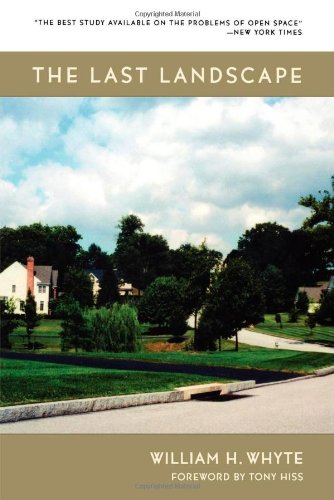
( The remaining corner of an old farm, unclaimed by devel...)
The remaining corner of an old farm, unclaimed by developers. The brook squeezed between housing plans. Abandoned railroad lines. The stand of woods along an expanded highway. These are the outposts of what was once a larger pattern of forests and farms, the "last landscape." According to William H. Whyte, the place to work out the problems of our metropolitan areas is within those areas, not outside them. The age of unchecked expansion without consequence is over, but where there is waste and neglect there is opportunity. Our cities and suburbs are not jammed; they just look that way. There are in fact plenty of ways to use this existing space to the benefit of the community, and The Last Landscape provides a practical and timeless framework for making informed decisions about its use. Called "the best study available on the problems of open space" by the New York Times when it first appeared in 1968, The Last Landscape introduced many cornerstone ideas for land conservation, urging all of us to make better use of the land that has survived amid suburban sprawl. Whyte's pioneering work on easements led to the passage of major open space statutes in many states, and his argument for using and linking green spaces, however small the areas may be, is a recommendation that has more currency today than ever before.
http://www.amazon.com/gp/product/0812217993/?tag=2022091-20
(Regarded as one of the most important sociological and bu...)
Regarded as one of the most important sociological and business commentaries of modern times, The Organization Man developed the first thorough description of the impact of mass organization on American society. During the height of the Eisenhower administration, corporations appeared to provide a blissful answer to postwar life with the marketing of new technologies-television, affordable cars, space travel, fast food-and lifestyles, such as carefully planned suburban communities centered around the nuclear family. William H. Whyte found this phenomenon alarming. As an editor for Fortune magazine, Whyte was well placed to observe corporate America; it became clear to him that the American belief in the perfectibility of society was shifting from one of individual initiative to one that could be achieved at the expense of the individual. With its clear analysis of contemporary working and living arrangements, The Organization Man rapidly achieved bestseller status. Since the time of the book's original publication, the American workplace has undergone massive changes. In the 1990s, the rule of large corporations seemed less relevant as small entrepreneurs made fortunes from new technologies, in the process bucking old corporate trends. In fact this "new economy" appeared to have doomed Whyte's original analysis as an artifact from a bygone day. But the recent collapse of so many startup businesses, gigantic mergers of international conglomerates, and the reality of economic globalization make The Organization Man all the more essential as background for understanding today's global market. This edition contains a new foreword by noted journalist and author Joseph Nocera. In an afterword Jenny Bell Whyte describes how The Organization Man was written.
http://www.amazon.com/gp/product/B00I2FDA3E/?tag=2022091-20
(This book was digitized and reprinted from the collection...)
This book was digitized and reprinted from the collections of the University of California Libraries. Together, the more than one hundred UC Libraries comprise the largest university research library in the world, with over thirty-five million volumes in their holdings. This book and hundreds of thousands of others can be found online in the HathiTrust Digital Library.HP's patented BookPrep technology was used to clean artifacts resulting from use and digitization, improving your reading experience.
http://www.amazon.com/gp/product/1125370432/?tag=2022091-20
http://www.amazon.com/gp/product/B0088OY0MY/?tag=2022091-20
http://www.amazon.com/gp/product/B000E7RQHO/?tag=2022091-20
Whyte, William Hollingsworth was born on October 1, 1917 in West Chester, Pennsylvania, United States. Son of William Hollingsworth and Louise (Price) Whyte.
Bachelor cum laude, Princeton University, 1939.
With, Vick Chemical Company, 1939-1941; with, First Marmes, 1941-1945; writer, Fortune magazine, New York City, 1946-1951; assistant managing editor, Fortune magazine, 1951-1959. Distinguished professor Hunter College, City Universitas Negeri Yogyakarta, 1970-1971.
( Regarded as one of the most important sociological and ...)
(Regarded as one of the most important sociological and bu...)
(This book was digitized and reprinted from the collection...)
(This book was digitized and reprinted from the collection...)
(These addresses were delivered at the seminar, "The City ...)
( Named by Newsweek magazine to its list of "Fifty Books ...)
(Business, Management, Finance, Business Administration, E...)
( The remaining corner of an old farm, unclaimed by devel...)
(In 1980, William H. Whyte published the findings from his...)
(book)
(1)
Member Hudson River Valley Commission. Member President's Task Force Natural Beauty, 1964-1965. Co-director White House Conference Natural Beauty.
Trustee Episcopal Church School Foundation. Trustee Conservation Foundation American Conservation Association. Board directors Municipal Art Society New York, New York Landmarks Conservancy.
Served to captain United States Marine Corps Reserve, 1941-1945. Member Society of Cincinnati (Maryland). Clubs: Quadrangle, Century Association (New York City).
Son of William Hollingsworth and Louise (Price) W. M. Jenny Bell Bechtel, October 1964. 1 daughter, Alexandra.
