

Background
Bary, William Theodore de was born on August 9, 1919 in New York City. Son of William Emil and Mildred (Marquette) de Bary.

(Sources of Indian Tradition Volume II edited by Wm. Theod...)
Sources of Indian Tradition Volume II edited by Wm. Theodore De Bary
http://www.amazon.com/gp/product/B000OV4YIY/?tag=2022091-20

(A seminal monograph in the field of Chinese Intellectual ...)
A seminal monograph in the field of Chinese Intellectual history.
http://www.amazon.com/gp/product/0231083130/?tag=2022091-20

( Since it was first published more than forty years ago,...)
Since it was first published more than forty years ago, Sources of Japanese Tradition, Volume 2, has been considered the authoritative sourcebook for readers and scholars interested in Japan from the eighteenth century to the post-World War II period. Now greatly expanded to include the entire twentieth century, and beginning in 1600, Sources of Japanese Tradition presents writings from modern Japan's most important philosophers, religious figures, writers, and political leaders. The volume also offers extensive introductory essays and commentary to assist in understanding the documents' historical setting and significance. Wonderfully varied in its selections, this eagerly anticipated expanded edition has revised many of the texts from the original edition and added a great many not included or translated before. New additions include documents on the postwar era, the importance of education in the process of modernization, and women's issues. Beginning with documents from the founding of the Tokugawa shogunate, the collection's essays, manifestos, religious tracts, political documents, and memoirs reflect major Japanese religious, philosophical, social, and political movements. Subjects covered include the spread of neo-Confucian and Buddhist teachings, Japanese poetry and aesthetics, and the Meiji Restoration. Other documents reflect the major political trends and events of the period: the abolition of feudalism, agrarian reform, the emergence of political parties and liberalism, and the Sino-Japanese and Russo-Japanese wars. The collection also includes Western and Japanese impressions of each other via Western religious missions and commercial and cultural exchanges. These selections underscore Japanese and Western apprehension of and fascination with each other. As Japan entered the twentieth century, new political and social movements-Marxism, anarchism, socialism, feminism, and nationalism-entered the national consciousness. Later readings in the collection look at the buildup to war with the United States, military defeat, and American occupation. Documents from the postwar period echo Japan's struggle with its own history and its development as a capitalist democracy.
http://www.amazon.com/gp/product/023112984X/?tag=2022091-20

http://www.amazon.com/gp/product/B00GTOJOFI/?tag=2022091-20

(These essays explore the continuities and discontinuities...)
These essays explore the continuities and discontinuities between the Neo-Confucian thought of Ming China and early Tokugawa Japan and the practical learning of the 17th and 18th centuries, underlining the need for a deeper examination of the complex relationship between traditional and modern thoughts and values.
http://www.amazon.com/gp/product/0231046138/?tag=2022091-20

( For almost fifty years, Sources of Japanese Tradition h...)
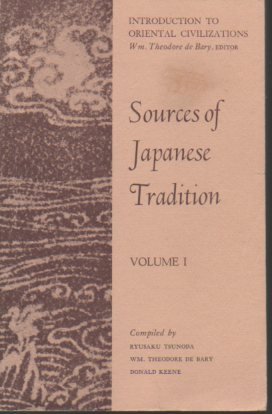
For almost fifty years, Sources of Japanese Tradition has been the single most valuable collection of English-language readings on Japan. Unrivalled in its wide selection of source materials on history, society, politics, education, philosophy, and religion, the two-volume textbook is a crucial resource for students, scholars, and readers seeking an introduction to Japanese civilization. Originally published in a single hardcover book, Volume 2 is now available as an abridged, two-part paperback. Part 1 covers the Tokugawa period to 1868, including texts that address the spread of neo-Confucianism and Buddhism and the initial encounters of Japan and the West. Part 2 begins with the Meiji period and ends at the new millennium, shedding light on such major movements as the Enlightenment, constitutionalism, nationalism, socialism, and feminism, and the impact of the postwar occupation. Commentary by major scholars and comprehensive bibliographies and indexes are included. Together, these readings map out the development of modern Japanese civilization and illuminate the thought and teachings of its intellectual, political, and religious leaders.
http://www.amazon.com/gp/product/0231139195/?tag=2022091-20

http://www.amazon.com/gp/product/B004MLH89E/?tag=2022091-20

http://www.amazon.com/gp/product/B01181TDHA/?tag=2022091-20

http://www.amazon.com/gp/product/B001JTPUMY/?tag=2022091-20

http://www.amazon.com/gp/product/0231056664/?tag=2022091-20

(A collection of seminal primary readings on the social, i...)
A collection of seminal primary readings on the social, intellectual, and religious traditions of China, Sources of Chinese Tradition, Volume 1 has been widely used and praised for almost forty years as an authoritative resource for scholars and students and as a thorough and engaging introduction for general readers. Here at last is a completely revised and expanded edition of this classic sourcebook, compiled by noted China scholars Wm. Theodore de Bary and Irene Bloom. Updated to reflect recent scholarly developments, with extensive material on popular thought and religion, social roles, and women's education, this edition features new translations of more than half the works from the first edition, as well as many new selections.
http://www.amazon.com/gp/product/B0022YBDRG/?tag=2022091-20

(This book represents the last in a series dealing with th...)
This book represents the last in a series dealing with the civilizations of China, Japan, and India. It contains source readings that tell us what the Chinese have thought about themselves, the universe they lived in, and the problems they faced living together.
http://www.amazon.com/gp/product/B0012MG04U/?tag=2022091-20

(New. Ships with Care, Daily.)
New. Ships with Care, Daily.
http://www.amazon.com/gp/product/B0012Q2R84/?tag=2022091-20

(This book, compiled from basic Buddhist writings, present...)
This book, compiled from basic Buddhist writings, presents a survey of Buddhist thought in India, China, and Japan, covering the central doctrines and practices that has profoundly influenced human life in Asia. Developments in practical ethics, social attitudes, philosophical speculation, and religious and aesthetic contemplation are represented by selected excerpts from basic writings with succinct introductions and commentary. From these one may observe not only the remarkable vitality of Buddhism in its spread through Asia, but also the essential links between widely diverse forms, showing how the spiritual message of the Buddha found expression in different historical and cultural circumstances. Thus both its continuity in time and its wide range of influence mark Buddhism as a major spiritual force in the world. Buddha, as the Awakened One, has exemplified to millions of followers throughout the ages a living Truth, a dynamic wisdom and an active compassion. It is these qualities that have inspired hope and courage in men who were asked to face to the stark reality of man's condition: the inevitable involvement in suffering which arises from his persistent egoism and refusal to recognize his finitude.
http://www.amazon.com/gp/product/0394716965/?tag=2022091-20

http://www.amazon.com/gp/product/0231070047/?tag=2022091-20

http://www.amazon.com/gp/product/B010TT8KH6/?tag=2022091-20

(Examines Japanese thought through the traditions of Shint...)
Examines Japanese thought through the traditions of Shinto, Buddhism, Confucianism, liberalism, nationalism, and socialism from earliest times to the present.
http://www.amazon.com/gp/product/0231086040/?tag=2022091-20

http://www.amazon.com/gp/product/B012HVJD1Q/?tag=2022091-20
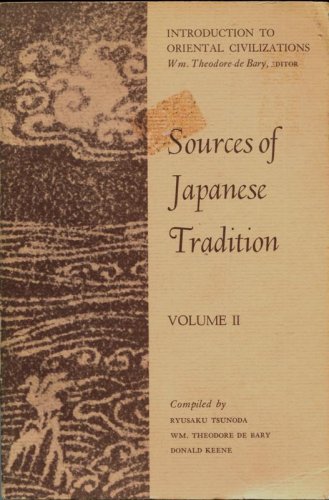
(Here, in the second volume of Sources of Japanese Traditi...)
Here, in the second volume of Sources of Japanese Tradition, the editors bring together translations that reflect Japanese thought in the world today.
http://www.amazon.com/gp/product/B0016X939E/?tag=2022091-20

( Since the horrific Tiananmen Square massacre in 1989, t...)
Since the horrific Tiananmen Square massacre in 1989, the debate on human rights in China has raged on with increasing volume and shifting context, but little real progress. In this provocative book, one of our most learned scholars of China moves beyond the political shouting match, informing and contextualizing this debate from a Confucian and a historical perspective. "Asian Values" is a concept advanced by some authoritarian regimes to differentiate an Asian model of development, supposedly based on Confucianism, from a Western model identified with individualism, liberal democracy, and human rights. Highlighting the philosophical development of Confucianism as well as the Chinese historical experience with community organization, constitutionalism, education, and women's rights, Wm. Theodore de Bary argues that while the Confucian sense of personhood differs in some respects from Western libertarian concepts of the individual, it is not incompatible with human rights, but could, rather, enhance them. De Bary also demonstrates that Confucian communitarianism has historically resisted state domination, and that human rights in China could be furthered by a genuine Confucian communitarianism that incorporates elements of Western civil society. With clarity and elegance, Asian Values and Human Rights broadens our perspective on the Chinese human rights debate.
http://www.amazon.com/gp/product/0674001966/?tag=2022091-20

(-- Journal of Chinese Religions)
-- Journal of Chinese Religions
http://www.amazon.com/gp/product/0231052294/?tag=2022091-20

http://www.amazon.com/gp/product/1597405930/?tag=2022091-20

http://www.amazon.com/gp/product/B003ZNRZ2U/?tag=2022091-20

(The doyen of Confucian studies in America here constructs...)
The doyen of Confucian studies in America here constructs a magisterial overview of 3,000 years of East Asian civilizations, principally in the form of dialogues among the major systems of thought that have dominated the Asian world's historical development.
http://www.amazon.com/gp/product/067422406X/?tag=2022091-20
http://www.amazon.com/gp/product/B001AD39EU/?tag=2022091-20

(-- Wing-tsit Chan)
-- Wing-tsit Chan
http://www.amazon.com/gp/product/0231068085/?tag=2022091-20

http://www.amazon.com/gp/product/B011DBEUSC/?tag=2022091-20

(Self and Society in Ming Thought)
Self and Society in Ming Thought
http://www.amazon.com/gp/product/0231032714/?tag=2022091-20

http://www.amazon.com/gp/product/B000K0CGBQ/?tag=2022091-20

http://www.amazon.com/gp/product/B003D8KWWC/?tag=2022091-20

http://www.amazon.com/gp/product/B01182NQJU/?tag=2022091-20

(This volume provides an understanding of contemporary civ...)
This volume provides an understanding of contemporary civilization in India and Pakistan in which the editor presents material that illustrates Indian thought since earliest times. 1958 384pp
http://www.amazon.com/gp/product/B000EHMIHM/?tag=2022091-20

http://www.amazon.com/gp/product/0674910168/?tag=2022091-20

(A collection of seminal primary readings on the social, i...)
A collection of seminal primary readings on the social, intellectual, and religious traditions of China, Sources of Chinese Tradition, Volume 1 has been widely used and praised for almost forty years as an authoritative resource for scholars and students and as a thorough and engaging introduction for general readers. Here at last is a completely revised and expanded edition of this classic sourcebook, compiled by noted China scholars Wm. Theodore de Bary and Irene Bloom. Updated to reflect recent scholarly developments, with extensive material on popular thought and religion, social roles, and women's education, this edition features new translations of more than half the works from the first edition, as well as many new selections. Arranged chronologically, this anthology is divided into four parts, beginning at the dawn of literate Chinese civilization with the Oracle-Bone inscriptions of the late Shang dynasty (1571–1045 B.C.E.) and continuing through the end of the Ming dynasty (C.E. 1644). Each chapter has an introduction that provides useful historical context and offers interpretive strategies for understanding the readings. The first part, The Chinese Tradition in Antiquity, considers the early development of Chinese civilization and includes selections from Confucius's Analects, the texts of Mencius and Laozi, as well as other key texts from the Confucian, Daoist, and Legalist schools. Part 2, The Making of a Classical Culture, focuses on Han China with readings from the Classic of Changes (I Jing), the Classic of Filiality, major Han syntheses, and the great historians of the Han dynasty. The development of Buddhism, from the earliest translations from Sanskrit to the central texts of the Chan school (which became Zen in Japan), is the subject of the third section of the book. Titled Later Daoism and Mahayana Buddhism in China, this part also covers the teachings of Wang Bi, Daoist religion, and texts of the major schools of Buddhist doctrine and practice. The final part, The Confucian Revival and Neo-Confucianism, details the revival of Confucian thought in the Tang, Song, and Ming periods, with historical documents that link philosophical thought to political, social, and educational developments in late imperial China. With annotations, a detailed chronology, glossary, and a new introduction by the editors, Sources of Chinese Tradition will continue to be a standard resource, guidebook, and introduction to Chinese civilization well into the twenty-first century.
http://www.amazon.com/gp/product/0231109393/?tag=2022091-20

http://www.amazon.com/gp/product/B000ODTKMC/?tag=2022091-20

(Brand New. In Stock. Will be shipped from US. Excellent C...)
Brand New. In Stock. Will be shipped from US. Excellent Customer Service.
http://www.amazon.com/gp/product/B004JX1OYK/?tag=2022091-20

http://www.amazon.com/gp/product/B000GWE94A/?tag=2022091-20

http://www.amazon.com/gp/product/B000GR7BGI/?tag=2022091-20

http://www.amazon.com/gp/product/B011821P34/?tag=2022091-20
Bary, William Theodore de was born on August 9, 1919 in New York City. Son of William Emil and Mildred (Marquette) de Bary.
Bachelor, Columbia University, 1941. Master of Arts, Columbia University, 1948. Doctor of Philosophy, Columbia University, 1953.
Doctor of Letters (honorary), St. Lawrence University, 1960. Doctor of Humane Letters (honorary), Loyola University, Chicago, 1970. Doctor of Letters (honorary), Columbia University, 1994.
Member of faculty, Columbia University, New York City, since 1949;
professor Chinese and Japanese, Columbia University, New York City, 1959-1966;
department chairman East Asian languages and cultures, Columbia University, New York City, 1960-1966;
chairman university committee Oriental studies, Columbia University, New York City, 1953-1961;
director East Asian Language and Area Center, Columbia University, New York City, 1960-1972;
Horace Carpentier professor Oriental studies, Columbia University, New York City, 1966-1978;
executive vice president for academic affairs, provost, Columbia University, New York City, 1971-1978;
John Mitchell Mason professor, Columbia University, New York City, 1979-1989;
John Mitchell Mason professor, provost emeritus, Columbia University, New York City, since 1990;
director Heyman Center for Humanities, Columbia University, New York City, since 1990. Ch'ien Mu lecturer Chinese U. Hong Kong, 1982. Inaugural lecturer Edwin O. Reischauer lectureship in East Asian affairs, Harvard University, 1986.
Guest lecturer College de France, 1986. Tanner lecturer University of California, Berkeley, 1988.
(A collection of seminal primary readings on the social, i...)
(A collection of seminal primary readings on the social, i...)
(These essays explore the continuities and discontinuities...)
(The doyen of Confucian studies in America here constructs...)
(The doyen of Confucian studies in America here constructs...)
( Since it was first published more than forty years ago,...)
(This book, compiled from basic Buddhist writings, present...)
(This volume provides an understanding of contemporary civ...)
( Since the horrific Tiananmen Square massacre in 1989, t...)
(Examines Japanese thought through the traditions of Shint...)
(Here, in the second volume of Sources of Japanese Traditi...)
( For almost fifty years, Sources of Japanese Tradition h...)
(This book represents the last in a series dealing with th...)
(A seminal monograph in the field of Chinese Intellectual ...)
(This is a reproduction of a book published before 1923. T...)
(Sources of Indian Tradition Volume II edited by Wm. Theod...)
(Two volume softcover set, in English. Volume 1 includes t...)
(Sources of Chinese Tradition, Vol. 2 by William Theodore ...)
(Self and Society in Ming Thought)
(-- Journal of Chinese Religions)
(Will be shipped from US. Used books may not include compa...)
(-- Wing-tsit Chan)
(VG Condition)
(Brand New. In Stock. Will be shipped from US. Excellent C...)
(2 Vol. Set. Vol. 1. has light pencil underline. Vol. 2. o...)
(New. Ships with Care, Daily.)
Lieutenant commander of The United States Navy Reserve, 1942-1946, PTO. Member Association Asian Studies (board directors 1961-1964, president 1969-1970), China Society, Japan society New York (board directors 1964-1966), American Council Learned Socs. (chairman subcommittee Chinese thought, board directors 1978-1986, fellow 1947-1948), American Academy Arts and Sciences (county), Phi Beta Kappa.
Married Fanny Brett, June 16, 1942. Children: Mary Brett, Paul Ambrose, Catherine Anne, Mary Beatrice.
