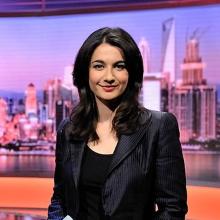
Yalda Hakim is an Australian broadcast journalist, international correspondent, documentary maker, and news presenter. Born in Kabul, she was raised in Sydney after her family fled Afghanistan. Her reporting has covered wars, humanitarian crises, and international politics for SBS, the BBC, and Sky News.
Background
Hakim was born in Kabul in 1983. When she was six months old, her family fled Afghanistan during the Soviet–Afghan War, traveling overland to Pakistan. After two years in Pakistan, the family settled in Australia in 1986, and Hakim grew up in Parramatta, western Sydney.
Her family background connected Afghan displacement with Australian migrant life. Hakim has spoken about the influence of Afghanistan's political upheaval on her interest in international affairs and journalism. As a school student, she attended Parramatta West Public School and Macarthur Girls High School, where she played violin and served as a sports captain and prefect.
Education
Hakim attended Parramatta West Public School and Macarthur Girls High School in Sydney. Macarthur Girls High School is a public secondary school serving the Parramatta region and has a long-established academic and extracurricular program.
She studied media at Macquarie University from 2002 to 2004 before completing a Diploma in Journalism at Macleay College in Sydney in 2005. Macleay College emphasized practical journalism and media training, including industry placements. Hakim later completed a Bachelor of Arts in Journalism through distance education at Monash University while undertaking professional training at the Special Broadcasting Service. Monash University, founded in Melbourne in 1958, is one of Australia's major research universities.
Career
Hakim began her journalism career at the Special Broadcasting Service, Australia's multicultural public broadcaster, through a cadetship and reporting work. She learned television production and self-shooting while working on programs including Living Black and Dateline. Her early assignments included reporting from remote Australian communities and international stories.
In 2008, Hakim returned to Kabul for a Dateline report and subsequently reported from Afghanistan and other international locations. Her work for SBS covered conflict, migration, humanitarian crises, and global affairs. From 2011, she co-hosted Dateline with Mark Davis, alternating presentation duties while the other presenter was on assignment.
Hakim joined BBC News in 2013 and worked as an international correspondent, presenter, and documentary maker. She presented Impact on BBC World News, reported for BBC News and Newsnight, and made films for the Our World strand. Her reporting included Afghanistan, Iraq, Syria, South Sudan, Darfur, Libya, Ukraine, and other regions affected by war and political instability. She interviewed political leaders and other prominent public figures, and reported extensively on the Taliban's return to power in Afghanistan in 2021.
In 2023, Hakim joined Sky News. She presents The World with Yalda Hakim and reports on major international events, including conflicts and humanitarian crises. She also founded the Yalda Hakim Foundation in 2018, which supports scholarships, mentoring, internships, and higher-education opportunities for talented young Afghan women.
Views
Hakim's public journalism emphasizes human dignity, the experiences of civilians in conflict, and the importance of representing people affected by war with accuracy and empathy. Her advocacy for Afghan girls' education reflects a commitment to access to education, professional opportunity, and the rights of women and girls.
Personality
Hakim has described empathy and human-centered reporting as central to her journalistic approach. She emphasizes the responsibility of reporting on people affected by conflict as individuals rather than reducing them to subjects of a news story.
Connections
Hakim established the Yalda Hakim Foundation in 2018 in partnership with the American University of Afghanistan. The foundation provides educational opportunities and professional support for young Afghan women, including scholarships and mentoring. It later supported students affected by the closure of the university and helped connect Afghan students with further study abroad.