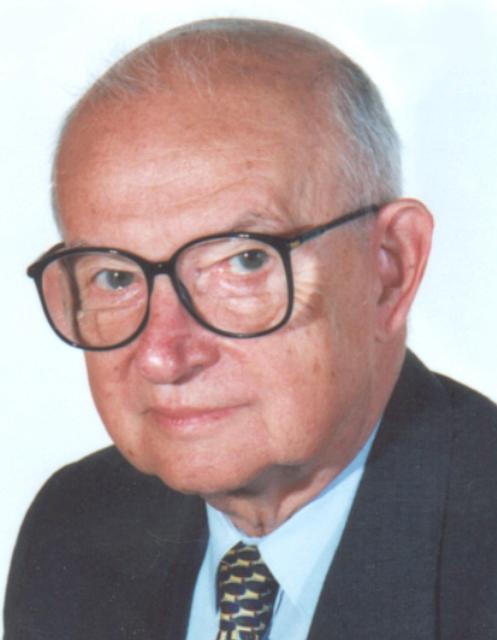
Zdzisław Lech Sadowski was a Polish economist, professor of economics and public official whose work focused on macroeconomics, economic policy, statistics and development theory. He served as Poland’s deputy prime minister in 1987–1988, chaired the Planning Commission, and headed the Polish Economic Society from 1985 to 2005.
Background
Zdzisław Lech Sadowski was born in Warsaw on 10 February 1925, the son of Sydney Jan Władysław Sadowski and Wanda née Malewska. He completed his secondary education through clandestine classes during the German occupation, graduating from the Stefan Batory Gymnasium and Lyceum in Warsaw in 1941. During the Second World War he belonged first to the National Armed Forces and later to the Home Army. As a corporal officer cadet in the Krybar combat group, he took part in the Warsaw Uprising. In 1945–1946 he was imprisoned for political reasons and received a suspended two-year sentence in the Trial of the Thirteen Students.
Education
Sadowski completed his secondary education at the Stefan Batory Gymnasium and Lyceum in Warsaw, receiving his baccalaureate through clandestine classes in 1941. He graduated from the Warsaw School of Economics in 1945. He then pursued an academic career at the University of Warsaw, where he obtained a doctorate in economic sciences in 1962, completed his habilitation in 1979, and received the title of professor of economic sciences in 1980. He subsequently became a full professor at the University of Warsaw’s Faculty of Economic Sciences.
Career
Sadowski began his academic work at the University of Warsaw in 1953 and remained associated with the institution for most of his professional life. From 1965 to 1970 he was a professor at the University of Ghana in Accra and also headed a department there. From 1970 to 1972 he served as deputy director of the United Nations Centre for Development Planning, Projections and Policies in New York. After returning to Poland, he worked at the Institute of Planning, where he was a department head and later deputy director between 1972 and 1981. He also held an academic post in the Department of Political Economy of Socialism at the University of Warsaw. From 1980 he was a professor at the University of Warsaw, and from 1989 to 2005 he headed its Chair of Economic Development Theory.
In public administration, Sadowski served from 1981 to 1985 as deputy government plenipotentiary for economic reform. From 1985 to 1987 he was vice-chairman and then chairman of the Consultative Economic Council. In 1987 he became deputy prime minister in the government of Zbigniew Messner and chairman of the Planning Commission at the Council of Ministers, holding the ministerial office until 1988 and the chairmanship of the Planning Commission until October 1987. He participated in the preparation of the second stage of Poland’s economic reform, the restructuring of the banking system, legislation on freedom of economic activity, and the programme that abolished meat ration coupons. He later served on the Consultative Council to the Chairman of the Council of State, represented the government-party side in the economic and social-policy group during the Round Table talks, and was a member of the Economic Council and Supervisory Board of the Foreign Debt Service Fund in 1989–1991. From 1993 he served on the Council for Social and Economic Strategy.
Achievements
Contributed to the development of Polish economic policy and economic reform, including preparation of the second stage of economic reform and the restructuring of the banking system.
Served as president of the Polish Economic Society for two decades and subsequently became its honorary president.
Developed an extensive body of work on macroeconomics, economic policy, statistics, economic development and the social consequences of economic transformation.
Works
Co-authored book
Wyzwania rozwojowe
(Co-authored work on development challenges.)
1977
Collected essays
Reforma z bliska: wybór tekstów
(Collection of texts prepared by Sadowski and published by...)
(Research report on social goals in determining developmen...)
1994
Politics
He was associated with left-wing economic thought, supported Keynesian economics and state intervention, and stood as a Senate candidate for the Labour Union (Unia Pracy) in 1993.
Views
Sadowski advocated a Keynesian and socially oriented approach to economic policy. He supported progressive taxation, the use of domestic demand to combat unemployment, and state intervention in the economy. He recognized the need for and achievements of Poland’s post-1989 transformation while criticizing its social costs and opposing an exclusively neoliberal interpretation of economic policy.
Membership
Sadowski was a member of the Polish Economic Society from 1945 and served as its president from 1985 to 2005; after his retirement he became its honorary president. He was a corresponding member of the Polish Academy of Sciences from 1994 and participated in the work of its Committee of Economic Sciences and the Forecasting Committee “Poland 2000 Plus,” where he served as deputy chairman. He was also associated with the International Economic Association, serving as editor-in-chief and a member of its council, and was a member of the Warsaw Scientific Society. He co-founded the Polish Society for Cooperation with the Club of Rome and served as its president. He was editor-in-chief of the economic journal Ekonomista from 1994.
President from 1985 to 2005; honorary president after retirement.
Polish Economic Society
1945 - 2005
Corresponding member from 1994; associated with the Committee of Economic Sciences and the Forecasting Committee “Poland 2000 Plus.”
Polish Academy of Sciences
1994
Editor-in-chief and member of the association’s council.
International Economic Association
Co-founder, member and president.
Polish Society for Cooperation with the Club of Rome
Participated in Polish cooperation with the Club of Rome.
Club of Rome
Ordinary member.
Warsaw Scientific Society
Personality
Sadowski presented himself as a socially engaged economist concerned with the relationship between economic development, employment and social welfare. His public economic positions combined support for rapid economic change with criticism of the social costs of neoliberal reform.
Connections
Sadowski was the son of Sydney Jan Władysław Sadowski and Wanda Malewska. He was married to Danuta Grabowska-Sadowska. His professional connections included long-standing academic and institutional associations with the University of Warsaw, the Polish Economic Society, the Polish Academy of Sciences, the United Nations and the Club of Rome.
Polish Economic Society: Presidents and Founders
Institutional profile documenting Sadowski’s education, academic titles, government responsibilities, presidency of the Polish Economic Society and major books.