Background
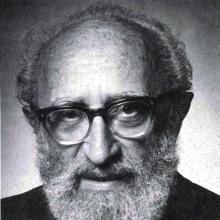
Lerner, Abba Ptachya was born in 1903 in Bessarabia, Russia. Son of Morris Isaac and Sofie (Buchman) Lerner.

Lerner, Abba Ptachya was born in 1903 in Bessarabia, Russia. Son of Morris Isaac and Sofie (Buchman) Lerner.
It was his early association with the plethora of socialist movements prevalent in the 1920s Britain that brought him into contact with economics. The L.S.E. attracted the self-taught Lerner largely because of its Fabian associations, but found himself instead in the hands of Lionel Robbins.
ABba Lerner's student career was sheer brilliance. He published several first-rank papers in economic theory and still found time to launch the Review of Economic Studies with Paul Sweezy and Ursula Webb. His 'student' papers catapulted him into the frontlines of the "Paretian revival" of the 1930s which consolidated neo-classical theory.
A six-month stint at Cambridge in 1934-1935 brought him into contact with John Maynard Keynes's "Cambridge Circus".
For forty years, Lerner has replaced a stunning number of institutions, rarely stayed in one place for more than five years.
Abba Lerner's numerous contributions to economic theory and policy make him one of most influential economists of the century - although his congenital inability to play academic politics ensured that he would not lead a conventional career.
Lerner's special contribution to the economy has been following:
• The use of fiscal policy and monetary policy as the twin tools of Keynesian economics is credited to Lerner by historians such as David Colander.
• The Lerner symmetry theorem states that an import tariff can have the same effects as an export tax
• The Lerner Index measures potential monopoly power as the negative inverse of demand elasticity.
• Lerner improved a formula of Alfred Marshall, which is known since as the Marshall–Lerner condition.
• He developed a model of market socialism, which differed from the pure planned economy. It became known as the Third Way. By the 1960s Lerner began to distance himself from his early work on socialism.
• Lerner improved the calculations made by Wilhelm Launhardt on the effect of terms of trade.
• He developed the concept of distributive efficiency, which shows that economic equality will produce the greatest total happiness with a given amount of wealth.
• Lerner contributed to the Lange-Lerner-Taylor theorem.
• Based on effective demand principle and chartalism, Lerner developed functional finance, a theory of purposeful financing (and funding) to meet explicit goals, including full employment, no taxation designed solely to fund expenditure or finance investment, and low inflation.
• Lerner developed the concept of the NAIRU (before Friedman and Phelps). He termed it "low full employment" and contrasted it the "high full employment," the maximum employment achievable by implementing functional finance.
• The Lerner-Samuelson theorem goes back to Lerner.
Lerner has proved himself in other areas. For example, in the 50's Lerner was adviser of the government of Israel. In 1966 he became an honorary member of the American Economic Association. In 1980, when Lerner was already 77 years old, he became President of the Atlantic Economic Society, thus added to a long list of economists-centenarians.
Money as a Creature of the State, 1947
The Diagrammatical Representation of Cost Conditions in International Trade, 1932
The Diagrammatical Representation of Demand Conditions in International Trade, 1934
Economic Theory and Socialist Economy, 1934
The Symmetry Between Import and Export Taxes, 1936
A Note on Socialist Economies, 1936
Theory and Practice of Socialist Economics, 1938
The Economic Steering Wheel; the Story of the People's New Clothes, 1941
Interest Theory: Supply and demand for loans or supply and demand for cash? 1944
The Inflationary Process: Some theoretical aspects, 1949
The Essential Properties of Interest and Money, 1952
Factor Prices and International Trade, 1952
On the Marginal Product of Capital and the Marginal Efficieny of Investment, 1953
Consumption-Loan Interest and Money, 1959
On Generalizing the General Theory, 1960
On Some Recent Developments in Capital Theory, 1965
The 1971 Report of the President's Council of Economic Advisers: Priorities and Efficiency, 1971
The Economics and Politics of Consumer Sovereignty, 1972
Alternative Formulations of the Theory of Interest, 1947
The Burden of the National Debt, 1948
The economics of Employment, 1951
The Economics of Control: Principles of welfare economics, 1944
The economics of control, 1975
Flation: not inflation of prices, not deflation of jobs, 1972
From Pre-Keynes to Post-Keynes, 1977
Mr Keynes's General Theory, 1936
Keynesian Economics in the Sixties, 1963
Macro-Economics and Micro-Economics, 1962
Map: A Market Anti-Inflation Plan, with D.Colander, 1980
Money, Debt and Wealth, 1973
Fellow American Economics Association (past vice president), Econometric Society, London School Economics (honorary). Member National Academy Sciences Atlantic Economics Society (president 1980), Western Economics Association (Vice-President 1980), Royal British Academy President, University Centers for Rational Alternatives, 1975-1977.