Background
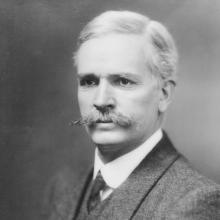
Andrew Fisher was born on August 29, 1862. He was born in Crosshouse, a mining village near Kilmaurs, East Ayrshire, Scotland. He was the second of eight children of Robert Fisher and Jane Garvin.

Andrew Fisher was born on August 29, 1862. He was born in Crosshouse, a mining village near Kilmaurs, East Ayrshire, Scotland. He was the second of eight children of Robert Fisher and Jane Garvin.
Fisher's education consisted of some primary schooling, some night schooling, and the reading of books in the library of the cooperative his father had helped to establish.
Andrew was a miner before emigrating to Queensland in 1885. Working in the Burrum coal mines, he served as a union leader, meanwhile reading economics and social science. He became a pioneer member of the emerging Labor party, under whose banner he entered the Queensland Legislative Assembly in 1893.
In Australia's first federal elections (March 1901) Fisher won a seat in the House of Representatives. He won the deputy leadership of the party in 1904. He was minister for trade and customs in Labour's first federal ministry. When his leader, John Christian Watson, rebelled against caucus domination in 1908, Fisher was the party's almost unanimous choice to succeed him.
In November 1908 Fisher, a self-avowed Socialist withdrew the support previously accorded Alfred Deakin and became prime minister and treasurer. Labour did not hold an outright majority, however, and the Fisher ministry lasted only 7 months before being ousted by a "fusion" of non-Labour forces.
The general election of April 1910 resulted in a Labour majority, opening the way for a spate of legislation. A federal land tax and compulsory military service were introduced, a government-owned bank (the Commonwealth Bank) was set up and private banks' notes withdrawn, maternity allowances were established as part of expanded social service benefits, and the transcontinental rail link was begun. After High Court rulings defined the limits of federal power in various fields important to Labour's objectives, Fisher in 1911 launched a referendum to amend the Constitution. It and a similar referendum in 1913 failed.
In the general election in mid-1913, Labour lost some seats and Fisher resigned, but a special poll in 1914 brought Fisher back to power. The third Fisher government fully supported Australia's participation in World War I and began immediate recruitment of an expeditionary force and deployment of the Royal Australian Navy. German possessions in the South Pacific area were taken over. Union pressure for social legislation was unabated, and as expectations for a quick end to the war faded, dissatisfaction grew. Amid signs of an impending party split Fisher resigned in October 1915 to become Australian high commissioner in London (1916-1920).
Andrew Fisher is remembered as an labor leader. As the fourth prime minister of Australia, he pursued aims of greater social justice and initiated major projects in the new nation.
At the end of the First World War, France awarded him the Légion d'honneur, but he declined it; he did not like decorations of any kind and adhered to this view throughout his life.
The federal electorate of Fisher was named after him. A Canberra suburb, Fisher, was also created in his memory, with its streets reflecting a mining theme in honour of Fisher's occupation before entering public life. Ramsay MacDonald, Britain's first Labour Prime Minister, unveiled a memorial to Fisher in Hampstead Cemetery in 1930. A memorial garden was also dedicated to Fisher at his birthplace in the late 1970s.
In 1972 he was honoured on a postage stamp bearing his portrait issued by Australia Post.
In 1992, his home in Gympie (Andrew Fisher's Cottage) was listed on the Queensland Heritage Register.
At the end of 1901, Fisher married to Margaret Irvine, his previous landlady's daughter. He had six children: John Fisher, Margaret Fisher, James Fisher, Robert Fisher, Andrew Fisher and Henry Fisher.