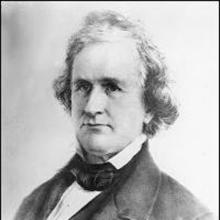
Antoine François Saugrain De Vigni was a French-born physician, scientist, naturalist and philosopher.
Background
He was born on February 17, 1763 in Paris, France, son of Antoine and Marie (Brunet) Saugrain, the de Vigni in his name, after a Paris custom, merely indicating the place where he was nursed as an infant. His ancestors were librarians, booksellers, and publishers.
Education
He was educated in physics, chemistry, and mineralogy.
Career
While still a very young man, he went into the service of the king of Spain, and in 1785 and again in 1786 he was in Mexico for the purpose of examining mines and mineral productions.
In 1787 in the company of two friends, M. Raquet and M. Picque, he sailed for the United States, remained for a while in Philadelphia, where he enjoyed the intimate friendship of Benjamin Franklin, and in the spring of 1788 traveled westward in the hope of finding a suitable spot for a French settlement. In an attack by Indians opposite the Big Miami, Picque and Raquet were killed, and Saugrain was wounded and taken captive. Escaping, he reached Louisville, Ky. , Mar. 29, 1788, but suffered the loss of part of one foot from an infected frost-bite.
In April 1790, after a visit to France, he returned with a party of French immigrants, destined for the settlement of Gallipolis, Ohio. After six years in that settlement and some time in Lexington, Ky. , and Portage des Sioux, Mo. , he reached St. Louis in 1800 and settled there. At St. Louis he was appointed post surgeon by the Spanish lieutenant-governor, Delassus.
After the American occupation he was appointed army surgeon by Jefferson and served from June 17, 1805, until he resigned in 1811. When the Lewis and Clark expedition was being fitted out in St. Louis, he supplied gratuitously a medicine chest, thermometers, barometers, and matches.
Achievements
Having the distinction of being the only practising physician in St. Louis when Upper Louisiana was transferred to the United States, he was known far and wide for his chemical laboratories. He made and sold ink, thermometers, phosphoric lights for hunters, barometers, and matches of glass tubes containing phosphorus; he conducted experiments in electricity and had an electric battery. He was also famed for treatment of smallpox by inoculation; in 1809 he introduced the first smallpox vaccine virus brought to St. Louis and publicly offered to vaccinate, free of charge, all indigent persons, paupers, and Indians.
Beside, he was a hero in combat with the Indians. In 1944 Liberty ship SS Antoine Saugrain was named in his honor.
Personality
He was very small of stature. He was high-spirited and full of fire, but at the same time a man of rare good nature.
Connections
He was married in Kanawha County, Va. , Mar. 20, 1793, to Genevieve Rosalie Michau, born in Paris, July 23, 1776. Many of the descendants of their six children became prominent in St. Louis in later years.