

Background
Bluestone, Barry Alan was born on December 27, 1944 in Brooklyn. Son of Irving Julius and Zelda Bluestone.

http://www.amazon.com/gp/product/0465015913/?tag=2022091-20
( This devastating critique by the authors of The Deindus...)
This devastating critique by the authors of The Deindustrialization of America documents how the economic policies of the Reagan era have damaged the American standard of living and suggests how this trend may be reversed.
http://www.amazon.com/gp/product/0465027199/?tag=2022091-20

( It is no secret that corporate America is in trouble—as...)
It is no secret that corporate America is in trouble—as are labor unions—and a principal reason is our archaic system of labor-management relations, which excludes labor from participating in, and sharing responsibility for, the growth and profitability of the enterprises for which it works. In a book sure to arouse controversy in both management and labor circles, Barry and Irving Bluestone propose a new Enterprise Compact under which labor becomes co-responsible with management for all strategic business decisions—pricing, investment, plant location, and more.
http://www.amazon.com/gp/product/0465049184/?tag=2022091-20

( In this elegantly argued book, political economists Bar...)
In this elegantly argued book, political economists Barry Bluestone and Bennett Harrison examine America's great surge of economic expansion in its historical context to demonstrate the causes for the vibrancy of our economy. A Century Foundation Book
http://www.amazon.com/gp/product/0520230701/?tag=2022091-20

(This volume documents Boston's metamorphosis from a casua...)
This volume documents Boston's metamorphosis from a casualty of manufacturing decline in the 1970s to a paragon of the high-tech and service industries in the 1990s. The city's rebound has been part of a wider regional renaissance, as new commercial centers have sprung up outside the city limits, and a stream of immigrants has flowed into the area, redrawing the map of ethnic relations in the city. Boston's renaissance remains uneven, and the authors identify a variety of handicaps (low education, unstable employment, single parenthood) that still hold minorities back. Nonetheless this book presents Boston as a hopeful example of how America's older cities can reinvent themselves in the wake of suburbanization and deindustrialization.
http://www.amazon.com/gp/product/0871541262/?tag=2022091-20

http://www.amazon.com/gp/product/B01181NBB4/?tag=2022091-20

( It is no secret that corporate America is in trouble—as...)
It is no secret that corporate America is in trouble—as are labor unions—and a principal reason is our archaic system of labor-management relations, which excludes labor from participating in, and sharing responsibility for, the growth and profitability of the enterprises for which it works. In a book sure to arouse controversy in both management and labor circles, Barry and Irving Bluestone propose a new Enterprise Compact under which labor becomes co-responsible with management for all strategic business decisions—pricing, investment, plant location, and more.
http://www.amazon.com/gp/product/0465049176/?tag=2022091-20
( It is no secret that corporate America is in trouble—as...)
It is no secret that corporate America is in trouble—as are labor unions—and a principal reason is our archaic system of labor-management relations, which excludes labor from participating in, and sharing responsibility for, the growth and profitability of the enterprises for which it works. In a book sure to arouse controversy in both management and labor circles, Barry and Irving Bluestone propose a new Enterprise Compact under which labor becomes co-responsible with management for all strategic business decisions—pricing, investment, plant location, and more.
http://www.amazon.com/gp/product/0465049176/?tag=2022091-20

http://www.amazon.com/gp/product/B0108EPF2A/?tag=2022091-20

http://www.amazon.com/gp/product/B0108EP30E/?tag=2022091-20

http://www.amazon.com/gp/product/B00JI0SKT6/?tag=2022091-20
Bluestone, Barry Alan was born on December 27, 1944 in Brooklyn. Son of Irving Julius and Zelda Bluestone.
Bachelor in Economics, University Michigan, 1966. Master of Arts in Economics, University Michigan, 1968. Doctor of Philosophy in Economics, University Michigan, 1974.
Professor economics Boston College, Chestnut Hill, Massachusetts, 1971-1986. Director public policy Doctor of Philosophy program University Massachusetts, Boston, 1987-1998. Russell B. and Andrée B. Stearns trustee/professor political economy Northeastern University, since 1999, also founding director Center for Urban and Regional Policy.
Director Nommos Consultant Group, Salem, Massachusetts, since 1990. Dean Northeastern University School Social Science, Urban Affairs and Public Policy.
Osterweil Prize Economics, 1966. Woodrow Wilson Fellow, 1966-1967. John Eliot Parker Award Labor Economics, 1971.
Aspen Institute, Institution Fellow, 1983. C. Wright Mills Award (Honorable Mention), 1983.
( It is no secret that corporate America is in trouble—as...)
( It is no secret that corporate America is in trouble—as...)
( It is no secret that corporate America is in trouble—as...)
( In this elegantly argued book, political economists Bar...)
( This devastating critique by the authors of The Deindus...)
(This volume documents Boston's metamorphosis from a casua...)
(1 HARDCOVER BOOK)
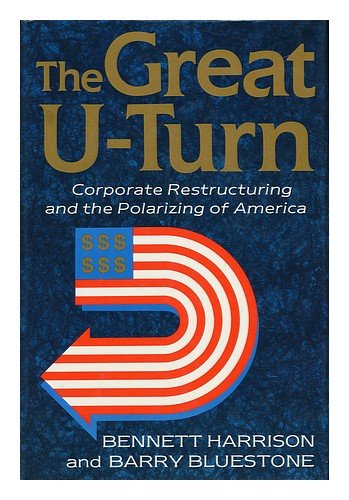
Author: (books) The Deindustrialization of America, 1982, The Great U-Turn, 1988, Negotiating the Future, 1992, Growing Prosperity, 2000, The Boston Renaissance: Race, Space, and Economic Change in an American Metropolis, 2000.
My early work focussed on low wage employment and dual labour market theory. Research on wage determination led me to conclude that, for the majority of the United States labour force, factors other than human capital dominated the wage determination process. In particular, unionisation and racial and gender discrimination were key factors for all groups of workers except highly skilled professionals.
Following up on a number of hypotheses raised by this early work, I turned my attention to pursuing a number of industry studies, in particular aircraft and retail trade. Research into these industries suggested the links between capital investment, capital mobility, labour market strategies and regional development. Along with research carried out by my colleague B. Harrison, these industry studies led me to investigate the problem of plant closings and worker dislocation in the United States.
This, in turn, generated the basis for our joint work on deindustrialisation. Changes in corporate behaviour in the postwar period toward enterprise location and labourmanagement relations is the central theme of this work. Most recently, Harrison and I have been investigating changes in the structure of the United States labour market and how these changes may affect the distribution of income and family living standards.
Senior advisor House Democratic leader Washington, 1995. Founding director Economic Policy Institute, Washington, since 1985. Member Gorbachev Foundation (senior fellow), International Center for Social Studies (scientific committee since 1997), Urban Outreach Council/Northeastern University (committee chair since 1999).
Bicycle riding, tennis.
Married Mary Ellen Colten, Jun 14, 1987. 1 child, Joshua.
